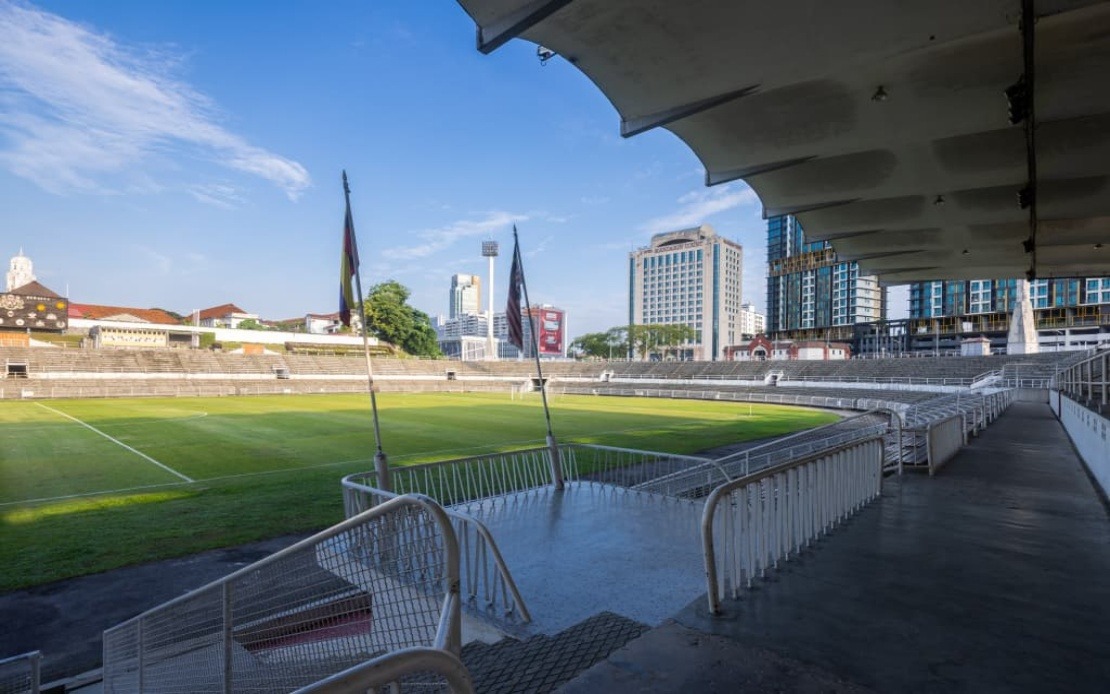
Nearly seven decades have elapsed since Stadium Merdeka witnessed one of Southeast Asia's defining political moments, yet the venue continues to function as a custodian of Malaysia's collective memory and national consciousness. Positioned against Kuala Lumpur's contemporary urban landscape, particularly alongside the towering Merdeka 118, the stadium stands as both a historical anchor and a living institution that refuses to be overshadowed by modernity or forgotten by succeeding generations of Malaysians.
The stadium's origins trace back to the mid-1950s, when it was constructed in a remarkably swift timeframe spanning less than twelve months at an estimated cost of RM2.3 million. This venue was purpose-built to serve as the setting for the proclamation of Malaya's independence by the nation's first Prime Minister, Tunku Abdul Rahman Putra Al-Haj, on August 31, 1957. The moment itself became immortalised through Tunku Abdul Rahman's seven resounding proclamations of "Merdeka!" and the subsequent playing of the national anthem, events that marked the definitive end of British colonial administration in Malaya and signalled the emergence of a sovereign nation on the world stage.
According to Prof Dr Sarjit Singh Gill, a social anthropology expert from Universiti Putra Malaysia and Chairman of the National Council of Professors' National Unity Cluster, Stadium Merdeka transcends its function as merely a sports facility. He characterises the venue as a historical monument that crystallises the nation's identity, upholds its dignity, and serves as a tangible expression of Malaysia's rich and complex heritage. This perspective underscores how architectural and geographical spaces become embedded with political and cultural significance, functioning as repositories of collective national experience that extend far beyond their original utilitarian purposes.
The stadium's historical importance deepened further in 1963, when it hosted another pivotal moment in Malaysia's constitutional development—the proclamation establishing the Malaysian Federation. This event formalised the political incorporation of Sabah and Sarawak into the federation and represented the final dismantling of British colonial structures in these territories, though Singapore's subsequent separation would reshape the federation's composition. The venue thus represents not a single historical instant but rather a series of transformative political moments that collectively defined the nation's trajectory.
The stadium's survival itself constitutes a significant narrative within Malaysian heritage conservation. During the late 1990s, the site faced existential threats from proposed redevelopment schemes that would have erased its historical footprint entirely. However, substantial public opposition mobilised by heritage advocates, coupled with decisive government intervention, ensured the stadium's preservation. In 2000, Permodalan Nasional Berhad (PNB) assumed custodianship of the site with an explicit mandate to safeguard its historical authenticity and significance for future generations of Malaysians.
Under PNB's stewardship, comprehensive restoration efforts have been guided by meticulous reference to original Public Works Department construction drawings, ensuring that conservation work remains historically grounded rather than speculative. Notably, later structural additions—including upper seating tiers that had been installed subsequent to the stadium's original construction—were deliberately removed to restore the venue to its authentic 20,000-seat capacity. Simultaneously, characteristic architectural features including the distinctive scoreboard, sanitary facilities, decorative mosaic tilework, and the iconic cantilevered roof structure underwent painstaking restoration to their original specifications. These conservation decisions reflect a philosophy that prioritises authenticity and historical integrity over contemporary convenience.
PNB Merdeka Ventures Sdn Bhd Chief Executive Officer Datuk Dr Izwan Ibrahim has articulated the organisation's underlying philosophy: preservation of the stadium's authenticity remains paramount, coupled with ensuring that the venue's historical narratives remain genuinely accessible to Malaysian citizens. He characterises Stadium Merdeka not merely as a repository of historical memory but as an embodiment of the aspirations and determination that fundamentally shaped contemporary Malaysia. This framing positions the venue as a dynamic site of meaning-making rather than a static museum piece, capable of generating ongoing relevance for audiences separated by generations from the actual independence proclamation.
The stadium's evolution has extended beyond ceremonial functions. Once exclusively reserved for National Day celebrations, it has transformed into a genuinely public national landmark, now accessible to citizens and featuring amenities including a refurbished running track available for community sporting use. The venue regularly hosts cultural and commercial events, most notably the Bazram Merdeka bazaar—a Ramadan marketplace that attracted more than 250,000 visitors during its most recent iteration, demonstrating the stadium's capacity to serve contemporary community needs whilst maintaining historical significance.
A particular emphasis of PNB's stewardship involves deliberate engagement with younger Malaysians who have no direct experiential connection to 1957 or the independence era. Datuk Dr Izwan Ibrahim articulated a clear strategy: rather than confining the stadium to pedagogical contexts where students encounter the independence narrative through textbooks or parental recollection, PNB actively encourages young people to experience the physical space firsthand. This educational philosophy recognises that embodied experience of a historical site—walking its grounds, inhabiting its spaces, and participating in activities conducted within its precincts—generates a qualitatively different form of historical consciousness than abstract classroom learning. Evidence already demonstrates this approach's effectiveness, with neighbouring schools increasingly incorporating Stadium Merdeka into their educational itineraries.
The stadium's international recognition has further reinforced its status within Malaysia's heritage landscape. In 2008, it received recognition through a UNESCO Asia-Pacific Heritage Award, and in 2009 it achieved formal gazetting as a National Heritage site. These designations provide institutional validation of the stadium's historical and cultural value, whilst also establishing legal frameworks intended to ensure its long-term protection against future redevelopment pressures or degradation.
Personal testimonies from those stewarding the venue contribute an emotional dimension to its historical significance. Alias Daud, a long-serving PNB staff member who devoted the final ten years of his 35-year career to maintaining the stadium, articulates how the venue transcends its function as a workplace. For him, Stadium Merdeka represents a space saturated with personal meaning, one that inspires simultaneously feelings of national pride, historical gratitude, and nostalgic reflection. His observation that visitors—encompassing individuals from remarkably diverse social and professional backgrounds—arrive at the stadium bearing their own distinctive stories and memories underscores how the venue functions as a nexus where individual and collective historical consciousness intersect.
During Malaysia's annual national observance period, the stadium's significance becomes particularly pronounced. Government agencies, educational institutions at all levels, and universities organise visits specifically to acquaint participants with the stadium's historical provenance and to facilitate the creation of independence-related commemorative content. Alias noted that visitors consistently express surprise and genuine appreciation upon learning that Stadium Merdeka constitutes the precise geographical location where independence was declared, with many engaging in photographic documentation and articulate expressions of recognition regarding the venue's national importance. This pattern proves especially pronounced among younger visitors whose prior historical knowledge may have been abstract or indirect.
As Kuala Lumpur's contemporary skyline continues expanding skyward with increasingly ambitious architectural projects, Stadium Merdeka endures as a symbolic counterpoint—a structure that remains deliberately modest in scale, accessible in its physical configuration, and grounded in a specific historical moment that continues resonating through Malaysian national consciousness. Its persistence represents far more than the mere preservation of a building; rather, it embodies a commitment to maintaining tangible connection with the foundational political and emotional experiences that established Malaysia as an independent nation. For contemporary and future generations, Stadium Merdeka functions as a permanent invitation to engage directly with the material circumstances and geographical specificity of the moment when Malaysia's journey toward national sovereignty definitively commenced.

