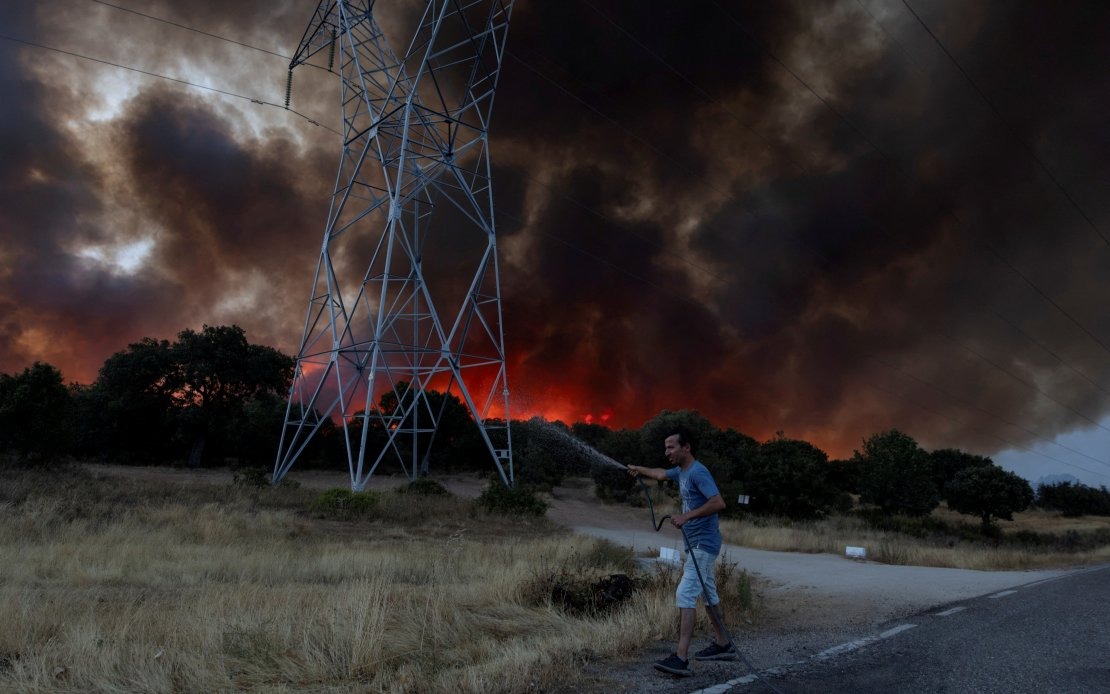
Spanish authorities have undertaken a large-scale evacuation operation in the north-western region of Castile and León after a significant wildfire ignited in the Arribes del Duero National Park, situated near the border with Portugal. The emergency response on Wednesday evening involved the removal of roughly 950 people from surrounding communities, marking one of the country's more dramatic displacement efforts in recent weeks. The incident underscores the mounting pressure on Spanish emergency services as the nation faces an intensifying natural disaster cycle driven by extreme weather patterns.
The fire originated near Fermoselle municipality within the protected national park area, prompting rapid intervention from regional authorities who ordered residents to leave their homes immediately. Officials also implemented stay-at-home directives for two adjacent villages as a precautionary measure, acknowledging the unpredictable nature of wildfire behaviour in the region. The Guardia Civil police force highlighted the particularly vulnerable status of occupants in a nursing home located in Muga de Sayago, where staff coordinated the organised departure of elderly residents during the evacuation process.
Prime Minister Pedro Sánchez characterised the current wildfire situation as "extremely tense," signalling government concern about the trajectory of multiple fires burning simultaneously across Spanish territory. During discussions with King Felipe VI in Palma de Mallorca, Sánchez emphasised the direct connection between soaring temperatures and the heightened combustibility conditions affecting much of the nation. These conversations reflect the political and institutional recognition that Spain faces a cascading environmental emergency requiring coordinated responses at the highest levels of government.
The scale of the crisis becomes apparent when considering that Spain is currently managing approximately ten wildfires of differing severity simultaneously. This concentration of simultaneous fire incidents stretches emergency response resources thin and prevents authorities from deploying personnel and equipment to any single location with maximum force. The prime minister cautioned citizens to observe strict safety protocols as meteorological forecasts predict a fresh heatwave will persist until the end of the following week, prolonging conditions that facilitate rapid fire spread.
Elsewhere on the peninsula, conditions demonstrated variability typical of large-scale wildfire situations. The Madrid region continues to experience significant displacement, with around 9,500 residents unable to return to their residences as authorities maintain evacuation protocols in areas still deemed unsafe. The Sierra Norte area west of Madrid and a separate fire in neighbouring Toledo province have been brought under increasing control, allowing officials to gradually reduce emergency measures in some locations. In Ávila province, the situation has sufficiently improved to permit the lifting of all evacuation orders and movement restrictions, enabling those communities to begin the long recovery process.
Spain's approach to this crisis extends beyond immediate emergency response to consideration of long-term institutional capacity. Sánchez announced that Spain has formally requested that the European Commission establish a centralised European wildfire-fighting centre on the island of Mallorca. This proposal reflects recognition that Mediterranean basin nations increasingly require transnational coordination and shared resources to combat wildfires that transcend national borders. The initiative, if implemented, could create a permanent infrastructure for rapid response coordination across southern Europe.
For Malaysian and Southeast Asian observers, Spain's predicament offers cautionary insight into the consequences of climate change on fire risk. While Malaysia faces distinct tropical forestry challenges, the underlying dynamics—rising temperatures increasing fuel moisture content reduction and fire propagation speed—represent a universal pattern. Spain's experience demonstrates how even developed nations with substantial emergency management capacity can be overwhelmed when fire incidents proliferate across vast geographical areas simultaneously.
The heatwave phenomenon driving Spain's current crisis reflects broader atmospheric patterns affecting the Mediterranean region. These extended periods of elevated temperatures reduce vegetation moisture to dangerous levels, transforming landscapes into tinderboxes where ignition sources—whether natural or anthropogenic—trigger rapidly spreading conflagrations. The intersection of heat, drought, and wind conditions creates perfect combustion scenarios that challenge containment efforts regardless of resource availability.
Spain's request for a European wildfire centre suggests that policymakers increasingly recognise fire management as requiring transnational coordination. The Mediterranean region, encompassing countries across southern Europe, northern Africa, and the Middle East, faces mounting wildfire pressure from climate dynamics. A centralised response mechanism could improve intelligence sharing, resource allocation, and operational coordination—lessons potentially applicable to Southeast Asian nations experiencing transboundary haze and fire challenges.
The recovery phase for affected Spanish communities will extend far beyond the immediate evacuation period. Residents unable to return home face economic disruption, psychological stress, and uncertainty about property conditions. Insurance claims will mount, and reconstruction timelines remain uncertain. For the nursing home residents and other vulnerable populations, displacement generates particularly acute hardship requiring sustained government support mechanisms.
Spain's current wildfire crisis illuminates the vulnerability of modern societies to natural disasters amplified by climatic change. Despite advanced technology, professional firefighting forces, and substantial economic resources, the nation struggles to contain multiple simultaneous incidents. This reality has profound implications for regional planning, insurance arrangements, and disaster preparedness across Europe and globally. The Spanish experience demonstrates that even prosperous nations require international cooperation and enhanced institutional capacity to address emerging fire risks.

