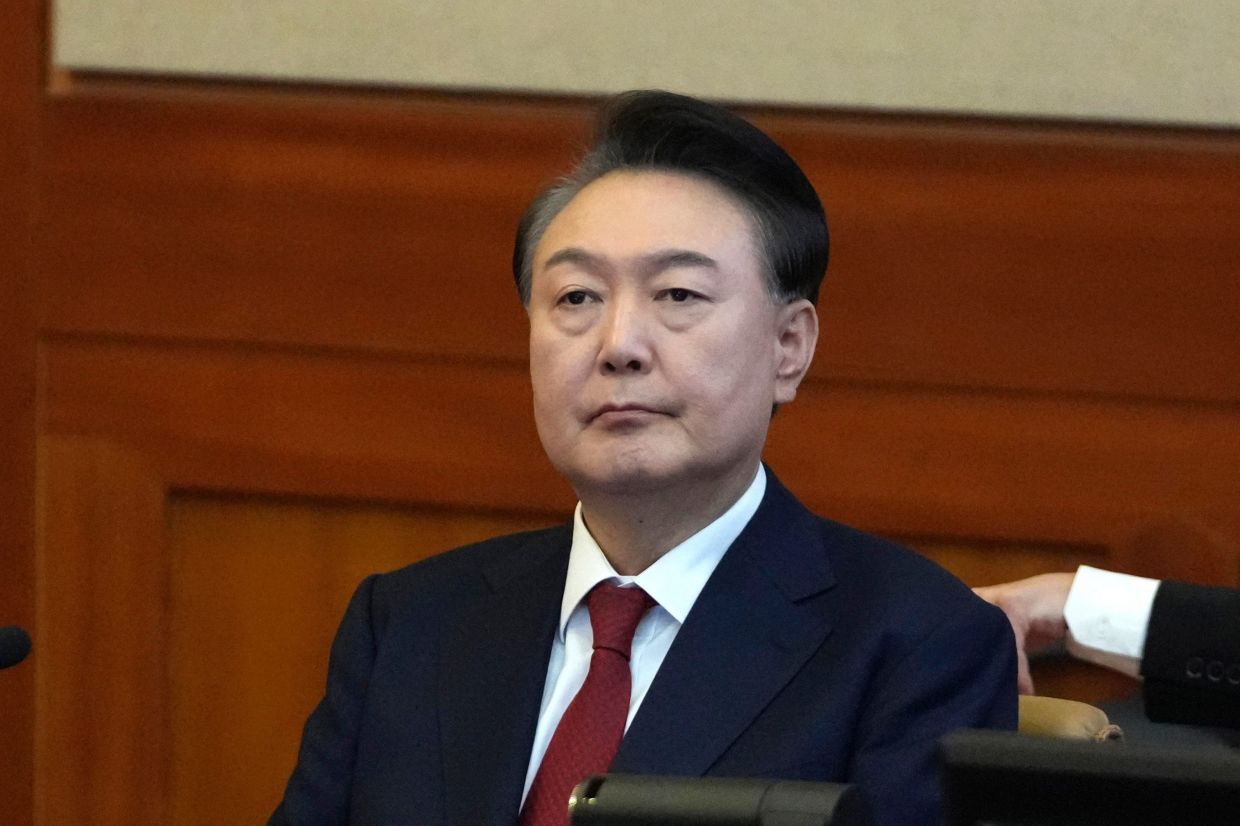
South Korea's highest court has delivered a final blow to former president Yoon Suk Yeol, confirming a seven-year prison sentence imposed for his role in orchestrating the nation's most destabilising political crisis in recent memory. The Supreme Court's ruling on Thursday marks the end of legal appeals in the case centred on the chaotic martial law declaration of December 2024, effectively sealing Yoon's fate for at least one of the multiple criminal convictions he faces. The judicial decision underscores how decisively South Korea's institutions have rejected Yoon's defence that his extraordinary actions were justified by national security concerns.
The charges against Yoon encompassed a web of alleged misconduct surrounding the lead-up to and aftermath of his dramatic martial law announcement. He was accused of circumventing proper cabinet procedures by convening only a handpicked group of ministers before making the declaration, fundamentally undermining the deliberative process required under South Korean law. Prosecutors alleged that Yoon orchestrated the creation and subsequent destruction of a false martial law decree bearing forged signatures purportedly from Prime Minister Han Duck Soo, a deception designed to lend apparent legitimacy to his extraordinary executive action. Additionally, the court found Yoon directed officials to issue misleading statements to international media, deliberately obscuring the true nature of events unfolding in Seoul to foreign governments and press outlets.
Yoon's alleged abuses of power extended beyond the declaration itself into the desperate aftermath when lawmakers moved rapidly to nullify his martial law order. Evidence presented during the trial demonstrated that Yoon had ordered his presidential security personnel to physically obstruct his own arrest, deploying security agents to prevent his detention as the National Assembly voted to revoke the declaration within hours. The court also found Yoon had directed an army commander to delete records stored on secure military communications systems, conduct consistent with an attempt to conceal evidence of the orchestration behind the martial law episode. These allegations collectively painted a picture of an executive willing to manipulate institutions, forge documents, and obstruct democratic processes to advance his political agenda.
The lower court in January had initially sentenced Yoon to five years imprisonment after convicting him on most charges brought by prosecutors. In April, an appellate panel reviewed the conviction and determined that additional evidence warranted an additional guilty verdict specifically for the misleading press release directed at international media. This intermediate ruling raised the sentence to seven years, the level now confirmed by the Supreme Court. Notably, prosecutors had sought an even harsher punishment, requesting a decade-long sentence, but the highest court declined to increase the penalty despite the gravity of the conduct involved. The Supreme Court's decision to affirm the seven-year term rather than escalate the sentence represents a subtle restraint despite the court's clear rejection of Yoon's arguments on the merits.
Yoon's legal team responded to the final judgment with defiance rather than resignation, announcing that they would challenge the ruling on constitutional grounds and lodge formal complaints against the Supreme Court's decision. The defence expressed what they termed "deep regret" at what they characterised as the court's failure to conduct "sufficient deliberation" of their arguments, effectively accusing the judiciary of rushing to judgment without properly weighing Yoon's justifications for his actions. This approach suggests that despite exhausting conventional appellate channels, Yoon's lawyers intend to pursue alternative legal avenues to overturn or minimise the conviction, though such prospects appear severely limited under South Korean law. The ex-president himself has repeatedly maintained that his martial law declaration stemmed from genuine concern for national security and claims of the necessity to counter alleged "anti-state forces" opposing his government.
The Supreme Court's televised ruling, in which a judge declared "all appeals are dismissed" and stated that the lower court's judgment "contained no errors," delivered a comprehensive rejection of Yoon's defence across all contested issues. This language minimises any ambiguity about the court's assessment of the case, effectively telling South Korean society and the international community that the lower courts had properly applied the law to the undisputed facts. The finality of the Supreme Court decision removes Yoon's ability to seek further review in the judicial system, though it leaves open the possibility of executive clemency or a potential presidential pardon should political circumstances change dramatically in future years. For now, however, this conviction stands as conclusive under Korean law.
Yoon's troubles extend well beyond this seven-year sentence, as he simultaneously faces a separate case arising from the same martial law episode. A different court handed down a thirty-year prison term against Yoon for the unauthorised deployment of drones into North Korean territory, which prosecutors argued was designed to manufacture an international crisis that would justify his subsequent martial law declaration. This additional conviction, involving more extreme charges related to national security and foreign policy, suggests that Korean courts have concluded Yoon's actions represented not merely abuse of executive power but potentially criminal conspiracy to create false pretexts for extraordinary governmental measures. The cumulative weight of these convictions paints Yoon as having engaged in a calculated scheme to circumvent constitutional limits on his authority.
The sequence of events that precipitated Yoon's downfall began in December 2024 when he delivered a shock late-night televised address announcing martial law, a suspension of civilian rule that sent shockwaves through South Korean society and beyond. The martial law order proved remarkably short-lived, lasting only approximately six hours before lawmakers convened in emergency session and voted decisively to nullify the declaration, demonstrating the resilience of South Korea's democratic institutions in resisting what many characterised as a coup attempt. However, the brief duration of the martial law episode belied its enormous consequences: the episode triggered mass protests throughout South Korea, sent stock market indices plunging, and caught important security allies including the United States entirely off-guard, embarrassing South Korea's diplomatic standing internationally.
Yoon was subsequently impeached and removed from office in April 2025, when South Korean voters responded by electing Lee Jae Myung of the centre-left Democratic Party to the presidency in special elections. This electoral outcome demonstrated that the Korean electorate firmly repudiated Yoon's approach to governance and his justifications for extraordinary executive action, opting instead for a political alternative that promised a return to conventional democratic procedures and respect for constitutional constraints on presidential power. The transition from Yoon's administration to Lee's represents a decisive institutional reset following one of South Korea's most severe political tremors in decades. For Malaysia and other Southeast Asian democracies, the Yoon case serves as a cautionary tale about how even established institutional democracies remain vulnerable to executive overreach and how judicial independence becomes crucial to protecting constitutional order when democratic norms face challenge.
Yoon has consistently maintained that his martial law declaration was "solely for the sake of the nation" and necessary to combat what he characterised as serious threats from North Korea and subversive internal elements. However, South Korea's courts have fundamentally rejected this framing, treating Yoon's security arguments as pretexts for an unconstitutional power grab that violated the rights of lawmakers, circumvented cabinet processes, and manipulated the public through forged documents and misleading information campaigns. The Supreme Court's affirmation of the conviction signals that Korean society, through its judicial institutions, has drawn a firm line against permitting security threats—whether real or exaggerated—to justify suspension of democratic procedures. This principled stance carries significance for regional democracies concerned about the erosion of constitutional constraints under the banner of national emergency.

