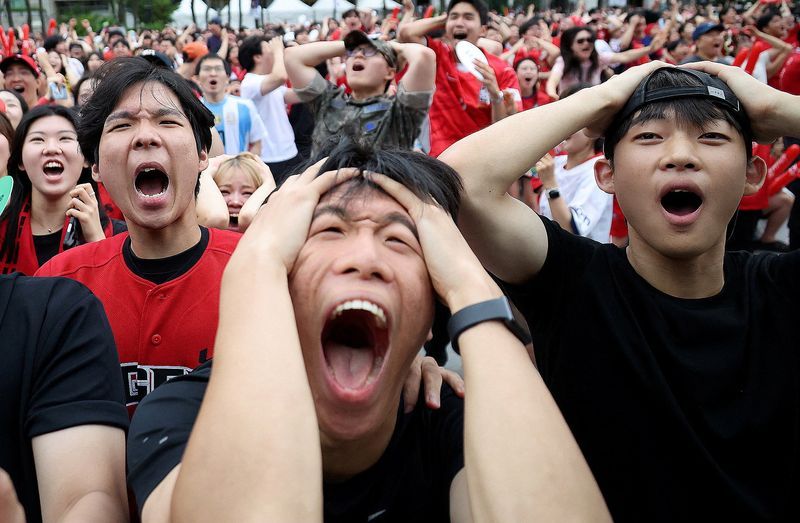
South Korean President Lee Jae Myung has struck a deeply frustrated tone following his nation's shock early exit from the World Cup, publicly assailing both the appointment process that elevated coach Hong Myung-bo and the broader culture of cronyism he says plagued the selection. The president's unfiltered response, shared across social media on Sunday, represents a rare instance of top-level political intervention in sporting affairs, signalling just how significant the team's underperformance has become within domestic discourse. His comments suggest that what might ordinarily be dismissed as athletic disappointment has instead crystallized into a larger conversation about systemic governance failures within South Korea's sports administration.
South Korea's exit came after consecutive defeats to Mexico and South Africa in the group phase, a result that left the team occupying third place in Group A—fatally outside the threshold of eight best third-placed finishers who would have advanced to the knockout rounds. The elimination proved particularly jarring given that the squad had entered the tournament as one of the more competitive teams in their group, with many analysts predicting qualification as a near-certainty. The magnitude of this failure—to stumble even from what was widely regarded as a manageable pool of opponents—appears to have transformed the sporting outcome into a political flashpoint.
At the heart of Lee's complaint sits Hong Myung-bo's reappointment as national team manager in 2024, a hiring decision that had already drawn persistent scrutiny from South Korean media outlets before the World Cup even commenced. These reports alleged that the selection process lacked transparency and reflected patterns of favouritism rather than genuine competitive evaluation of available candidates. Hong has categorically rejected such accusations, maintaining that his selection reflected legitimate sporting merit. Nevertheless, the allegations have persisted in public discourse, and the team's subsequent collapse has substantially amplified these earlier concerns, creating a narrative in which poor governance appears to have directly produced sporting failure.
The president's analysis extends beyond simply criticizing individual personnel choices to indict what he characterizes as a systemic disease within institutional decision-making. Lee argues that when personal allegiances and factional loyalty supersede genuine assessment of capability, the inevitable result becomes organisational dysfunction. He contended that nepotism and in-group preference have become so deeply embedded within South Korea's administrative culture that meaningful oversight and accountability mechanisms have deteriorated or become ineffectual. This diagnosis, while ostensibly focused on sports administration, carries broader implications about governance standards across various sectors of South Korean public institutions.
The political temperature surrounding Hong's position has continued to rise even as the coach remains in post. A petition demanding his removal, lodged through South Korea's national assembly website on Thursday, accumulated the threshold of signatures necessary to trigger an initial formal review of the dismissal request. This administrative process, while preliminary, reflects the substantial depth of public dissatisfaction extending beyond passionate sports fans to encompass broader sections of the population. The scale of the petition response demonstrates that public opinion has decisively turned against the coach, creating considerable political pressure on officials responsible for sports governance decisions.
The social dimension of this backlash has proven equally striking. Reports from inside South Korea indicate that some retail establishments have begun displaying notices prohibiting Hong from entering their premises, a form of unofficial sanction that has circulated widely across social media platforms. Such actions, while technically the prerogative of individual business owners, nonetheless signal the depth of public frustration and the social ostracism now directed at the coach. These grassroots expressions of disapproval, transmitted and amplified through digital networks, create an environment of intense reputational pressure that extends far beyond the sporting realm into everyday social interactions.
President Lee's call for a formal investigation through the Ministry of Culture, Sports and Tourism represents an escalation from mere criticism to institutional action. The investigation mandate encompasses not only establishing what precisely transpired regarding the team's performance, but also conducting a root-cause analysis intended to identify systemic vulnerabilities within sports administration that facilitated the poor hiring decision and subsequent competitive failure. The investigation is explicitly framed as prospective as well as retrospective—aimed not simply at understanding what went wrong, but at engineering preventive measures and establishing safeguards to prevent similar failures in future sporting undertakings.
The international dimension of South Korea's elimination deserves consideration within Southeast Asian and broader Asian football contexts. The region has demonstrated increasing competitive depth in football, with teams from across Asia now routinely challenging traditional powerhouses. South Korea's shock exit, despite theoretical advantages in group composition and player resources compared to many regional competitors, underscores how vulnerable even conventionally strong footballing nations have become to unexpected results. For other Asian federations and national programs, the South Korean case study offers sobering lessons about the potential consequences of compromised administrative decision-making during high-stakes international competition.
The controversy also illuminates broader questions about the relationship between political leaders and sporting institutions within East Asian democracies. Lee's intervention demonstrates how thoroughly sports have become intertwined with national pride and political legitimacy in contemporary South Korea, where World Cup performance carries significance extending well beyond the football pitch. Presidential engagement with sporting affairs, whether constructive or critical, signals the weightiness with which political leadership regards athletic outcomes and the degree to which sporting success has become enfolded into narratives about national competence and governmental effectiveness.
Looking forward, the investigation's findings will likely carry consequences extending substantially beyond football administration. If the probe substantiates claims of systemic cronyism and inadequate accountability within South Korea's sports governance structures, it could trigger broader institutional reforms with implications for how personnel decisions are made across multiple government sectors. The spotlight trained upon Hong Myung-bo and the hiring process that elevated him therefore represents potentially a beginning point for larger conversations about administrative integrity and meritocratic principle within South Korean public institutions more broadly.
The timing of Lee's intervention, coming relatively swiftly after the team's elimination, suggests that he views the World Cup exit not as an isolated sporting disappointment to be absorbed and forgotten, but as symptomatic of deeper governance failures requiring urgent institutional remediation. Whether the investigation ultimately delivers substantive reforms or becomes absorbed into the familiar pattern of political attention cycles remains to be seen, but the presidential pressure already applied indicates that sporting failure has acquired genuine political consequences within South Korea's contemporary landscape.

