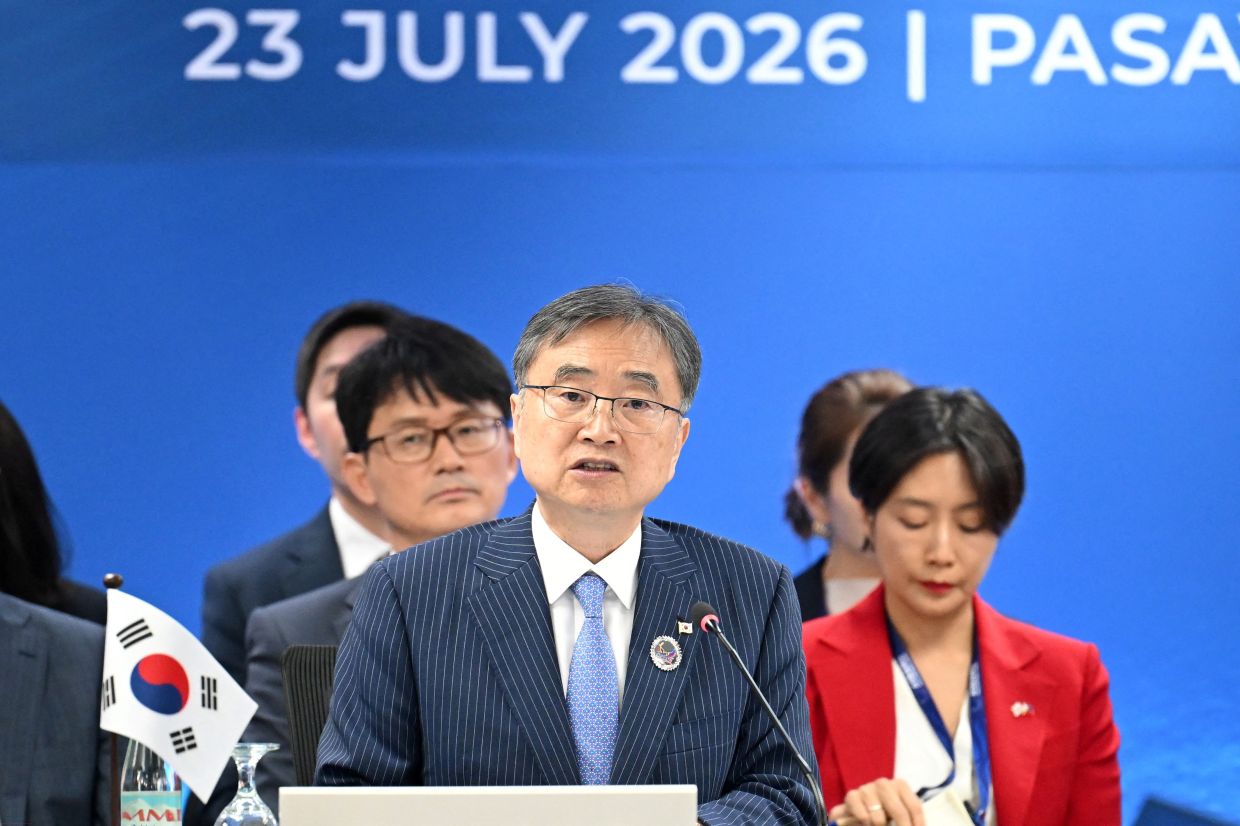
Tensions within President Lee Jae Myung's government over how to approach North Korea have spilled into public view, with Seoul's Foreign Minister Cho Hyun directly challenging proposals put forward by Unification Minister Chung Dong-young this week. The ministerial disagreement exposes deeper complications in the administration's attempt to restore meaningful dialogue with a regime that has grown increasingly isolated and hostile towards inter-Korean engagement over recent years.
At a Wednesday policy meeting with President Lee, Minister Chung unveiled an ambitious proposal centring on four-party negotiations involving both Korean states alongside the United States and China. When briefing reporters on the discussions, Foreign Minister Cho characterised these suggestions as excessively optimistic, noting that no consensus had emerged across the broader government apparatus. "Since Minister Chung was speaking in idealistic terms, I would ask you to discount those remarks somewhat," Cho stated publicly. The Unification Minister responded the following day by defending the need for aspirational thinking, countering that ideals were essential "to change reality." This tit-for-tat exchange between two senior cabinet officials underscores the lack of unified strategy within Seoul's decision-making circles.
The policy discord reflects a fundamental disagreement about methodology. Cho's position suggests caution about premature diplomatic gestures without sufficient internal coordination, while Chung advocates for bold initiatives that might capture Pyongyang's attention and signal a genuine shift in Seoul's approach. What complicates this internal debate is the broader geopolitical context: the Lee administration has deliberately repositioned its stance away from insisting on denuclearisation as a precondition for engagement, instead embracing what officials describe as a "peace-first" framework. This conceptual reorientation represents a significant departure from previous conservative administrations and signals Seoul's willingness to prioritise dialogue over confrontation, at least rhetorically.
Among the components of this recalibrated approach, the government has encouraged US President Donald Trump to pursue direct talks with North Korean leader Kim Jong Un as a mechanism for reopening communication channels. Simultaneously, Seoul has undertaken various confidence-building measures designed to demonstrate benign intent to Pyongyang, including the cessation of anti-North Korean loudspeaker broadcasts that have periodically animated the demilitarised zone. Yet despite these overtures, North Korea has largely responded with indifference or rejection, signalling that Pyongyang remains unconvinced by Seoul's diplomatic initiatives.
Analysts warn that the visible disagreement between Cho and Chung carries significant risks for Seoul's diplomatic objectives. Lim Eul-chul, a Korea specialist at Kyungnam University, observed that the public clash "exposed internal differences and weakening policy momentum surrounding North Korea policy." More troublingly, he suggests that such divisions reinforce Pyongyang's historical concern that any agreements reached with Seoul could be readily reversed by subsequent administrations or through domestic political shifts. This perception of instability has long plagued inter-Korean relations and continues to undermine confidence-building efforts even when both sides express interest in dialogue.
The deterioration of relations between North and South Korea over the past several years provides essential context for understanding the stakes involved in these policy disputes. Since the end of the Covid-19 pandemic disrupted already fragile cross-border contact, Kim Jong Un's regime has escalated its rejection of reunification as an objective, with officials explicitly abandoning language about eventual national integration. Pyongyang has additionally demolished or dismantled joint economic projects on its territory, signalling a hardening posture towards cooperative ventures with the South. The human consequences are measurable: in the first half of 2026, merely 63 North Koreans successfully defected to the South, a decline so severe that it underscores how dramatically conditions have shifted from 2019, when 1,047 individuals made the crossing.
The Lee administration's recalibrated strategy has generated concerns among international human rights advocates and civil society organisations. While Seoul co-sponsored a United Nations resolution addressing North Korean human rights practices during the previous year, several monitoring groups report that the government has subsequently downgraded emphasis on these issues to avoid antagonising Pyongyang. This includes suspending certain rights documentation efforts and reducing critical broadcasts. Kim Tae-Hoon, former president of the rights advocacy organisation PSCORE, indicated in recent interviews that this diplomatic reorientation has created financial headwinds for groups working on North Korean human rights, as potential donors interpret the government's shifting priorities as a diminishment of these concerns. The tension between engagement objectives and human rights advocacy represents an ongoing dilemma for Seoul's policymakers.
When questioned about their divergent public statements, both the Foreign and Unification ministries asserted commitments to ongoing policy coordination while declining to elaborate further on the specific disagreements. The presidential Blue House similarly refrained from immediate commentary, suggesting that officials hoped to contain and resolve the dispute through less public channels. This reticence itself communicates something to Pyongyang, however: it suggests an administration uncertain about its own internal consensus and potentially vulnerable to accusations of inconsistency.
The broader challenge facing Lee's government involves reconciling competing imperatives in an environment of profound mistrust. Pyongyang has demonstrated little inclination to engage meaningfully with Seoul's outreach efforts, and internal divisions within the South Korean government only reinforce North Korean scepticism about the durability and sincerity of any diplomatic engagement. As regional powers including China and Japan monitor developments closely, Seoul's ability to project coherent and resolute policy direction remains crucial to any prospects for eventual dialogue with the North.

