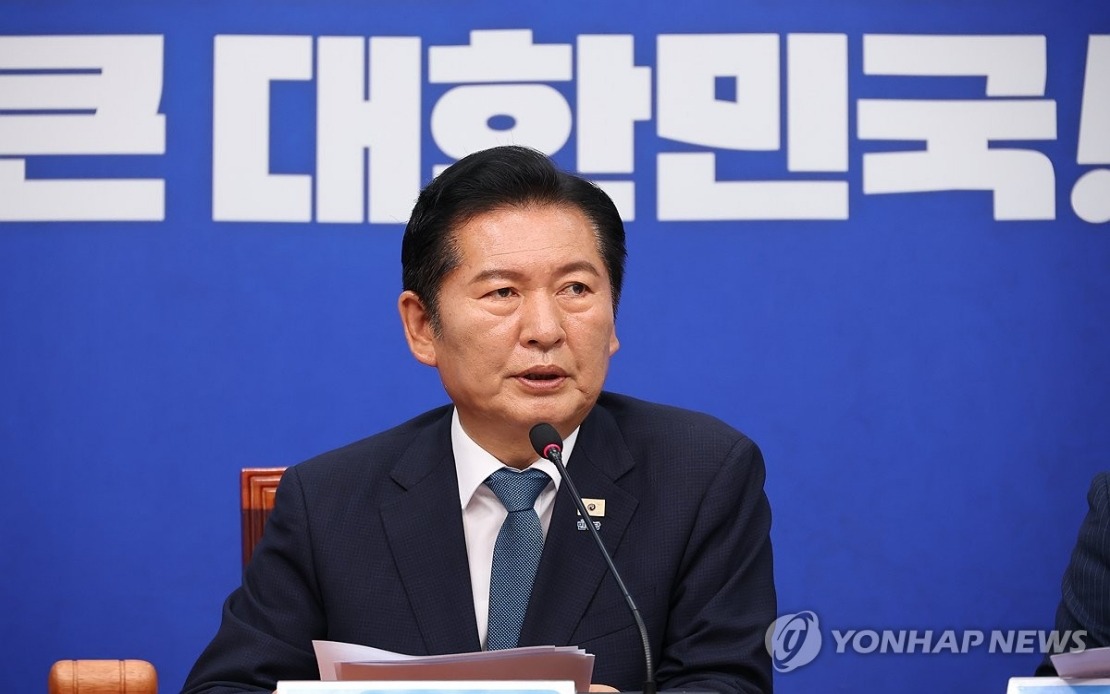
Jung Chung-rae, a prominent lawmaker from South Korea's ruling Democratic Party, relinquished his position as party chairman on Wednesday, a strategic move widely interpreted as clearing the way for his candidacy in the party's forthcoming national convention. The resignation marks a significant development in the country's political landscape as the DP navigates internal tensions and prepares for leadership renewal ahead of critical political moments. Jung's departure from the chairmanship sets the stage for what analysts expect will be a closely watched contest that could reshape the party's direction and its relationship with President Lee Jae Myung's administration.
During remarks delivered at a National Assembly meeting of the party's supreme council, Jung offered a reflective assessment of his tenure, describing a leadership journey marked by personal sacrifice and unwavering commitment to party unity. He characterised his period in office as demanding and exhausting, having spent considerable time engaged in introspection about both his personal conduct and his broader political trajectory. His comments suggested that the weight of managing internal party dynamics while maintaining external credibility had taken a substantial toll, though he presented his departure as a decision made with careful deliberation rather than under pressure.
Jung's statement emphasised his dedication to buttressing Lee Jae Myung's administration throughout his chairmanship, arguing that he consistently worked to synchronise efforts between the ruling party structure, the government apparatus, and the presidential office. He framed his leadership as predicated on maintaining cohesion across these institutions, presenting this alignment as essential to effective governance. However, Jung's comments also implicitly acknowledged the friction that had characterised his tenure, noting that he faced sustained resistance from multiple quarters despite his commitment to collective purpose.
The underlying tensions that prompted Jung's resignation reflect deeper ideological and strategic divisions within the DP. Critics, particularly those aligned with President Lee, have levelled accusations that Jung has permitted the party to drift toward positions favoured by his own hard-line faction rather than maintaining alignment with Lee's policy agenda and political vision. These internal disagreements have reportedly strained the relationship between the party leadership and the presidential office, creating a governance deficit that Jung's resignation is expected to address.
The upcoming convention, scheduled for August 17, will now function as an arena for determining which faction gains ascendancy within the party. Rather than being a straightforward succession, the contest appears poised to become a three-cornered battle involving substantial political figures, each commanding distinct support networks and representing different orientations within the DP. The shape this competition takes will likely influence not only party operations but also the trajectory of Lee's presidency and the government's legislative priorities.
Prime Minister Kim Min-seok stands as a major contender, positioned as the candidate most closely aligned with President Lee's preferences and political interests. As a key ally within the administration, Kim represents continuity and closer coordination between party and government structures. His candidacy appeals to party members who prioritise strengthening the DP's supporting role for Lee's presidency and who are concerned about the drift that has characterised recent party management. Kim's entry into the race underscores the extent to which this leadership selection process carries implications well beyond party management.
Former Democratic Party leader Song Young-gil has also signalled his intention to enter the race, adding a third major dimension to the competition. Song's re-emergence as a candidate reflects calculations that the convention represents an opportunity to redirect party leadership and possibly moderate some of the factional tensions that have characterised recent years. Notably, Song has reportedly explored the possibility of consolidating support with Kim's candidacy, suggesting that coalition-building and strategic alliances may prove decisive in determining the eventual outcome.
Pending the convention's conclusion, DP floor leader Han Byung-do will assume the responsibilities of acting party leader, ensuring institutional continuity during the interim period. Han's appointment as acting chairman provides stability during what could be a contentious leadership campaign while preventing any single faction from consolidating organisational advantage before the formal vote. His interim role will require careful navigation of party dynamics to preserve institutional legitimacy and prevent the leadership contest from destabilising parliamentary operations.
For Malaysian observers and Southeast Asian analysts tracking regional political developments, South Korea's internal party dynamics merit attention as an example of how governing coalitions navigate succession and factional competition within structured democratic institutions. The DP's situation illustrates tensions that emerge when executive leadership and party structures maintain distinct operational bases and constituencies, a phenomenon relevant to multiparty systems across the region. Furthermore, the August convention outcome will influence South Korea's political trajectory and potentially its regional engagement strategies during a period of significant geopolitical importance for Southeast Asian states.