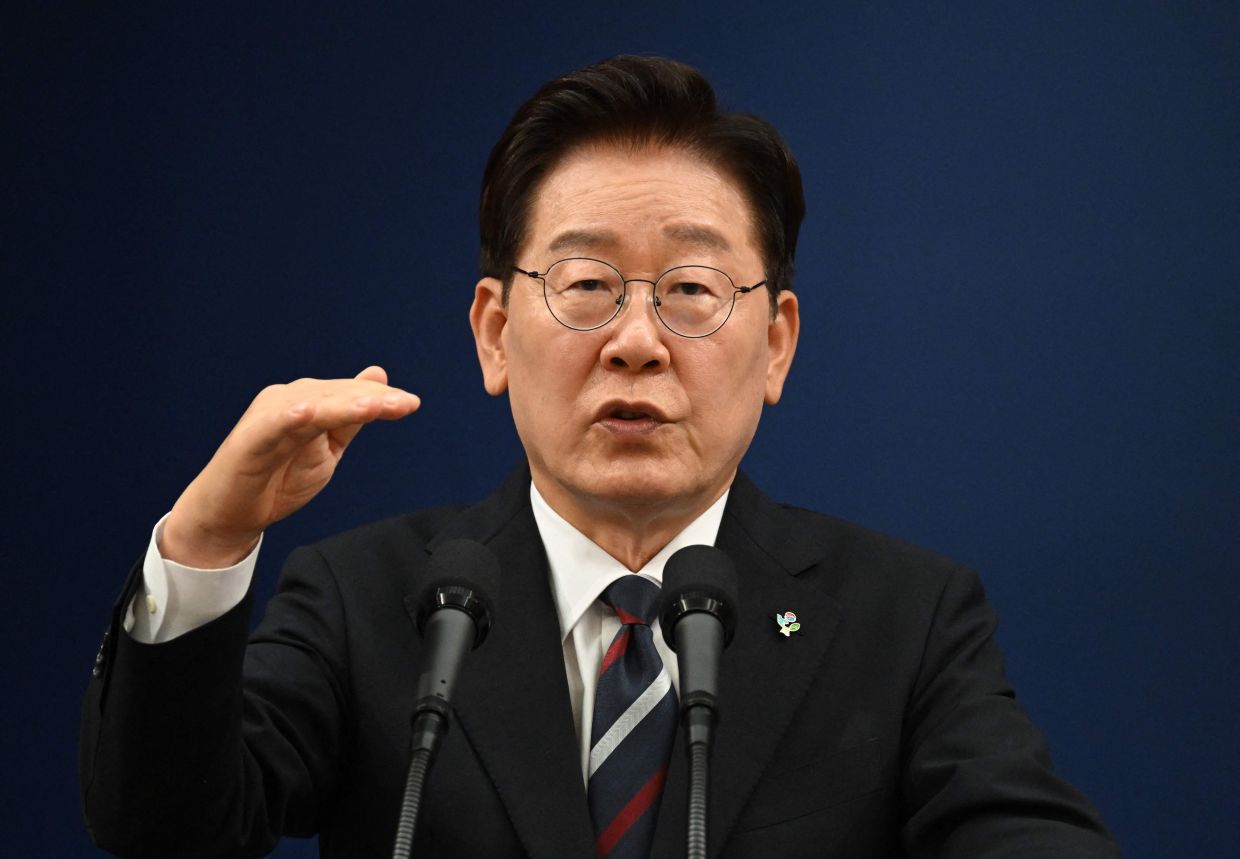
South Korean President Lee Jae Myung has seen his approval rating collapse into negative territory for the first time since taking office just over two months ago, marking a sharp reversal from the strong mandate he enjoyed at the outset of his presidency. According to polling data released on June 22 by Realmeter, a leading South Korean research firm, Lee's job approval rating now stands at 46.7 per cent, dropping nearly five percentage points in a single week and falling below the crucial 50 per cent threshold. This represents the fifth consecutive week of declining support, transforming what appeared to be a promising political honeymoon into an early crisis that has placed significant pressure on his administration and reshaped the domestic political landscape.
The decline has been dramatic and sustained. When Lee assumed office on June 4, 2025, his approval rating exceeded 60 per cent in early May, demonstrating substantial public backing for his policy agenda and vision for the country. However, that initial support has eroded steadily over the subsequent eight weeks, dropping from 60.5 per cent in mid-May to 59.3 per cent, 59.1 per cent, and 55.2 per cent in successive weeks before the more precipitous falls that culminated in this week's 46.7 per cent figure. The trajectory reveals not merely a minor fluctuation in public sentiment but a fundamental realignment of voter attitudes toward the new administration and its capacity to govern effectively.
Equally significant is the reversal in the approval-disapproval balance. Negative evaluations of Lee's performance have surged to 49.7 per cent, now exceeding his positive ratings for the first time since his inauguration. Although this lead falls within the survey's margin of error of plus or minus two percentage points, the symbolic importance cannot be understated, as it signals that a plurality of South Koreans now harbour reservations about his presidency rather than backing it. The remaining 3.6 per cent of respondents expressed uncertainty, highlighting the volatile nature of current political sentiment and the potential for further shifts as events unfold.
The primary culprits behind this precipitous decline, according to Realmeter's analysis, trace to two interconnected political crises. The first involves ballot shortages that marred the June 3 local elections, creating widespread public frustration over administrative incompetence during what should have been a routine electoral exercise. The second stems from escalating internal conflicts within Lee's own Democratic Party of Korea, which has become consumed by disputes over the party leadership race ahead of an August 17 convention to select a new party chair. These twin controversies have dominated Korean news coverage and captured public attention precisely when the new president might have hoped to establish his credentials and consolidate support. The pollster noted that both factors have created a broader political malaise that has overshadowed otherwise positive developments, including Lee's successful European diplomatic tour and the symbolic achievement of the Kospi stock index breaking above the 9,000-point mark.
Regional variations in the approval decline offer revealing insights into shifting voter coalitions and the distribution of political dissatisfaction across South Korea's geography. The most dramatic erosion occurred in traditionally conservative strongholds, particularly Daegu and North Gyeongsang Province, where Lee's approval rating plummeted 9.9 percentage points to just 34.6 per cent. This deterioration in his core support base suggests that even voters traditionally aligned with conservative politics have become disenchanted with his early performance. The Greater Seoul region, encompassing the capital and surrounding provinces of Incheon and Gyeonggi, has also turned sharply against Lee, with approval ratings falling to 44.8 per cent in Incheon and Gyeonggi and 39.8 per cent in Seoul itself. These metropolitan areas, home to nearly half of South Korea's population, represent crucial battlegrounds in any political contest, and their drift away from the president signals serious challenges ahead.
Demographic analysis by political ideology reveals further fracturing of Lee's political coalition. Support among moderates, the crucial swing voter segment, declined 4.9 percentage points to 47.5 per cent, suggesting that centrist voters are reconsidering their initial backing. Liberal voters, traditionally more distant from Lee, have nonetheless maintained substantial support at 80.4 per cent despite a 3.2 percentage point decline. Tellingly, conservative voters have consistently remained Lee's weakest demographic, with approval at only 19.8 per cent and showing minimal change from previous weeks. This pattern indicates that Lee faces a squeeze from multiple directions, with moderate voters drifting away while failing to consolidate his conservative base, a situation that fundamentally constrains his political room for manoeuvre.
The presidential office responded to the unfavourable polling with a statement emphasizing humility and renewed commitment to public concerns, acknowledging that both economic conditions and the broader conduct of governance have contributed to the public's reservations. This measured response reflects the administration's awareness that the current moment requires careful political management and a demonstrated willingness to address public grievances rather than dismissing the poll results. However, the question remains whether rhetorical acknowledgement of public concerns will suffice to reverse the downward trajectory, particularly given that the underlying causes—the electoral mismanagement and party infighting—remain unresolved.
Lee's trajectory contrasts meaningfully with his predecessors, though the timing of the approval collapse occurs somewhat earlier than historical precedent might suggest. Former President Yoon Suk Yeol's disapproval surpassed approval only six weeks into his term, positioning Lee as having retained positive ratings somewhat longer. By comparison, former President Park Geun-hye experienced a similar crossover roughly 16 months into her presidency in 2014, and Moon Jae-in faced comparable sentiment shifts approximately 19 months into his term in late 2018. This historical context suggests that early presidential crises are not unprecedented in South Korean politics, though their precise timing and nature vary considerably based on specific circumstances and political contexts.
Simultaneously, broader partisan dynamics reveal that Lee's personal struggles have not automatically translated into overwhelming advantage for the main opposition People Power Party. In a separate survey measuring party support, the Democratic Party of Korea narrowed the gap with its conservative rival, rising 2.1 percentage points to 40.1 per cent while the People Power Party slipped 2 points to 42.3 per cent. The People Power Party's own approval has deteriorated as it grapples with controversies surrounding the election administration failures and faces mounting internal pressure over questions of leadership accountability. Younger voters, particularly those in their twenties and thirties, have continued their exodus from conservative politics, with People Power Party approval falling 10.5 percentage points to 48.6 per cent among voters aged twenty to twenty-nine and 5.1 percentage points to 47.4 per cent among those aged thirty to thirty-nine.
The Democratic Party's marginal recovery has been attributed by analysts to a perceived successful crisis-management phase, including a bipartisan agreement to launch a National Assembly investigation into the election administration debacle. This development demonstrates that despite internal factional tensions, the opposition party has benefited from presenting a unified front around accountability and good governance. Whether this reprieve proves durable remains uncertain, as the party continues to wrestle with internal divisions and competing factions eye the August convention for party chair as an opportunity to consolidate power and reshape the party's direction.
For Malaysia and Southeast Asian observers, Lee's political difficulties offer instructive lessons about the volatility of early presidencies, the capacity of administrative mishaps to rapidly erode public confidence, and the persistent challenge of managing intra-party politics while simultaneously governing. The erosion of Lee's initial approval advantage in a relatively short timeframe illustrates how quickly political capital can dissipate when crises are perceived as poorly managed or when governing institutions appear dysfunctional. As South Korea continues to navigate economic challenges and geopolitical uncertainties, the question of whether Lee can arrest the decline in his political standing and restore public confidence will shape not only Korean domestic politics but potentially regional dynamics as well, given Seoul's significance in Northeast Asian affairs.

