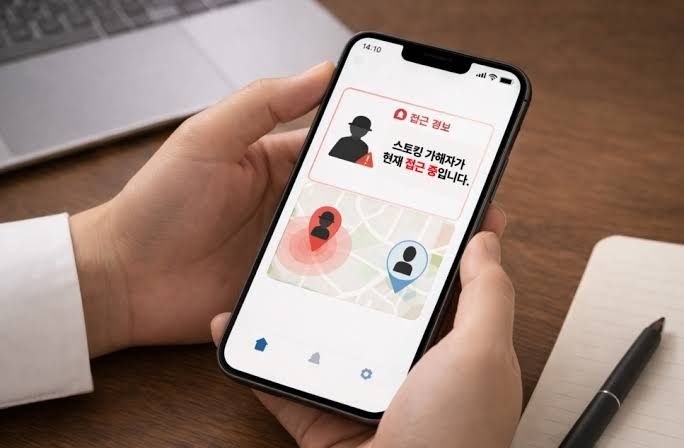
South Korea's Ministry of Justice unveiled a mobile tracking application on June 24 designed to furnish victims of stalking with immediate visibility into the whereabouts of individuals suspected of harassment or pursuit. The system represents a significant expansion of the country's stalking prevention infrastructure, allowing victims to monitor a perpetrator's current position and direction of travel directly through their smartphone. This initiative follows mounting public concern regarding gaps in the existing safety apparatus and mounting evidence that previous protective mechanisms have proven insufficient in preventing tragic outcomes.
The technological foundation of this new protective measure rests on electronic ankle monitors worn by suspected stalkers under court-ordered surveillance. Rather than relying solely on emergency alert devices—smartwatch-type systems that have been distributed to vulnerable individuals for several years—victims can now access granular, real-time data about their pursuer's movements. This dual-layer approach combines passive notification systems with active location monitoring, fundamentally altering the information asymmetry that previously favoured perpetrators over victims.
The impetus for this legislative response stems from documented failures of earlier safeguarding mechanisms. Between 2021 and August 2025, at least 23 individuals issued with emergency alert devices were nonetheless killed or subjected to attempted murder by their stalkers, according to Representative Lee Gwang-hee of the ruling Democratic Party of Korea. These fatalities underscore the limitations of reactive alert systems that depend on victims activating them during moments of acute danger. The new application addresses this vulnerability by enabling victims to maintain continuous situational awareness rather than awaiting an imminent threat.
Electronic monitoring of suspected stalkers represents a relatively recent development in South Korean law enforcement strategy. Starting in 2024, courts began ordering ankle monitors for high-risk cases, effectively creating the infrastructure necessary for real-time location sharing. This progression reflects evolving judicial thinking about proportionality—balancing suspects' privacy rights against victims' fundamental safety interests. The availability of this monitoring technology formed the prerequisite for the new application's deployment.
Regulatory frameworks governing the collection and sharing of suspects' location information presented substantial obstacles to implementing such a system. Concerns about privacy infringements and potential misuse of tracking technology necessitated careful calibration of legal guardrails. Acknowledging these tensions, the Ministry of Justice undertook a comprehensive revision of electronic monitoring regulations in December 2025, establishing protocols for data access, storage, and usage. These amendments established the legal foundation permitting victims to access location intelligence without exposing the system to abuse or constitutional challenges.
The implications for Malaysian readers extend beyond South Korea's borders, as several Southeast Asian jurisdictions grapple with similar challenges regarding stalking prevention and victim protection. Malaysia's own legal frameworks for restraining orders and electronic monitoring remain less developed than those now emerging in Seoul. The South Korean experience demonstrates how technology can be leveraged to rectify information imbalances between vulnerable individuals and their pursuers, though successful implementation requires robust privacy protections and clear judicial oversight. Malaysian policymakers considering enhanced victim protection measures might examine both the benefits and safeguards embedded in the South Korean approach.
The system's effectiveness will depend heavily on practical deployment challenges. Ensuring reliable GPS signal transmission, preventing technical malfunctions that could compromise victims' access to critical information, and training law enforcement to respond appropriately to tracked movements all present operational complexities. Additionally, the psychological impact of continuous surveillance on suspects' behaviour—whether deterrent or provocative—remains an open empirical question requiring longitudinal study as the system matures.
Beyond real-time location sharing, South Korea's government has articulated plans to expand victim agency within the legal system itself. Beginning in April 2027, stalking victims will gain authority to petition courts directly for restraining orders, circumventing the traditional requirement that law enforcement agencies initiate such applications on their behalf. This institutional reform directly empowers victims to activate protective mechanisms without depending on police discretion or resource constraints. Such decentralization of restraining order authority acknowledges that victims often possess superior knowledge regarding threats to their safety and possess greater motivation to pursue protective remedies.
The broader trajectory of South Korean stalking prevention policy reflects recognition that technological solutions and legal reforms must move in tandem. Neither ankle monitors nor mobile applications nor restraining orders individually provide complete protection; rather, their combination creates overlapping protective layers that address distinct vulnerabilities in the existing system. The real-time location application fills a critical gap by converting monitoring infrastructure into actionable intelligence accessible to those at risk.
Stalking represents an insidious form of violence that erodes victims' sense of security and autonomy before escalating to physical harm. The psychological torment inflicted by persistent, unwanted contact and surveillance often precedes and facilitates subsequent violence. By providing immediate visibility into perpetrators' movements, South Korea's new system aims to restore victims' capacity to make informed decisions about their movements and interactions. This represents a philosophical shift from reactive criminal justice response toward proactive victim empowerment.
As this system becomes operational across South Korea, international observers will monitor its effectiveness in reducing stalking-related fatalities and in deterring would-be perpetrators. Success metrics will extend beyond mere technical functionality to encompass victim satisfaction, false-alarm rates, and whether perpetrators' knowledge of being tracked influences their behaviour. The results may inform policy discussions throughout the region regarding how democratic societies can balance security, privacy, and victim protection in the digital age.

