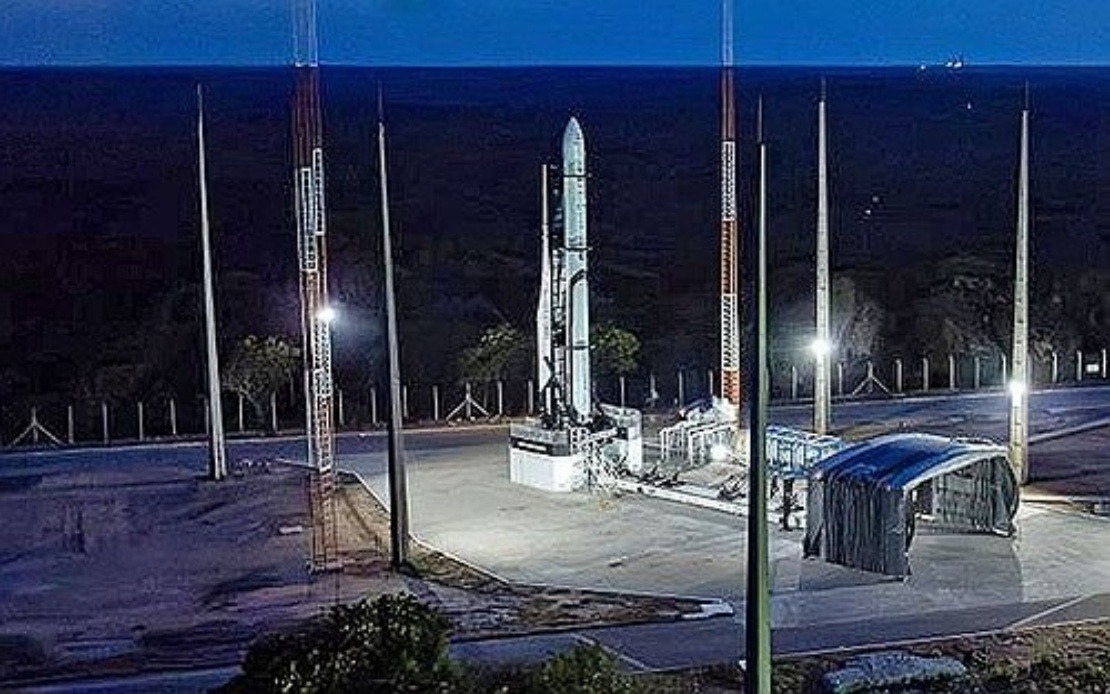
South Korea's defence ministry announced on Tuesday that it has postponed the launch of the Mir space rocket, a critical milestone in the nation's efforts to develop indigenous space capabilities independent of foreign reliance. The four-stage solid-fuel vehicle was scheduled to lift off at 2 pm from a sea barge positioned off Jeju Island's southern coast, but safety concerns identified during final preparations forced officials to shelve the attempt. The ministry did not specify the exact technical issues that triggered the cancellation, only stating that "a set of issues" emerged during the countdown phase, warranting a delay in the schedule.
The Mir programme represents a significant strategic initiative for Seoul, underpinning South Korea's broader goal to strengthen its surveillance and reconnaissance capabilities on the Korean peninsula. As tensions with North Korea persist, the ability to operate an independent network of observation satellites has become increasingly important for Seoul's national security architecture. Rather than relying solely on intelligence shared by the United States, South Korea seeks to develop a comprehensive domestic system that provides real-time monitoring of potential threats and reduces vulnerability to disruptions in allied intelligence-sharing arrangements.
This particular launch would have represented a major technical achievement for South Korean aerospace engineers. Prior to this attempt, the nation had successfully tested partial configurations of the rocket system during trials conducted throughout 2022 and 2023, each evaluating three-stage variants. A fully assembled four-stage launch would have demonstrated that South Korea had overcome the engineering complexities of integrating all components into a single functioning system, validating years of research and development investment. The postponement therefore marks not merely a scheduling inconvenience, but a setback for validation of critical technological milestones.
Solid-fuel rockets offer distinct advantages over their liquid-fuel counterparts that make them particularly attractive for military applications. The simpler structural design of solid-propellant systems translates into lower manufacturing complexity and reduced operational costs compared to liquid-fuel alternatives. Critically, solid-fuel vehicles can be stored in operational readiness for extended periods without degradation, enabling rapid deployment when circumstances demand swift action. For a nation facing unpredictable security scenarios on its peninsula, this responsiveness represents a key operational advantage.
Since 2021, South Korea has invested substantially in developing the Mir solid-propellant launch system, specifically designed to place small observation and surveillance satellites into low-Earth orbit at altitudes below 500 kilometres. This orbital zone provides optimal coverage for detailed reconnaissance of terrestrial targets, allowing sophisticated imaging and monitoring of specific geographical areas. The compact design of small satellites offers advantages in deployment flexibility and operational redundancy compared to relying on fewer large platforms.
Parallel to the Mir programme, Seoul has pursued an alternative path through its military spy satellite initiative, which has successfully deployed five reconnaissance satellites into orbit using SpaceX's Falcon 9 rockets, with the most recent launches completed by November of the previous year. This dual-track approach demonstrates South Korean strategic thinking: while pursuing independent domestic rocket development, Seoul has simultaneously ensured continuous expansion of its surveillance assets through proven foreign launch services. The hedging strategy provides immediate capability enhancement while longer-term indigenous systems mature.
Under current planning, South Korea intends to deploy up to 60 small spy satellites into space by 2030 through the Mir programme. Combined with the existing constellation of five larger military reconnaissance satellites, this expanded network would establish comprehensive coverage capabilities across the Korean peninsula and surrounding regions. The proliferation of satellites across multiple orbits and altitudes creates a resilient system less vulnerable to the loss of individual assets, while the sheer density of coverage points enables persistent monitoring of adversary activities with minimal temporal gaps.
The strategic implications extend beyond mere surveillance enhancement. Developing independent space launch capabilities positions South Korea as a more autonomous actor in regional security affairs, reducing dependence on United States intelligence sharing and potentially enabling Seoul to pursue security policies with greater flexibility. As space-based reconnaissance becomes increasingly central to modern military operations, nations without indigenous launch capabilities remain constrained by their reliance on allies. South Korea's investment in Mir therefore addresses both immediate reconnaissance gaps and longer-term strategic autonomy.
For the broader East Asian security environment, South Korea's advancement in space capabilities carries ripple effects. Other regional actors, particularly Japan and potentially Taiwan, monitor Seoul's progress in indigenous space technology as a benchmark for their own aspirations. Successful demonstration of domestic launch capabilities contributes to regional perceptions of a nation's technological sophistication and military readiness. Conversely, technical setbacks such as launch postponements can affect international assessments of capability timelines and reliability.
The postponement, while disappointing, reflects responsible engineering practice rather than fundamental programme failure. Identifying and rectifying safety issues before launch protects both expensive infrastructure and human personnel, ultimately strengthening programme credibility. The ministry's commitment to announce a rescheduled launch date demonstrates that officials view this delay as temporary rather than indicative of insurmountable obstacles. For Malaysian observers, South Korea's sustained investment in space capabilities serves as a reminder of the technological sophistication that advanced regional economies bring to security challenges, and the complexity of developing truly independent space infrastructure that rivals established spacefaring nations.

