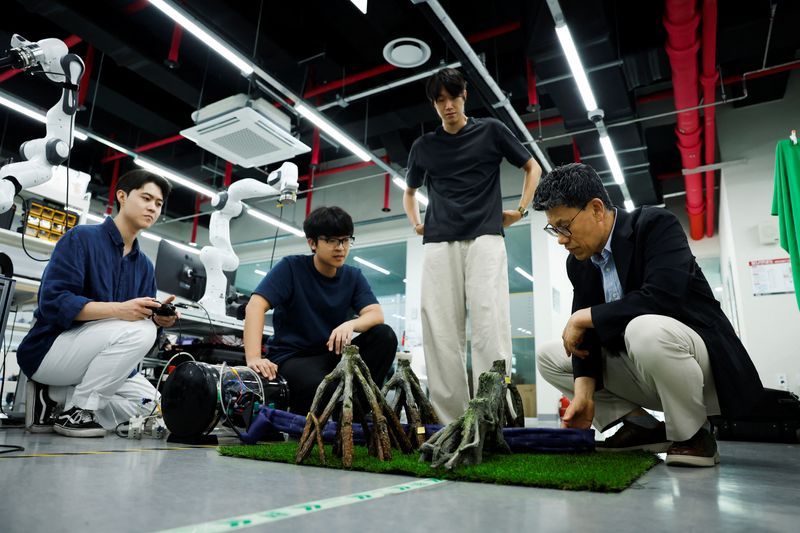
Scientists from South Korea's Korea Advanced Institute of Science and Technology (KAIST) and Stanford University have jointly developed an innovative robotic system that enables hands-free dressing, potentially transforming how people don protective clothing or garments in demanding environments. The breakthrough technology employs soft, flexible pneumatic structures—termed "vines" by the research team—woven directly into fabric and activated through air pressure to seamlessly guide clothing onto a wearer's body. The mechanism operates independently of manual assistance or the wearer maintaining a stationary position, addressing practical challenges in semiconductor manufacturing, emergency response, and healthcare contexts.
The conceptual inspiration behind this engineering achievement emerged from everyday observation rather than laboratory abstraction. Kim Nam Gyun, the postdoctoral researcher who led the project at KAIST, recounted how a chance bicycle ride in rainy weather sparked the creative thinking that would eventually culminate in the technology's development. His observation about the difficulty of donning rain protection while maintaining balance in motion crystallised into a vision of clothing that could autonomously adapt to a wearer's body—a notion that bridged the fields of biomimicry and robotics in practical fashion.
The robotic vine system mimics the climbing behaviour of ivy plants, utilising a growth mechanism at its extremity rather than repositioning its entire structure to traverse surfaces. When pressurised, these artificial vines systematically turn the garment inside-out as they progress upward along the wearer's body contours, establishing a dressing action that completes a full protective suit in approximately ten seconds. This elegant solution eliminates the need for complex computational algorithms to govern movement, a simplification that enhances reliability in real-world deployment scenarios where processing delays could prove problematic.
Professor Ryu Jee-Hwan from KAIST's civil and environmental engineering department emphasised the mechanical superiority of this approach by highlighting the vine robot's adaptive capabilities. The system can navigate through confined spaces, expand while conforming to variable body shapes, and maintain traction across diverse surface conditions ranging from slippery to sticky to inclined terrain. These characteristics distinguish the technology from rigid robotic systems that demand precisely controlled environments, making it inherently more versatile for practical applications where human variability and environmental unpredictability define operational constraints.
The technology's capacity to function while wearers remain mobile represents a significant departure from conventional dressing mechanisms that typically require stationary positioning. This dynamic functionality addresses a critical limitation in emergency response scenarios where rapid protective equipment deployment often occurs in chaotic, mobile circumstances. First responders managing hazardous material containment or medical personnel in contamination situations frequently require hands-free protection that accommodates movement—precisely the operational context this innovation facilitates.
Semiconductor manufacturing emerges as another compelling application domain for this technology. Cleanroom protocols mandate that workers undergo rigorous donning procedures before entering production zones, a process that currently consumes considerable time and demands concentrated attention to procedural requirements. The automated vine-robot system could accelerate this transition while simultaneously reducing human error in protective equipment application, ultimately enhancing both operational efficiency and worker safety within these highly controlled manufacturing environments.
Beyond occupational applications, the research team identifies potential benefits for elderly individuals and people with mobility limitations who encounter daily difficulties managing clothing fasteners, zippers, and layering requirements. This demographic consideration reflects a growing recognition within robotics research that technological innovation should address accessibility challenges faced by vulnerable population segments. The hands-free dressing capability could meaningfully enhance independence and dignity for individuals whose physical constraints currently necessitate assistance with fundamental daily activities.
The publication of this research in IEEE Robotics and Automation Letters, a peer-reviewed scholarly journal, signals the technology's credibility within the academic and professional robotics community. Peer review processes ensure that claimed capabilities withstand rigorous scrutiny, lending confidence to practitioners considering implementation. The scholarly pathway also establishes foundational documentation that facilitates further refinement and adaptation by other research teams pursuing related innovations.
Professor Ryu contextualised this mechanical engineering achievement within the contemporary technology landscape dominated by artificial intelligence discourse. He argued persuasively that while algorithmic advancement attracts substantial attention and investment, complementary progress in mechanical engineering remains essential for translating computational capabilities into tangible human benefits. The vine-robot exemplifies how sophisticated mechanical design can achieve functional objectives that purely software-based approaches cannot address, suggesting that future technological advancement will continue depending on balanced development across multiple engineering disciplines rather than singular focus on artificial intelligence.
The collaboration between KAIST and Stanford University reflects the increasingly international character of advanced robotics research, with Korean and American institutions combining expertise to solve problems transcending geographical boundaries. Such partnerships leverage distinct research traditions and resources available within different academic ecosystems, potentially accelerating innovation cycles. For Southeast Asian nations contemplating technology adoption and manufacturing competitiveness, this collaboration demonstrates how participation in international research networks can position regional institutions and industries at innovation frontiers.
As the technology progresses from laboratory demonstrations toward practical implementation, questions regarding scalability, cost-effectiveness, and user experience will determine market adoption trajectories. The ten-second dressing timeframe suggests commercial viability, though manufacturing costs and reliability in production environments remain undetermined at this stage. These implementation questions will likely occupy researchers and industry partners over subsequent development phases as the technology transitions from proof-of-concept toward commercial deployment in semiconductor facilities, emergency services organisations, and healthcare institutions throughout the Asia-Pacific region and beyond.

