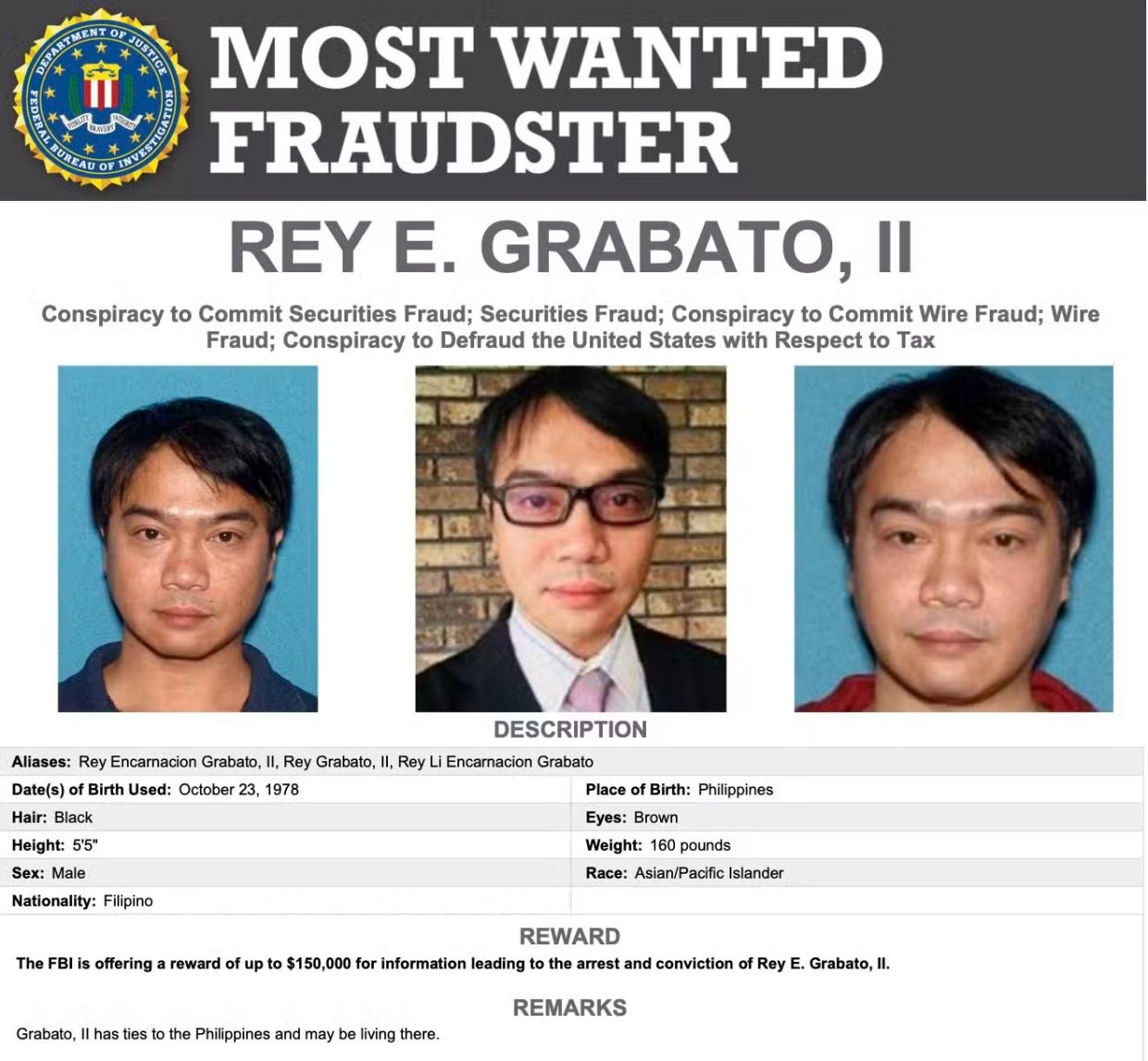
Rey E. Grabato II, whose father and mother both held the position of mayor of Mina in Iloilo province, has become the latest Filipino-linked fugitive to appear on the FBI's Most Wanted Fraudsters list in connection with what federal authorities describe as a massive US$650 million Ponzi scheme. The Los Angeles-based FBI office announced the addition of Grabato to its high-profile fugitives roster, with authorities offering a substantial reward of up to US$150,000 for credible information that leads to his capture and subsequent conviction in United States courts.
Grabato's designation follows the launch of a dedicated FBI Most Wanted Fraudsters list in June 2026, a strategic initiative reflecting Washington's determination to elevate the profile of major financial crime suspects and accelerate international manhunts. His inclusion underscores growing concerns about transnational fraud networks and the exploitation of cross-border investment mechanisms by individuals with connections spanning multiple countries. The former president and majority stakeholder of National Realty Investment Advisors LLC, or NRIA, Grabato is accused of orchestrating an elaborate deception that ultimately harmed approximately 2,000 investors across the United States, with a particularly concentrated impact on hundreds of victims in New Jersey.
The fraudulent operation, which prosecutors allege ran from February 2018 through January 2022, allegedly centred on the NRIA Partners Portfolio Fund I LLC, a purported real estate investment vehicle. Grabato and his alleged co-conspirator Thomas Nicholas Salzano are accused of deploying an aggressive and sophisticated marketing campaign that leveraged modern mass communication channels including thousands of targeted emails, television and radio spots, and strategically placed billboard advertisements supplemented by in-person investor presentations. This multi-pronged approach proved effective in attracting capital from a broad demographic of investors who believed they were participating in a legitimate and profitable real estate venture.
At the heart of the scheme lay deliberate misrepresentations about NRIA's financial condition and operational performance. Prosecutors contend that investors were consistently assured that the company maintained robust financial health and generated substantial returns on investment. The reality, according to federal investigators, differed dramatically—NRIA allegedly produced minimal or negligible profits and instead operated on a classic Ponzi structure whereby funds received from newly recruited investors were directly used to satisfy payment obligations to earlier participants. This unsustainable mechanism inevitably collapsed when the flow of new investor capital could not sustain the promised distributions.
Beyond the primary investment fraud allegations, Grabato faces additional charges related to the misappropriation of millions of dollars in investor funds. Prosecutors suggest these diverted monies may have been redirected toward personal enrichment or to sustain other operations associated with Grabato or his network. The scale of alleged personal financial benefit underscores the predatory nature of the scheme and distinguishes it from more passive fraud scenarios involving merely negligent business management.
In a separate but concurrent scheme, Grabato and alleged associates are accused of orchestrating a deliberate obstruction campaign targeting the Internal Revenue Service and its efforts to collect approximately US$26 million in outstanding federal tax liabilities. This tax-related conspiracy allegedly spanned from November 2007 through August 2022, suggesting a prolonged pattern of tax evasion and intentional interference with government collection efforts. The temporal overlap between the tax obstruction period and the investment fraud timeline raises questions about the potential interconnection between these schemes and their collective impact on victims and government revenues.
A federal arrest warrant was issued against Grabato on October 12, 2022, following his formal charging in the United States District Court for the District of New Jersey, Newark Division. At that time, prosecutors identified him as being ordinarily resident in Hoboken, New Jersey, though with known ties to the Philippines. Despite the active warrant and his public identification, Grabato has remained a fugitive. His alleged partner Salzano was apprehended in October 2022, but Grabato's location has remained unknown to authorities. The FBI notes that Grabato has utilised multiple variations of his name, including Rey Encarnacion Grabato II, Rey Grabato II, and Rey Li Encarnacion Grabato, suggesting a pattern of identity management that may have facilitated his evasion efforts.
For Malaysian and Southeast Asian business communities, the Grabato case illustrates significant vulnerabilities in cross-border investment structures and the importance of rigorous due diligence when evaluating foreign investment opportunities. The case demonstrates how sophisticated marketing and professional presentation can mask underlying financial fraud, particularly when real estate ventures—which inherently involve long development timelines and complex financial structures—are employed as cover. The involvement of a Philippine political figure's family member also highlights the intersection of political prominence and white-collar financial crime, underscoring that elite status does not necessarily provide immunity from fraud allegations in the United States legal system.
Grabato joins several other individuals with Filipino or Asia-Pacific connections already listed on the FBI's Most Wanted Fraudsters roster. Michael Lizaso Marasigan, a holder of both Filipino and United States citizenship with documented ties to Guam and the Philippines, was convicted in May 2025 on charges encompassing illegal gambling operations, money laundering, and wire fraud. Additionally, John Michael Dimitrion and his wife Julieanne Baldueza Dimitrion, the latter bearing a Filipino surname, have remained fugitives since their 2010 failure to appear for sentencing in a mortgage fraud prosecution stemming from Hawaii. Their case, dating to guilty pleas entered in 2009, demonstrates that some fraud fugitives maintain evasion for extended periods.
The FBI's establishment of the dedicated Most Wanted Fraudsters list reflects a strategic shift toward combating high-profile financial crimes with enhanced visibility and international coordination. By regularly publicising the identities and alleged criminal conduct of major fraud fugitives, the agency aims to leverage global awareness and community information networks to facilitate arrests. The substantial US$150,000 reward for information leading to Grabato's capture represents a meaningful financial incentive for potential informants who may have knowledge of his whereabouts or activities.
For individuals in Southeast Asia considering investment opportunities in foreign markets, particularly in the United States, the Grabato case serves as a cautionary narrative about the importance of independent verification of investment vehicle legitimacy. Verifying that purported investment managers are properly registered with appropriate regulatory bodies, reviewing audited financial statements, and cross-referencing claims with regulatory databases can mitigate exposure to fraud schemes. The velocity and scale of the alleged fraud—affecting 2,000 investors across multiple jurisdictions—underscores how rapidly fraudulent schemes can expand when armed with modern marketing tools and unchecked by regulatory oversight.
Any individual with information regarding Grabato's current location or activities is encouraged to contact their local FBI office, or alternatively, to reach out to the nearest United States embassy or consulate. The ongoing investigation remains active, and authorities continue to pursue leads that may facilitate Grabato's apprehension and extradition to face trial in United States courts.

