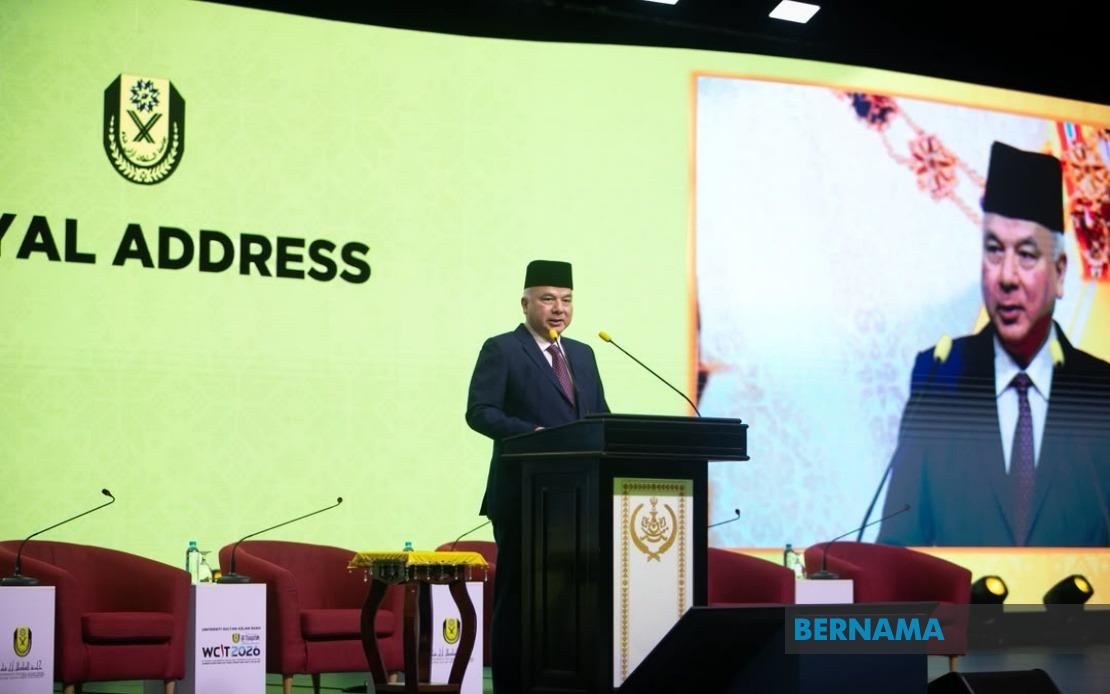
The Sultan of Perak, Sultan Nazrin Shah, has articulated a vision of national security fundamentally rooted in social unity rather than military apparatus or technological defences. Speaking at the 8th World Conference on Islamic Thought and Civilisation in Ipoh on July 21, His Royal Highness presented a nuanced argument that transcends conventional security doctrine, contending that while border protection, cyber defence, and counter-extremism efforts remain important, they represent only surface-level responses to deeper vulnerabilities that threaten the fabric of any nation.
The Sultan's intervention into contemporary security discourse carries particular weight given Malaysia's ongoing challenges with communal tensions, political polarisation, and questions of national identity. His framing of social cohesion as the most durable security mechanism suggests a philosophical reorientation away from militaristic solutions toward the harder, longer-term work of nation-building through inclusive governance and equitable systems. This perspective implicitly critiques approaches that prioritise security spending or surveillance at the expense of addressing root causes of social fragmentation.
Central to Sultan Nazrin's address was a pointed warning about the weaponisation of religious sentiment for narrow political purposes. He specifically condemned what he termed the manipulation of faith to justify division and exclusion, positioning such exploitation as a fundamental threat to national integrity. In the Malaysian context, where religious identity intersects with ethnicity and political affiliation in complex ways, this statement carries urgent relevance. The deliberate inflaming of religious sensibilities to mobilise support or marginalise communities represents a direct attack on the social cohesion the Sultan advocates as essential for genuine security.
The Sultan articulated a compelling logic linking security to belonging. He argued that a nation experiencing external stability while internally corroded by corruption, injustice, and exclusion has merely deferred its reckoning rather than achieved authentic security. This framework inverts the typical hierarchy of governance priorities, suggesting that investments in social justice, institutional integrity, and equitable representation generate more lasting security returns than investments in defence infrastructure alone. For Malaysian policymakers, this reasoning challenges conventional budget allocations and policy emphases.
Crucially, the Sultan rejected uniformity and enforced silence as pathways to unity, instead advocating for genuine stakeholder inclusion across all segments of society. His emphasis on ensuring that communities see themselves reflected fairly in laws, economic structures, educational institutions, and leadership positions speaks directly to long-standing grievances in Malaysia regarding representation, opportunity distribution, and systemic fairness. This is not merely aspirational rhetoric but a diagnosis of fragility: when citizens perceive the system as rigged or indifferent to their welfare, institutional legitimacy erodes regardless of external security arrangements.
The distinction the Sultan drew between brittle unity imposed through coercion and resilient unity built on shared belonging encapsulates a sophisticated understanding of what prevents state collapse or civil breakdown. Coercive unity, maintained through restrictive laws, surveillance, or force, remains vulnerable to internal pressure and requires constant enforcement resources. By contrast, unity grounded in citizens' genuine sense of ownership and fair treatment proves self-sustaining because it aligns institutional interests with individual welfare. This insight has profound implications for Malaysia's approach to social policy and interethnic relations.
Beyond security proper, Sultan Nazrin devoted substantial attention to human capital development as foundational to navigating future challenges. He positioned education as critical infrastructure for confronting automation, climate change, and the transition to knowledge-based economies. His vision encompasses not merely expanding access to schools and universities but fundamentally reconceiving educational objectives and pathways. The call for equal investment in technical and vocational training alongside academic routes addresses both practical workforce needs and pervasive social hierarchies that devalue certain forms of labour—issues particularly relevant to Southeast Asia's development aspirations.
The Sultan's analysis of educational transformation in the artificial intelligence era represents a particularly forward-thinking contribution to regional discourse. He identified the obsolescence of rote memorisation and standardised testing in contexts where information retrieval is instantaneous and nearly costless. Instead, he positioned critical thinking, ethical reasoning, creativity, and adaptability as the irreplaceable human capacities that justify education investments. His suggestion that Islamic intellectual traditions, properly understood as syntheses of revealed knowledge and rational inquiry, naturally cultivate these capacities offers a framework for reconciling contemporary educational demands with cultural and religious identity—a perennial challenge in Muslim-majority nations.
The Sultan's framing of education as encompassing humanities and the arts alongside sciences and mathematics reflects recognition that technical skills absent ethical grounding or cultural literacy produce incomplete human development. This becomes particularly important in contexts where rapid technological adoption has outpaced social institutions' capacity to manage its consequences. Malaysia and the region face precisely this challenge: technological capability advancing faster than institutional frameworks for managing social disruption or ensuring equitable benefit distribution.
The presence of Deputy Prime Minister Fadillah Yusof, Perak Menteri Besar Saarani Mohamad, and Higher Education Minister Zambry Abd Kadir lent governmental weight to the Sultan's address, suggesting official receptiveness to this security paradigm. However, translating such rhetoric into concrete policy requires sustained commitment and difficult prioritisation decisions. It demands redirecting resources from conventional security spending toward social programmes, acknowledging that genuine national defence requires investments in education, justice systems, and economic inclusion that may not yield immediate measurable returns.
For Malaysia specifically, the Sultan's emphasis on preventing religious exploitation for political ends addresses a recurring vulnerability. Political actors have historically capitalised on religious identity to mobilise support or marginalise opponents, fragmenting the national community in the process. The Sultan's intervention from the institution of the monarchy—traditionally positioned as custodian of constitutional order and national unity—carries symbolic weight suggesting that preserving Malaysia's social fabric ranks as a paramount state responsibility.
The implications extend throughout Southeast Asia, where multiple nations navigate similar tensions between development, modernisation, communal identity, and political stability. The Sultan's prescription—building security through inclusive institutions, equitable systems, and genuine stakeholder belonging rather than through force or exclusion—offers a regionally relevant alternative to both Western security doctrine and authoritarian stability models. It suggests that the region's most pressing security challenge is not external military threats but internal fracture caused by perceived injustice or exclusion.
Ultimately, Sultan Nazrin's address proposes that durable national security emerges from citizens' profound sense that they belong to a community that values them, provides genuine opportunity regardless of background, and governs through fair and transparent institutions. Achieving this demands political courage, sustained investment in inclusive institutions, and resistance to the temptation of short-term security gains through divisive rhetoric or exclusionary policies. For Malaysia and the region, accepting this vision means fundamentally reordering priorities and measuring security success not by military capabilities but by social health and institutional legitimacy.

