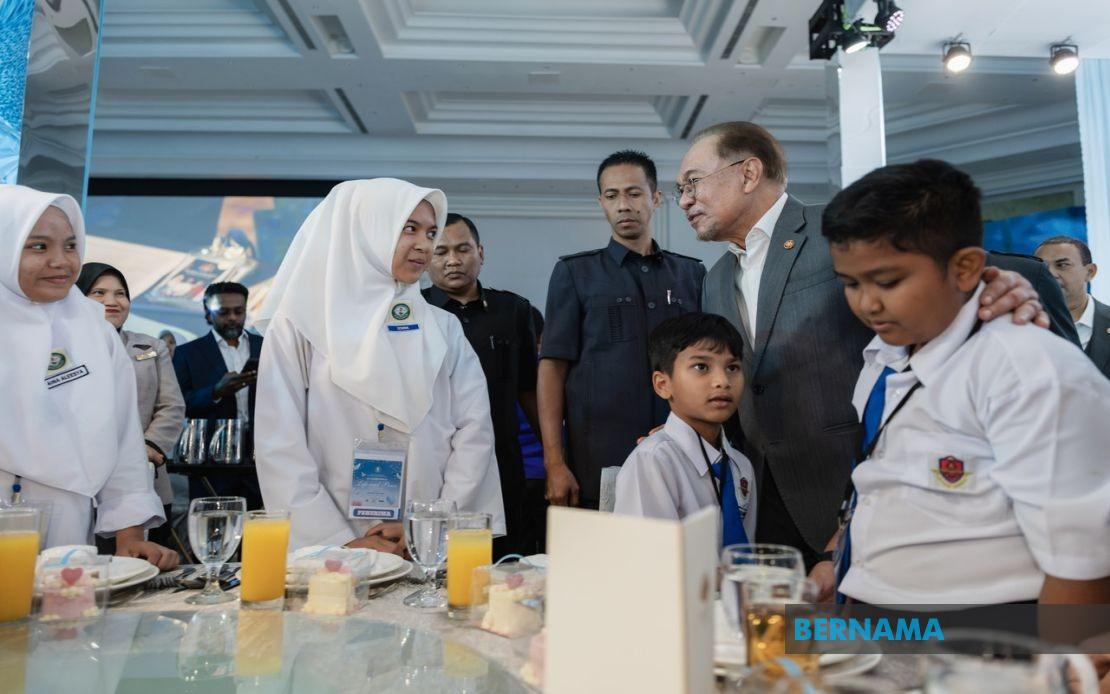
Prime Minister Datuk Seri Anwar Ibrahim has delivered a pointed message about education and child development, asserting that schools should cultivate virtue and integrity alongside academic prowess. Speaking at a celebration gathering 700 students from 47 schools across Kuala Lumpur and Putrajaya, Anwar underscored a distinction often blurred in the pursuit of high exam scores: the difference between intelligence and character. His remarks came during the "Celebration of Life and Peace" event organised by ERM Foundation, where the emphasis shifted deliberately from performance metrics to the formation of responsible citizens.
The Prime Minister's intervention into this domain reflects growing anxiety across Malaysia about the behavioural trajectory of young people, particularly regarding interpersonal conduct within educational settings. Anwar framed the question in deeply personal terms, asking the assembled children whether they understood the true purpose of attending school. His rhetorical approach—contrasting academic success with bullying and disruptive behaviour—highlighted the gap between what many institutions teach and what society ultimately needs from its next generation. By addressing the students directly and speaking of himself as "this grandpa," Anwar attempted to establish a conversational, almost familial tone while delivering what amounted to a moral imperative.
The scope of Anwar's message extended beyond a simple platitude about being nice. He explicitly connected early conduct to long-term life outcomes, suggesting that bullying and harmful behaviour jeopardise the futures of those who engage in such acts. This framing moves the conversation away from purely victim-centred discourse about bullying's impact on targets toward consideration of how perpetrators damage their own prospects and social standing. For Malaysian parents and educators wrestling with discipline and character formation, the Prime Minister's intervention offers a subtle endorsement of zero-tolerance approaches to school bullying, grounded not in punishment alone but in protective concern for all children involved.
Particularly significant is Anwar's explicit call for parental and educator accountability. He did not position children as autonomous moral agents solely responsible for their choices but rather summoned the adults who guide them to fulfil their complementary roles. This tripartite responsibility—parents, teachers, and students themselves—reflects a traditional Malaysian understanding of child-rearing as a collective endeavour involving family, school, and community. By invoking this structure, Anwar aligned his message with deeply held cultural values while simultaneously holding multiple stakeholders accountable for the moral climate in which children develop.
The event itself carried symbolic weight beyond the Prime Minister's speech. The attendance of Anwar's wife, Datuk Seri Dr Wan Azizah Wan Ismail, projected a family-centred image of leadership, suggesting that concerns about childhood welfare are not bureaucratic abstractions but personal commitments. The distribution of RM500 cash assistance to each attending child, combined with feast and entertainment, transformed the gathering into something more than a lecture venue—it became a demonstration of state concern for student wellbeing conceived broadly, encompassing both material support and moral guidance.
Xin'er, the ERM Foundation founder, articulated a complementary vision during the event. Her emphasis on celebrating children who face illness and other hardships added a compassion dimension to proceedings, suggesting that moral formation must include sensitivity to vulnerability and gratitude for privilege. Her articulation of wishes for peaceful growth and joyful birthdays, framed against implicit awareness that many children lack such security, connected the celebration to a broader humanitarian framework. This approach aligns with international child welfare priorities while remaining rooted in Malaysian social contexts where disparities in childhood experiences remain pronounced.
The selection of 47 schools from Kuala Lumpur and Putrajaya indicates a deliberate focus on urban and semi-urban centres where bullying and behavioural challenges may be particularly acute. Malaysia's rapid urbanisation and changing family structures have coincided with evolving patterns of youth conduct. Schools in these zones frequently grapple with diverse student populations, complex social hierarchies, and varying parental engagement levels. By targeting these institutions, the initiative acknowledges where intervention efforts may yield significant returns.
Anwar's emphasis on respect for teachers warrants particular attention given recent controversies surrounding teacher-student relationships and institutional authority in Malaysian schools. His explicit call for young people to honour educators reinforces traditional hierarchies while acknowledging that such respect must be earned through institutional integrity and professional conduct. This formulation avoids simply demanding deference while restoring dignity to a profession increasingly besieged by criticism and resource constraints.
The timing and framing of this message suggests awareness within the Prime Minister's office that Malaysian society faces emerging challenges to social cohesion, particularly among younger demographics. School bullying, whether physical, verbal, or cyber-based, has intensified as a public concern, with periodic media coverage of severe incidents generating alarm about child safety and institutional effectiveness. By positioning the Prime Minister as directly addressing this issue, the government signals that such matters merit top-level attention rather than remaining delegated to subordinate agencies.
The event also reflects a particular vision of moral education that emphasises cultivation rather than punishment. Rather than framing the agenda around enforcement of discipline codes or consequences for misbehaviour, Anwar positioned character development as something children might aspire toward willingly, even enthusiastically. This aspirational approach contrasts with purely regulatory frameworks, though both have roles in comprehensive approaches to behavioural formation.
For Malaysian educators and administrators, Anwar's remarks provide political cover for initiatives prioritising character education alongside academic achievement. His public endorsement of this balance legitimises curricula incorporating ethics, emotional intelligence, and social responsibility. As schools nationwide review their approaches to student welfare and institutional culture, the Prime Minister's words carry weight in resource allocation discussions and policy deliberations.
Looking forward, the challenge lies in translating such public declarations into systemic change. Single events, however symbolically significant, cannot address the structural conditions contributing to bullying and poor conduct in schools. Implementation requires sustained investment in teacher training, school counselling services, parental engagement programmes, and creation of school cultures genuinely prioritising kindness alongside achievement. Whether the government follows this rhetorical emphasis with corresponding budgetary and policy commitments remains to be seen, but the public statement establishes benchmarks against which future performance can be measured.

