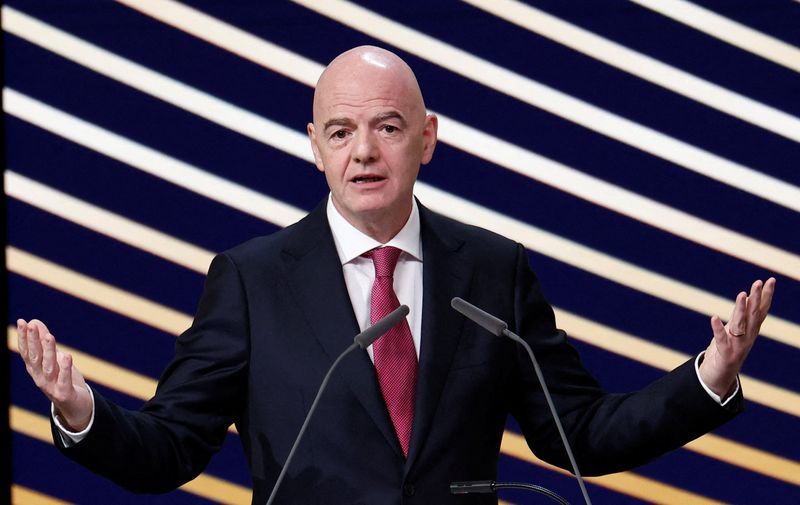
Gianni Infantino's battle to secure a fourth term as FIFA president has taken an unexpected turn: his strongest lifeline may not come from world football's established superpowers but from a coalition of smaller and developing nations that have grown accustomed to his administration's financial generosity. The Swiss administrator now faces the most serious challenge of his decade in charge, with major regional confederations publicly questioning his leadership and several nations formally withdrawing their backing following his failed attempt to bring private equity investment into the World Cup structure.
The crisis deepened this week when Wales became the first national federation to formally revoke its support for Infantino, while UEFA, representing Europe's 55 member associations, warned it was preparing legal action against him over the private equity proposal. More significantly, UEFA has signalled it would consider orchestrating an extraordinary congress to challenge his presidency—a mechanism that requires only 20 percent of FIFA's 211 member associations to request one in writing. Such a move would force a leadership vote within three months and potentially open the door for rival candidates to emerge. Despite these mounting obstacles, removing an incumbent FIFA president from office remains a formidable political undertaking that demands considerable coalition-building.
The structural reality of FIFA's voting system creates a paradoxical advantage for Infantino's camp. Although the world's football nations span vast gulfs in wealth, infrastructure, development and competitive standing, each of the 211 member associations possesses precisely one vote in any decision. This democratic principle, while ostensibly fair, has historically favoured incumbents with established relationships across football's less prominent regions. Rather than investing political capital on traditional powerhouses like France, Spain and England—nations with robust domestic leagues and established football cultures—Infantino's survival strategy increasingly hinges on retaining the allegiance of emerging footballing nations such as Bhutan and Vanuatu, countries whose football programmes depend almost entirely on FIFA's financial umbrella.
The incentive structure underlying this dynamic is straightforward and deeply embedded in FIFA's funding architecture. During the current 2023-26 World Cup cycle, member nations have been able to access up to three million dollars for soccer development projects—a fifty percent increase from the previous cycle. For wealthy European and South American federations with professional infrastructure and substantial domestic television revenues, these grants represent marginal additions to their budgets. For small island nations and landlocked developing countries, however, such funding is transformative. It finances training facilities, covers player development programmes, enables participation in regional competitions and provides the basic infrastructure necessary to sustain international football activities.
Vanuatu exemplifies how this financial architecture has reshaped Infantino's political positioning in the global football hierarchy. The Pacific island nation, home to approximately 340,000 people and ranked 160th in world football, received a development grant of four million one hundred fifty thousand dollars from FIFA to construct a six-thousand-five-hundred-seat stadium in Port Vila, completed in 2022. Beyond the infrastructure investment, Vanuatu's football federation president Lambert Maltock has ascended to FIFA's Executive Council, serving as one of eight vice-presidents—a position that grants influence on the world body's highest policy decisions. For a nation whose football culture was marginal on the global stage merely a decade ago, this elevation represents unprecedented institutional access and diplomatic standing.
Brian Kaltak, Vanuatu's first professional footballer currently with Perth Glory, articulates the gratitude that such investments generate among developing football nations. Speaking on Monday, Kaltak emphasised that Infantino's patronage extended beyond stadium construction to encompassing genuine expansion of opportunities for players from smaller nations to compete internationally. The defender credited Infantino with creating pathways for emerging countries to participate in broader football development, arguing that his administration has genuinely attempted to grow the sport beyond traditional strongholds. This testimonial reflects a deeper sentiment among football communities in the developing world: Infantino's tenure has resulted in tangible material improvements to their football infrastructure and competitive opportunities.
Across Asia, Africa, the Caribbean and the Pacific, similar patterns of FIFA-financed football development have become commonplace. Training pitches constructed with FIFA grants now dot the landscape in nations where domestic government budgets could not support such infrastructure investment. Gyms, coaching education programmes and tournament participation fees have all flowed through FIFA's development channels to federations lacking alternative sources of capital. National associations that would otherwise struggle to maintain consistent international participation have transformed into regular World Cup qualifiers and regional competition participants, directly attributable to this funding model. The psychological and institutional effect is substantial: these federations have come to view FIFA's administrative apparatus, and by extension Infantino's presidency, as fundamentally aligned with their sporting interests.
Critics of this arrangement contend that Infantino's funding strategy, while superficially philanthropic, constitutes a sophisticated form of political patronage that consolidates executive power by creating structural dependencies. By making smaller nations reliant on FIFA development grants, the system effectively ensures that these nations' voting blocs remain aligned with the sitting president's preferred policies. This creates a formidable obstacle for reform-minded challengers: any campaign to unseat Infantino must not only overcome the emotional goodwill generated by stadium construction and player development funding but also convince multiple federations to vote against their material interests. The private equity proposal that triggered the current crisis reveals this tension acutely—while European confederations viewed the scheme as a threat to football's governance integrity, developing nations had little to lose and potentially much to gain from additional World Cup-derived revenue.
The political mathematics facing Infantino's opponents are consequently far less straightforward than superficial analysis suggests. UEFA's unified opposition and legal threats carry substantial weight within European football's hierarchy, yet Europe's 55 votes represent only twenty-six percent of FIFA's total membership. A successful effort to depose Infantino through an extraordinary congress would require securing a majority of at least 106 votes from the broader FIFA membership, meaning opponents would need to peel away approximately 56 developing nation votes from Infantino's presumed coalition. Given that these nations have received millions in direct FIFA funding and experienced genuine expansion in football opportunities under his tenure, mounting such a challenge demands offering something more compelling than institutional reform rhetoric—potentially competing financial inducements or governance commitments that European confederations may be reluctant to guarantee.
The Wales decision to withdraw support represents a symbolic blow that reverberates differently across different regions. Within European football circles, it signals growing elite discomfort with Infantino's leadership style and decision-making. Among smaller federation leaders, however, it may register primarily as an intra-European dispute rather than a broader indictment of Infantino's development policies. The distinction proves crucial: any extraordinary congress would be decided by simple majority, meaning Infantino could theoretically survive even with substantial European opposition if his base among smaller nations remains intact. This asymmetry explains why his team's strategic focus appears concentrated on reassuring development-dependent federations that his commitment to funding and infrastructure investment will continue undiminished, regardless of European opposition.
The unfolding crisis thus exposes fundamental tensions within FIFA's governance architecture that extend far beyond Infantino's personal political fortunes. The system's core principle—one nation, one vote—creates incentive structures that can entrench particular leadership styles and administrative approaches even when serious governance questions arise. Smaller nations gain voting parity but lose substantive influence unless they aggregate into voting coalitions, while wealthier federations possess institutional capacity and alternative resources that reduce their dependence on FIFA's financial largesse. Infantino has understood these dynamics intuitively and structured his tenure around maximizing support among the numerical majority of smaller nations while managing relations with traditional powerhouses. Whether that strategy survives the current crisis depends ultimately on whether his developing nation coalition views reform as threatening to their interests or essential to football's integrity.

