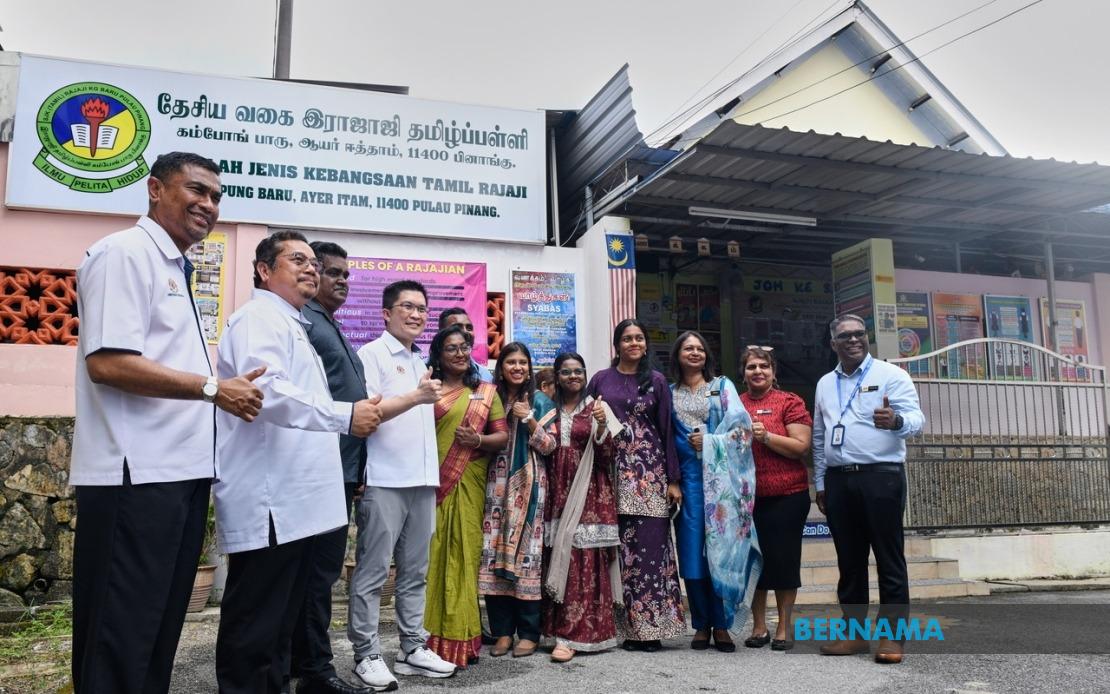
Penang's venerable Sekolah Jenis Kebangsaan Tamil (SJKT) Rajaji is set for a transformative expansion after the Education Ministry greenlit an RM8 million construction project at a new campus in Farlim, near Bandar Baru Ayer Itam. The 76-year-old institution, which has struggled with spatial constraints while accommodating roughly 100 pupils, will finally gain breathing room through this privately-funded initiative that underscores the growing partnership between government and corporate bodies in advancing Tamil-medium education across the country.
Deputy Education Minister Wong Kah Woh announced the approval during a ceremony where he presented the construction sanction letter to school officials. The relocation addresses longstanding challenges that have hampered the school's ability to deliver quality education. Operating in what officials describe as cramped quarters, SJKT Rajaji has reached a capacity ceiling that threatens both pupil welfare and pedagogical effectiveness. The new facility promises not merely additional space, but a modernised learning environment capable of serving the institution's community far more comprehensively than its current premises.
The project timeline indicates that construction will span approximately 18 months from commencement, with the school targeted to commence classes at the new Farlim site by the 2029 academic session at the latest. This phased approach allows the school to minimise disruption to the academic calendar whilst ensuring that structural and operational preparations are completed to exacting standards. The extended timeline also reflects the complexity of coordinating land acquisition, infrastructure development, and compliance with local authority requirements.
The land acquisition process itself demonstrates how deliberate planning at state and federal levels can facilitate educational development. Penang's government identified and approved a 2.3-acre plot in Farlim in 2022, situated approximately 500 metres from the school's existing location. This proximity proves strategically advantageous, as it enables smoother transition logistics and allows the existing community to maintain geographic accessibility to the institution. The school's board of governors subsequently lodged a formal application with the Education Ministry, which granted approval after resolving outstanding matters with relevant local authorities.
Crucially, the entire RM8 million investment comes through corporate social responsibility funding provided by a private developer, eliminating direct budgetary pressure on state finances. This arrangement exemplifies an emerging model within Malaysia's educational infrastructure development, wherein businesses contribute meaningfully to community facilities in exchange for recognising their social commitments. For Penang, already managing competing fiscal demands across multiple policy portfolios, such partnerships prove invaluable in accelerating improvements to schools serving minority language communities.
Penang's Tamil-medium school ecosystem encompasses 28 institutions statewide, many of which face similar infrastructure challenges. State Housing and Environment Committee chairman and Penang Tamil Schools Special Committee chairman Datuk Seri S. Sundarajoo highlighted that several facilities are advancing through various developmental stages, ranging from securing permanent premises to implementing staged construction projects. The momentum evident in SJKT Rajaji's approval reflects broader commitments within the state administration to systematically address accumulated infrastructure deficits affecting Tamil schools.
Beyond SJKT Rajaji, at least three other Tamil school projects anticipate groundbreaking ceremonies within the current year, signalling accelerated capital investment in the sector. Simultaneously, authorities are reviving stalled initiatives affecting other institutions, including SJKT Sungai Bakap and SJKT Juru, both of which had encountered obstacles in their respective development trajectories. This coordinated push represents recognition that Tamil schools, despite their critical role in preserving linguistic and cultural heritage whilst providing quality education, have historically received insufficient infrastructure investment compared to their Malay-medium counterparts.
For Malaysian Tamil communities, particularly in Penang where significant populations maintain strong cultural and educational ties to the language, such initiatives carry significance extending beyond mere facility improvements. Well-resourced Tamil schools strengthen intergenerational language transmission, foster cultural pride, and provide equitable educational pathways for families who wish their children to develop proficiency in Tamil alongside English and Malay. The new SJKT Rajaji campus embodies recognition that minority language education deserves equivalent infrastructural investment to majority-stream institutions.
The project also illustrates how public-private collaboration can overcome traditional constraints limiting government spending on education. Rather than requiring appropriations from limited development budgets, corporate funding allows simultaneous advancement of multiple initiatives. This model, when properly structured and transparently managed, enables accelerated progress on infrastructure backlogs whilst maintaining public oversight and accountability. For other Tamil schools anticipating improvements, SJKT Rajaji's success may establish a replicable pathway for securing necessary funding without depleting state resources.
Looking forward, the successful completion of this project will establish a precedent within Penang's Tamil school network. A modern, adequately resourced SJKT Rajaji will demonstrate tangible commitment to educational equity whilst creating a model facility that others may reference when advocating for their own improvements. Beyond the immediate benefits to current and future students, the new campus represents institutional validation—an acknowledgement that Tamil-medium education remains valued within Malaysia's plural educational landscape. For the broader Southeast Asian region, where Tamil communities maintain significant presence across Malaysia, Singapore, and diaspora networks, such infrastructure development strengthens the ecosystem supporting Tamil language and culture transmission.

%22%2F%3E%3C%2Fpattern%3E%3C%2Fdefs%3E%3Crect%20width%3D%22100%25%22%20height%3D%22100%25%22%20fill%3D%22url(%23ph1354vg)%22%2F%3E%3Crect%20width%3D%22100%25%22%20height%3D%22100%25%22%20fill%3D%22url(%23ph1354vp)%22%2F%3E%3Ctext%20x%3D%2250%25%22%20y%3D%2250%25%22%20text-anchor%3D%22middle%22%20dominant-baseline%3D%22central%22%20fill%3D%22rgba(255%2C255%2C255%2C0.95)%22%20font-family%3D%22Georgia%2C%20'Times%20New%20Roman'%2C%20serif%22%20font-weight%3D%22700%22%20font-size%3D%22320%22%20letter-spacing%3D%22-0.02em%22%3EGRS%3C%2Ftext%3E%3C%2Fsvg%3E)