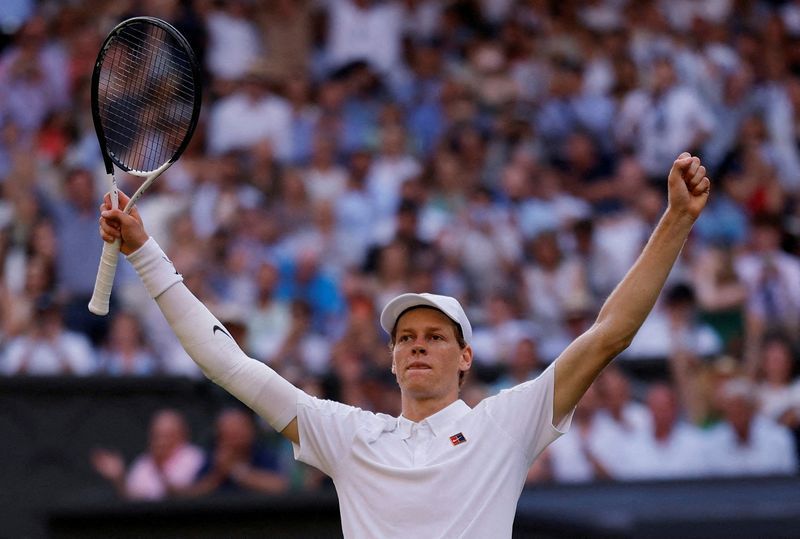
Jannik Sinner returns to the All England Club as defending champion, but the aura surrounding the world number one has grown noticeably fragile following a troubling exit at Roland Garros last month. The Italian's collapse in Paris punctured what had appeared to be an unstoppable trajectory, forcing the 24-year-old to contemplate whether his dominance across the professional calendar can withstand the mounting pressures of the Grand Slam stage. His arrival at Wimbledon represents far more than a routine title defence; it signals a critical juncture in establishing whether his clay-court brilliance translates convincingly to grass, the sport's fastest and most unforgiving surface.
Sinner's decline at the French Open carried particular sting because it interrupted a remarkable 30-match winning streak that stretched back to February, a period during which he seemed capable of overwhelming nearly any opponent on red clay. Yet in Paris, physical deterioration rather than tactical deficiency appeared to unravel his challenge, raising uncomfortable questions about his conditioning and capacity to maintain such sustained excellence across consecutive weeks of demanding competition. The fact that he bypassed traditional warm-up tournaments before heading to London suggests a calculated gamble—prioritising rest and recovery over match sharpness, a decision that carries inherent risk at a venue where rhythm and grass-court acclimation prove invaluable.
Mats Wilander, the seven-times Grand Slam champion now offering expert analysis, attributes Sinner's predicament to scheduling rather than fundamental weakness. According to Wilander's assessment, the Italian played extensively during the eight weeks leading into Roland Garros with insufficient opportunity to recuperate properly or conduct meaningful training sessions, leaving him depleted precisely when the stakes demanded peak performance. The legendary Swede believes Sinner has now rested adequately and should return energized, though he acknowledges that grass surfaces introduce unpredictable variables absent on clay. This observation captures a crucial distinction: Sinner's invincibility on clay does not automatically transfer to the faster courts of Wimbledon, where service returns, volleys, and movement patterns operate according to different physics and tactical imperatives.
No figure looms more ominously across Sinner's title defence than Novak Djokovic, whose movement and return-of-serve capabilities render him perpetually formidable on grass. At 39 years old, the Serbian maestro pursues twin objectives that have tantalizingly eluded him: an eighth Wimbledon crown that would draw him level with Roger Federer's record, and an elusive 25th Grand Slam title achieved independently rather than as part of a broader total. Time operates as an increasingly precious commodity for Djokovic, making this summer's Grand Slam swing arguably his final genuine window to capture both milestones before age and injury claim their inevitable toll. Though he exited Paris early, providing him with extended recovery and preparation time, his history suggests Wimbledon has always suited his game more harmoniously than the red clay environment.
Former finalist Andy Roddick articulated Djokovic's calculating perspective with particular clarity, noting that the Serbian's premature French Open departure might paradoxically strengthen rather than weaken his Wimbledon prospects. By avoiding a gruelling fortnight at Roland Garros, Djokovic arrives at the All England Club fresher and mentally reinvigorated, potentially viewing the grass-court stage as his genuine opportunity to reclaim supremacy. Roddick's assessment captures the realistic possibility that despite not operating at absolute peak form, Djokovic retains sufficient mastery of grass-court tennis to overcome most challengers. The psychological factor cuts particularly sharp for a veteran contemplating his final realistic chances at extending a legacy already deemed among tennis history's greatest.
Alexander Zverev emerges as perhaps the tournament's most compelling narrative arc, arriving as the newly crowned French Open champion following his maiden Grand Slam breakthrough at Roland Garros. The German's victory—his first major title after years of near-misses—provides tangible momentum heading into Wimbledon, where his explosive service and powerful baseline game theoretically align well with grass-court demands. Zverev's long-awaited Grand Slam success carries psychological significance extending beyond mere tournament victory; it demonstrates conclusively that he possesses both the technical proficiency and mental resilience to navigate the rigorous Grand Slam fortnight successfully. Boris Becker, the six-times major champion and fellow German, rates Zverev as the favourite precisely because his serve, ordinarily among the most potent on professional tour, becomes potentially devastating when unleashed on accelerated grass courts where service winners accumulate rapidly.
Becker's endorsement reflects a sophisticated understanding of Wimbledon dynamics: players who command dominant serves effectively reach semi-finals through sheer service dominance alone, regardless of baseline excellence. Zverev's capacity to deploy his serve as a genuine weapon on grass, combined with his demonstrated ability to perform under Grand Slam pressure following his Paris triumph, positions him as a legitimate championship contender rather than merely a talented challenger. The question remaining concerns not whether Zverev possesses the tools to succeed at Wimbledon, but whether he can overcome the mental hurdles often associated with players transitioning directly from one major title to another major tournament within the same season.
Carlos Alcaraz's enforced absence creates a substantial void in the draw that fundamentally reshapes the tournament's competitive landscape. The Spanish phenom's dominance across 2023 and 2024 established him as the only contemporary player capable of truly overwhelming opposition on grass through sustained aggression and consistent excellence, and his injury removes the one challenger most capable of rivalling Sinner's intensity and shot-making. This absence paradoxically strengthens the title prospects of multiple contenders by eliminating the player most likely to navigate to the final and potentially disable other aspirants through superior execution. While unfortunate from a competitive standpoint that fans lose the opportunity to witness Alcaraz's artistry on grass, his withdrawal effectively democratizes the draw and creates realistic pathways for a wider range of credible contenders.
Beyond the established triumvirate of Sinner, Djokovic, and Zverev, an intriguing cohort of American players possesses the weaponry to trouble even the highest-ranked opponents on grass's treacherous surface. Ben Shelton, Taylor Fritz, and Frances Tiafoe each bring serve-and-volley capabilities and explosive power that translate effectively to fast courts, occasionally producing upsets against complacent or poorly prepared seeded players. Additionally, French Open runner-up Flavio Cobolli leads the emerging generation of challengers, having demonstrated that he can sustain excellence over successive matches in major championship contexts. This depth of competition creates a genuinely unpredictable scenario where Wimbledon 2024 lacks a consensus favourite despite Sinner's defending status.
For Malaysian and Southeast Asian audiences, Wimbledon's competitive realignment carries significance beyond mere sporting intrigue. The tournament demonstrates how elite athletes navigate physical recovery, mental resilience, and the perpetual pressure to perform consistently across diverse competitive environments. Sinner's struggles illuminate the often-invisible toll that extended touring demands, while Djokovic's twilight pursuit of historical greatness resonates with observers appreciating longevity and purposeful career management. Zverev's breakthrough exemplifies the value of persistence and the often-random nature of Grand Slam success in professional tennis, where marginal differences in form, court conditions, and mental state determine outcomes. As the All England Club opens its gates, the narrative has shifted decisively from inevitable Sinner dominance toward genuine uncertainty, creating conditions for theatrical competition and unexpected coronations across the tournament's final rounds.

