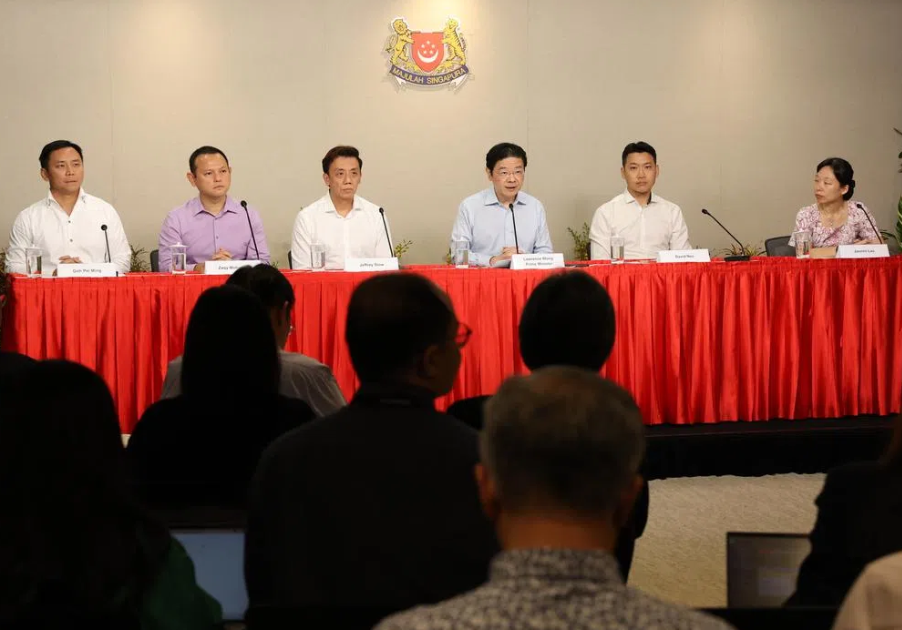
Prime Minister Lawrence Wong has unveiled a restructured Singapore Cabinet that shifts significant responsibility to a newer generation of politicians while maintaining the steady guidance of seasoned leaders, a balancing act that comes amid recent high-profile political departures. The announcement on July 22 marks the latest phase in Singapore's carefully managed leadership renewal, one that reflects the government's dual imperative to address immediate national challenges whilst preparing fresh talent for long-term stewardship of the nation.
The reshuffle elevates several first-term Members of Parliament elected in 2025 to expanded ministerial portfolios. Jeffrey Siow and David Neo, both newcomers to Parliament in the last general election, will transition from acting roles to full ministerial appointments. Siow, who has been managing transport affairs in an acting capacity since May 2025, and Neo, who has held the portfolio for culture and community development in a similar arrangement, will formally assume their respective positions. This progression reflects the government's confidence in their ability to handle substantive policy responsibilities following what Wong characterised as successful performances in their provisional assignments.
The Cabinet changes extend beyond simple promotions. Jasmin Lau, another first-term politician, will assume a leadership position within the Manpower Ministry as acting minister, taking over the portfolio from Tan See Leng. The latter transitions sideways to helm the Ministry of Trade and Industry with a focus on energy and industry matters, a shift that redistributes ministerial energy across economic portfolios. Two additional first-term backbench MPs, Foo Cexiang and Shawn Loh, both former senior civil servants, ascend to minister of state positions, broadening the base of mid-tier executive authority among newer parliamentary members.
Simultaneously, Singapore has moved to preserve institutional continuity by consolidating senior ministerial roles. K. Shanmugam transitions to Senior Minister status, joining Senior Minister Lee Hsien Loong in a category reserved for the government's most experienced operators. Labour chief Ng Chee Meng, a long-serving figure in Singapore's political ecosystem, returns to Cabinet as Minister in the Prime Minister's Office following a period away from frontline ministerial duties. Sim Ann, another incumbent, gains expanded responsibility as Second Minister covering both Foreign Affairs and Home Affairs portfolios, positioning her at the intersection of Singapore's most strategically sensitive policy domains.
PM Wong framed the reshuffle as a deliberate exercise in governance architecture, emphasizing that Singapore requires both the accumulated wisdom of experienced leaders to navigate immediate pressures and the dynamism of emerging figures to chart a sustainable course. He noted that the promoted politicians have earned the confidence not merely of their political colleagues but of the civil service machinery they direct, an achievement he identified as prerequisite for elevation. The changes commence progressively from July 27, with some modifications taking effect subsequently, allowing for administrative transition and ensuring no abrupt disruption to governmental operations.
The timing of the reshuffle reflects both cyclical governance practice and reactive necessity. While Cabinet composition undergoes annual review in Singapore's system, Wong acknowledged that the 2026 reshuffle was catalysed by two unexpected departures that created immediate vacancies and forced recalibration of ministerial responsibilities. Faishal Ibrahim, previously Senior Minister of State for Home Affairs and Acting Minister-in-charge of Muslim Affairs, resigned on July 20 citing a judgment lapse in personal conduct involving interactions with a woman. Earlier, in June, Koh Poh Koon stepped down from political office, a senior minister of state departing on grounds of family considerations. These departures necessitated urgent restructuring whilst creating opportunities for broader renewal.
Wong's approach to succession planning suggests a measured philosophy distinct from abrupt generational transitions. He characterised his search for a successor in the finance portfolio, which he has held since 2021, as a "work in progress," indicating that readiness for senior appointment varies individually and cannot be accelerated artificially. The Prime Minister emphasised that his evaluative function involves assessing when politicians mature sufficiently for enlarged responsibilities and positioning them strategically where their contributions maximise benefit for Singapore. This incremental approach contrasts with models that rotate senior leaders according to predetermined timeframes, instead privileging demonstrated competence and peer respect as advancement criteria.
The structural decision to maintain a single deputy prime minister alongside Gan Kim Yong, rather than appointing a second, reflects Wong's judgment about institutional architecture. He characterised the current configuration as providing adequate senior leadership capacity whilst remaining flexible to adjustment as renewal proceeds. To buttress executive coordination across the sprawling administrative apparatus, the Cabinet incorporates three coordinating minister positions, including Shanmugam's oversight of national security, alongside Chan Chun Sing and Ong Ye Kung, who coordinate other governmental spheres. This matrix of senior roles distributes strategic responsibility horizontally whilst preserving clear lines of authority.
For regional observers including Malaysian stakeholders, Singapore's Cabinet reshuffle illustrates competing governance challenges evident across Southeast Asia. The imperative to groom successor generations while preserving institutional knowledge and leadership quality confronts most regional governments navigating demographic and political transitions. Singapore's approach emphasizes meritocratic progression validated through administrative performance rather than seniority alone or factional accommodation, a model contrasting with systems relying more heavily on party structures or personal networks. The elevation of first-term politicians to substantial roles signals confidence in parliamentary institutions' ability to identify and develop talent, whilst parallel retention of experienced figures acknowledges that governance complexity requires accumulated judgment.
The reshuffle also underscores Singapore's vulnerability to sudden departures among senior political figures, prompting continuous attention to succession pipelines. Wong's explicit reference to the need for "strong pipeline" development encompassing not merely ministers but younger parliamentarians and quality backbenchers reflects recognition that political systems depend on deep benches of capable individuals. The government's willingness to trial first-term MPs in acting ministerial roles prior to formal appointment suggests institutional confidence in evaluation mechanisms and demonstrates gradualism in testing readiness for senior authority.
Moving forward, this Cabinet configuration tests whether first-term politicians can translate acting arrangements into substantive policy leadership whilst working collaboratively with reshaped senior guidance structures. The outcome will partly determine whether Singapore's deliberately iterative approach to leadership transition—building new ministers through progressive responsibility rather than sudden elevation—successfully balances institutional renewal with operational consistency. For regional observers, the reshuffle illustrates how stable political systems manage generational transitions through carefully calibrated institutional mechanisms rather than episodic restructuring, though the ongoing challenge of identifying truly capable successors remains universal among Southeast Asian governments.

