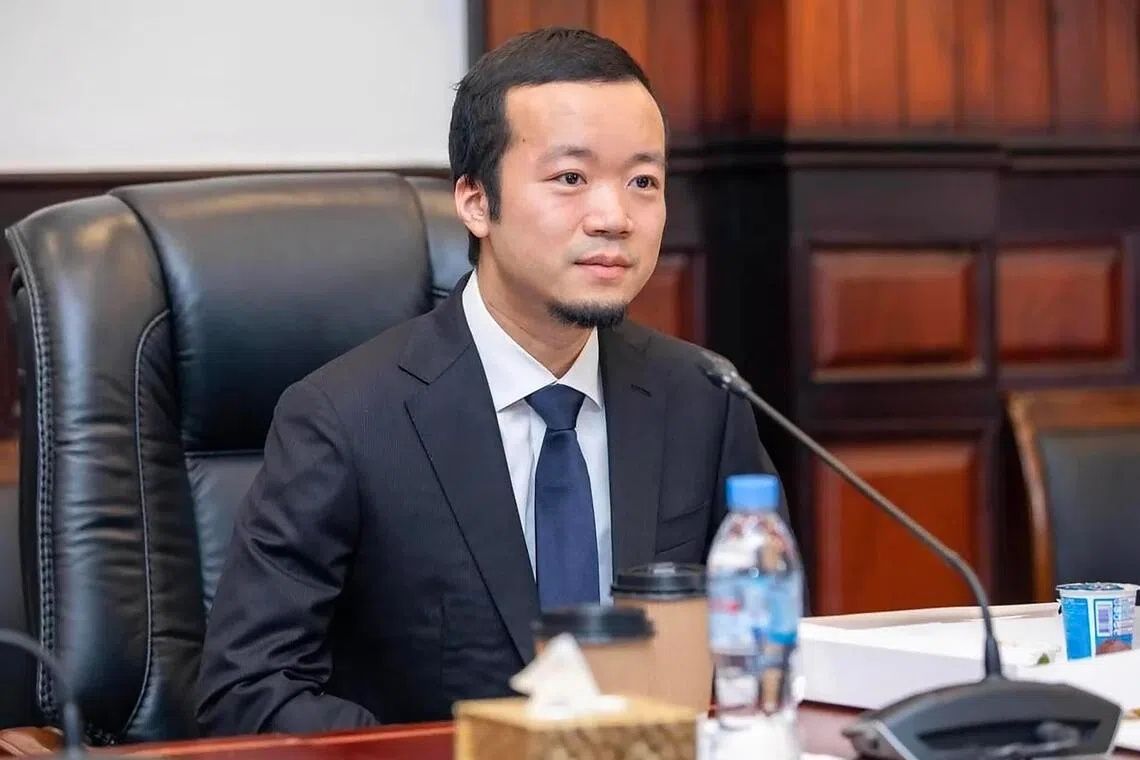
A sprawling investigation spanning six months has revealed how one of the world's largest criminal syndicates exploited Singapore's financial infrastructure and real estate market to build a sophisticated money-laundering operation. Chen Sokly, identified as the second co-conspirator in a criminal case brought by US prosecutors in October 2025, emerged as a crucial figure in the multi-billion dollar Prince Holding Group, which orchestrated investment fraud and enslaved workers in Cambodian scam compounds. Working alongside scam kingpin Chen Zhi, Sokly accumulated a significant portfolio of assets across Singapore, the United States, and elsewhere, even as the syndicate's illicit activities generated an estimated US$30 million per day.
The investigation, conducted by The Straits Times in partnership with the Organised Crime and Corruption Reporting Project, required painstaking analysis of hundreds of pages of official records to piece together Sokly's identity and operations. Born in Shanghai in 1986 as Chen Xing, Sokly strategically reinvented himself by obtaining Cambodian citizenship around the end of 2017, later adding Cypriot citizenship to his collection of legal identities. In Singapore, he cultivated a separate persona as Martin Chen, a wealthy businessman, while maintaining corporate structures and real estate holdings under various names. This deliberate fragmentation of identity across jurisdictions reflects a deliberate strategy to obscure beneficial ownership and complicate law enforcement investigations—a tactic increasingly common among transnational organised crime networks operating in Asia.
Sokly's role within the Prince Group extended far beyond routine management. According to the US indictment, Chen Zhi specifically tasked him with overseeing the syndicate's risk control function, a euphemism for monitoring law enforcement activities and engaging in systematic corruption of government officials worldwide. Documents recovered by US authorities revealed the extent of Sokly's connections: he maintained contacts within Chinese government circles who promised to shield Prince Group members from legal jeopardy, while simultaneously directing local police officers to extort businesses on behalf of the organization. In one particularly brazen instance documented in prosecutors' files, Sokly allegedly arranged for a Chinese official's son to receive special treatment in exchange for protection, underscoring how personal relationships and family obligations became weaponized within the criminal network.
The sophistication of the group's corruption apparatus becomes evident in examining Sokly's role as facilitator and enforcer. A ledger of bribes kept by Chen Zhi and discovered during the investigation showed that in 2019, Sokly purchased a yacht valued at more than US$3 million specifically as a bribe for a foreign government official. This level of corruption penetration—reaching into multiple countries' administrative structures—enabled the syndicate to operate with relative impunity across borders. Beyond his functions as a fixer and corrupted official liaison, Sokly also served as an enforcer willing to deploy violence against members who threatened the group's interests, demonstrating the duality of his role as both sophisticated businessman and operational enforcer.
Singapore emerged as a crucial hub in Sokly's operations, reflecting the island's status as a regional financial and real estate centre attractive to high-net-worth individuals. In 2017, Sokly announced his arrival with the purchase of an S$11 million luxury apartment at 10 Leedon Heights, a prestigious residential address in Singapore's prime district. This purchase served multiple purposes: establishing a base of operations, signalling wealth and legitimacy within Singapore's elite circles, and creating a platform for investments in the local corporate landscape. Over the subsequent two years, he incorporated multiple companies and registered as director of at least 16 Singapore firms, concentrating them around a shared address in Shenton Way's commercial district. This clustering of entities, combined with rapid changes in directorship between 2020 and 2023, suggests a deliberate pattern of entity rotation designed to obscure the true beneficial owners and the flow of funds through the structures.
Sokly's Singapore presence, while significant, appears to have been part-time and carefully compartmentalized. Former employees, who requested anonymity due to safety concerns, revealed that Sokly typically spent only two to three months annually in the city-state, using his time for entertainment and relationship-building with associates including Chen Zhi himself. His lifestyle reflected his access to illicit wealth: he maintained a fleet of luxury vehicles including a Bentley and a seven-seater at his Leedon Heights residence, indicators of conspicuous consumption intended to reinforce his status within both criminal and ostensibly legitimate business circles. The deliberate separation of his time between Singapore, the United States, and Cambodia allowed him to maintain operational deniability while simultaneously leveraging each jurisdiction's particular advantages—Singapore's financial infrastructure and real estate appeal, the US for property acquisition, and Cambodia for the underlying scam operations.
Property records obtained by investigators painted a revealing picture of asset accumulation and strategic transfers in the United States. In 2019, Sokly purchased a California home from Fang Zhizhen, himself a member of the Knight Attack Group, a cybercriminal syndicate that predated the Prince Group. This transaction demonstrates how criminal networks intersect and collaborate, with Sokly effectively joining a broader ecosystem of organised cybercrime operators. Five years later, he sold that same property for approximately US$4.5 million, realizing substantial gains that remain untraceable to legitimate sources of income. More tellingly, in November 2025—just weeks after sweeping US sanctions targeted the Prince Group—Sokly transferred ownership of a separate US$4 million property to his wife, a classic asset protection manoeuvre designed to place wealth beyond reach of government seizure. The subsequent placement of this property into a trust operated by his wife in December 2025 represents a sophisticated layering technique within money-laundering frameworks.
The US government's response to the Prince Group's activities underscores the scale and severity of the conspiracy. In October 2025, prosecutors secured the forfeiture of 127,271 bitcoins valued at approximately US$15 billion at the time of seizure, representing one of the largest financial fraud takedowns in history. Remarkably, just six days after this indictment was unsealed, the US dropped all sanctions against Chen Zhi, the Prince Group, and its affiliates—a decision that raised questions about diplomatic negotiations or settlements behind the scenes. This timing suggests either that the indictment served primarily symbolic purposes, or that higher-level diplomatic considerations superseded prosecution objectives. For Southeast Asian observers, the episode demonstrates how major cybercrime operations can leverage regional vulnerabilities, particularly Cambodia's limited capacity to regulate technology-enabled scams and Singapore's attractiveness as a financial hub.
The identification of Sokly as a central figure in the syndicate carries significant implications for how regional governments approach money-laundering prevention and beneficial ownership transparency. His creation of multiple legal identities, strategic use of different jurisdictions' corporate registration systems, and deliberate compartmentalization of assets represent a masterclass in evading financial oversight mechanisms that Southeast Asian countries have struggled to strengthen. The fact that he operated from Singapore, one of the region's most developed financial centres with robust regulatory frameworks, highlights how determined transnational criminals can exploit even sophisticated systems through patience, compartmentalization, and corrupting key officials. The investigation's ability to unmask these networks depended entirely on collaborative journalism and law enforcement cooperation—precisely the kind of cross-border intelligence sharing that remains inconsistent across Southeast Asia.
For Malaysia and other regional economies, the case illustrates vulnerabilities that extend beyond Singapore's experience. The Prince Group's fundamental source of illicit revenue—workers trafficked to Cambodian scam compounds—represents a human trafficking and modern slavery crisis with regional dimensions. Malaysian nationals have been documented among victims of such operations, often deceived by recruitment schemes promising overseas employment. The sophistication with which syndicate members like Sokly laundered proceeds through legitimate property purchases, corporate structures, and financial instruments demonstrates that countering such networks requires not only stronger anti-money-laundering regulations but also improved information-sharing between regional financial intelligence units. The involvement of multiple nationalities—Chinese operatives, Cambodian citizenship, Singapore residency, US properties—underscores how transnational organised crime exploits the patchwork of regulatory approaches across Asia-Pacific jurisdictions.
The broader strategic context reveals how regional crime syndicates have evolved beyond traditional organised crime patterns. The Prince Group's systematic corruption of government officials across multiple countries, combined with its technological sophistication and ability to generate massive daily revenues, reflects an emerging threat category: highly organised, digitally-enabled criminal enterprises with international reach and significant resources. Sokly's role demonstrates how such networks recruit specialized talent—sophisticated financial operators, corruption facilitators, and enforcement personnel—creating hierarchical structures that rival legitimate multinational corporations. For Southeast Asian policymakers, the case underscores the necessity of strengthening beneficial ownership registries, enhancing cross-border regulatory cooperation, and improving capacity to detect and interdict high-value money-laundering schemes before assets become entrenched in legitimate real estate and financial markets.

