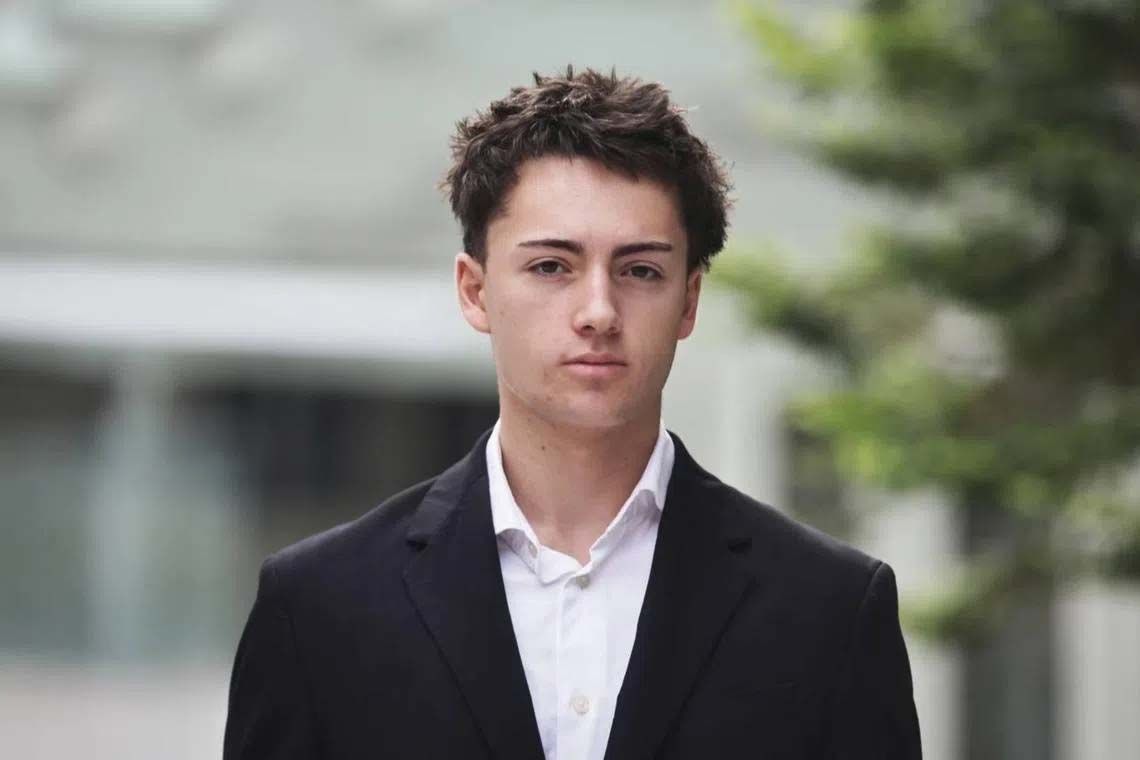
A Singapore court has convicted a 19-year-old man for his part in a viral social media stunt that saw him deliberately contaminate a public vending machine straw, resulting in significant operational losses for the juice company involved. Didier Gaspard Owen Maximilien received a $600 fine on July 30 after pleading guilty to one count of causing public nuisance, marking the conclusion of a case that highlighted the real-world consequences of internet pranks conducted in shared spaces.
The incident unfolded in mid-March when Maximilien visited a boxing class at Goldhill Centre on Thomson Road. Following his training session, he approached an iJooz vending machine—the Singapore-based company known for dispensing freshly squeezed orange juice through its network of automated outlets. Rather than simply purchasing a beverage, he filmed himself deliberately licking a straw he had extracted from the machine's dispenser before returning it and then retrieving the same contaminated item for use. The footage was subsequently edited and uploaded to his Instagram account as a story.
What Maximilien likely intended as a momentary viral stunt with his immediate followers quickly spiralled beyond his control. Someone within his circle of Instagram followers screen-recorded the footage and shared it with media outlets, transforming a private digital joke into a widely circulated piece of content. The viral spread prompted iJooz's operations team to take the contamination threat seriously—the company responded by replacing all 500 straws in the affected vending machine dispenser, a precautionary measure that underscored the potential health risks posed by such actions in food and beverage service environments.
The company's assistant operations manager filed a formal police report on March 25, more than a week after the incident, once the video had achieved significant online circulation. This bureaucratic delay reflected the time required for the viral content to reach sufficient prominence to trigger operational awareness and response protocols. The police subsequently launched an investigation into the matter, eventually charging Maximilien under Singapore's public nuisance provisions—laws designed to protect communal spaces and public health.
During court proceedings, the prosecution's approach evolved based on practical and administrative considerations. Initially, probation had been contemplated as a potential outcome, but Deputy Public Prosecutor Maximilian Chew ultimately recommended a monetary fine instead. His reasoning centred on Maximilien's imminent departure to France for tertiary studies commencing in September through December, which would have rendered probation supervision logistically impractical. Chew explicitly stated that a short detention order was unwarranted, as the severity threshold for custodial punishment had not been breached.
The prosecution's stance was further complicated by immigration considerations. The case raised questions about whether Maximilien's student pass status would be affected by his conviction, with the Immigration & Checkpoints Authority needing to make a determination. Chew clarified that the prosecution's sentencing recommendation remained independent of the eventual decision on his pass, establishing a clear separation between criminal justice outcomes and immigration consequences—though the latter remained a possibility.
Maximilien's defence counsel, Kalidass Murugaiyan, concurred that a fine represented the most suitable penalty. The defence strategy emphasised several mitigating factors: the contaminated straw was never actually used by any member of the public, significantly reducing tangible harm; Maximilien was merely a teenager at the time of the offence; and the viral amplification resulted from his immediate circle's actions rather than deliberate mass distribution on his part. Murugaiyan presented his client as someone who genuinely recognised the gravity of his actions, noting that what had seemed like playful content had become unexpectedly consequential.
The defence also highlighted important family context, noting that Maximilien's parents had actively counselled him on personal responsibility and the serious implications of his conduct. This element of remorse and family guidance evidently influenced the court's assessment. District Judge Kelly Ho acknowledged in her sentencing remarks that community-based alternatives or probation would ordinarily merit consideration given Maximilien's youth and the specific circumstances. However, she agreed with both prosecution and defence that the logistical impediments—particularly his imminent relocation to France—made alternative sentencing impractical.
The $600 fine ultimately imposed sits at the lower end of possible penalties for public nuisance offences under Singapore law, where offenders can face up to three months imprisonment, fines reaching $2,000, or both. This lenient outcome reflected recognition of Maximilien's age, his lack of prior criminal history, genuine remorse, and the indirect nature of the harm caused. The case underscores how viral social media content, even when intended as entertainment within private circles, can trigger serious legal consequences once amplified through digital channels.
For Malaysian readers and Southeast Asian observers, the case illustrates the region's increasingly strict approach to internet-based conduct affecting public health and commercial interests. Singapore's decision to prosecute demonstrates that the perceived anonymity and youth of social media creators offer no shield against criminal liability when their actions compromise public spaces or cause material losses to businesses. The incident also reflects broader concerns across Southeast Asia about food and beverage safety, where contamination incidents—whether deliberate pranks or negligent acts—can generate regulatory and public health scrutiny.
The case carries particular resonance in light of similar viral challenges that have periodically emerged across social media platforms throughout Asia. Authorities across the region have grown increasingly vigilant about prosecuting such behaviour, recognising that permitting internet stunts in commercial or public-facing environments normalises contamination risks. Maximilien's experience serves as a cautionary tale for young content creators, illustrating that acts undertaken for brief online entertainment can result in criminal records, fines, and complications to future educational or employment prospects—consequences that extend far beyond the momentary digital gratification sought.

