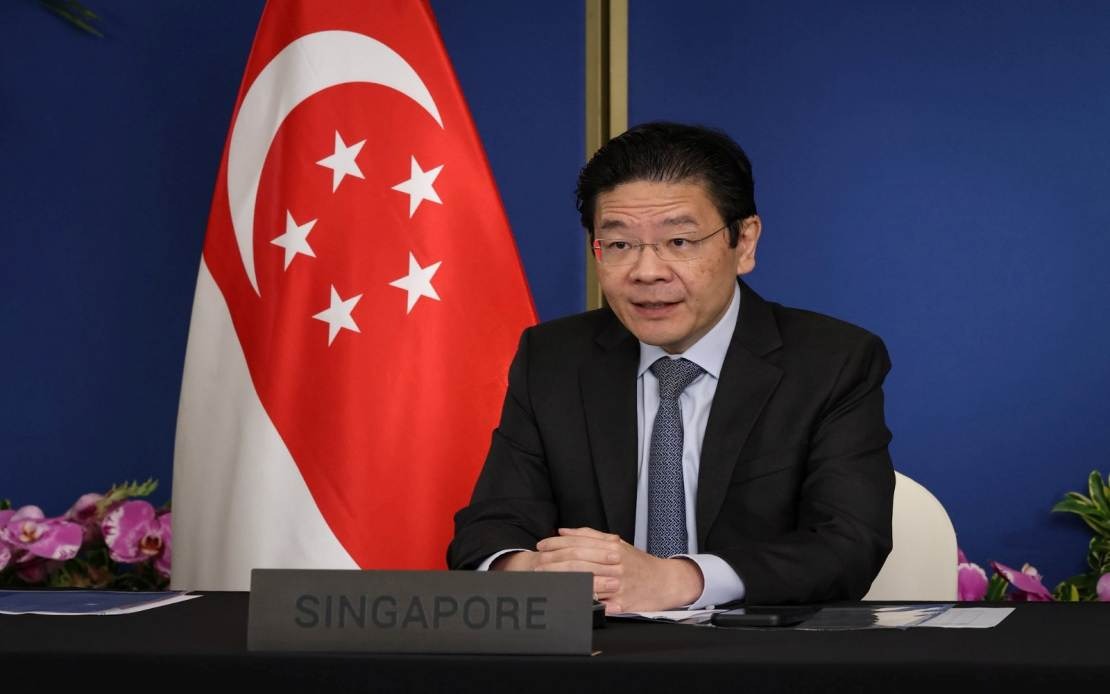
Singapore Prime Minister Lawrence Wong has orchestrated a comprehensive cabinet reshuffle designed to accelerate the rise of the nation's next generation of leaders while preserving institutional continuity through the retention of seasoned figures in critical positions. Announced on Wednesday, the restructuring represents a carefully calibrated transition that reflects Singapore's strategic approach to leadership succession at a critical juncture for the city-state.
The appointments will principally take effect on July 27, with the exception of a small number of positions, according to an official statement from the Prime Minister's Office. Among the most significant moves, K. Shanmugam has been elevated to Senior Minister, a role that acknowledges his decades of experience in national security matters. Shanmugam will maintain his concurrent responsibilities as Coordinating Minister for National Security and Minister for Home Affairs, positions that underscore his enduring influence over Singapore's most sensitive policy domains. In doing so, he joins Senior Minister Lee Hsien Loong, the country's founding Prime Minister's son and a towering figure in Singapore's political establishment, as one of the two most senior ministerial voices in Wong's administration.
Wong emphasized during a press conference that the retention of these experienced statesmen serves a mentoring function essential to Singapore's institutional health. The Prime Minister articulated a deliberate philosophy in which Shanmugam and Lee will "provide valuable counsel and help guide and mentor our younger officeholders." This framing reveals a sophisticated understanding of Singapore's succession challenge: the nation must simultaneously prepare a new cohort of leaders for autonomous decision-making while avoiding the institutional memory loss that can accompany generational transitions. For regional observers, this approach offers a template for how small, tightly managed political systems navigate leadership change without sacrificing strategic coherence.
A marquee feature of the reshuffle involves a structural reorganization of Singapore's economic machinery. The Ministry of Trade and Industry will be renamed the Ministry of Energy, Trade, and Industry effective October 1, a rebrand that signals the government's elevated prioritization of energy security and industrial transformation. This expanded ministry will operate under a dual leadership model, with Deputy Prime Minister Gan Kim Yong and Tan See Leng jointly stewarding the portfolio. Gan will retain oversight of Singapore's international trade relationships and macroeconomic strategy, a remit that reflects his standing as potential successor material. Tan, meanwhile, will concentrate on energy and industrial policy, a concentrated focus that represents a substantial elevation from his previous role as Minister-in-charge of Energy and Science and Technology. By relinquishing his Ministry of Manpower responsibilities, Tan gains the bandwidth to address Singapore's critical energy transition challenges.
The promotion of Jeffrey Siow and David Neo to full ministerial rank signals the advancement of officials who have demonstrated competence in their portfolios. Siow assumes the title of Minister of Transport, while Neo becomes Minister for Culture, Community and Youth, maintaining their existing policy domains while gaining the formal seniority that a full ministerial designation confers. These elevations represent recognition of performance rather than dramatic policy shifts, providing stability in crucial sectors affecting citizens' daily lives and social cohesion.
Among the junior ministerial ranks, Sim Ann's promotion to Second Minister of Foreign Affairs and Home Affairs places her in a position where she can accumulate expertise in two governmentally demanding portfolios. Jasmin Lau's appointment as Senior Minister of State for the Ministry of Digital Development and Information simultaneously positions her as Acting Minister of Manpower, a dual responsibility that suggests leadership potential alongside practical ministerial experience. Goh Pei Ming's elevation to Senior Minister of State for Social and Family Development and Home Affairs further accelerates the career trajectories of officials earmarked as successor material.
The appointments also reflect Singapore's institutional depth and the deliberate dispersal of responsibilities across multiple officials. Alvin Tan's appointment as Minister of State in the Ministry of Foreign Affairs, coupled with his retention in the Ministry of National Development and relinquishment of Ministry of Trade and Industry responsibilities, demonstrates the fluid reallocation of portfolios that characterizes Singapore's merit-based administrative apparatus. Ng Chee Meng, elevated from his role leading the National Trades Union Congress, becomes Minister in the Prime Minister's Office, a position that typically signals grooming for higher responsibilities. Zhulkarnain Abdul Rahim joins as Minister of State in the Ministry of Foreign Affairs and Home Affairs, while new entrants Foo Cexiang and Shawn Loh assume ministerial positions in manpower, trade, and industry portfolios, alongside education and health respectively.
Wong's articulation of the reshuffle's underlying rationale provides valuable insight into Singapore's succession philosophy. He emphasized that the government requires "both experienced leaders to steer through immediate challenges and a new generation ready to take us forward." This formulation acknowledges that Singapore confronts concurrent pressures demanding seasoned judgment—likely encompassing geopolitical tensions in the Taiwan Strait, regional economic competition, and China's evolving strategic posture—while needing to prepare leaders capable of addressing emerging challenges such as energy transition, artificial intelligence governance, and demographic headwinds. The cabinet structure thus reflects a deliberately asymmetrical distribution of burdens between senior and junior officials.
For Malaysian and broader Southeast Asian readers, Singapore's approach to leadership transition offers instructive contrasts with regional practice. Unlike some neighbors where succession planning remains politically fraught and opaque, Singapore's structured, announced elevation of younger officials creates transparency and reduces uncertainty about institutional continuity. The elevation of multiple officials rather than concentration of power in a single successor also distributes leadership capacity across the administration, reducing single-point-of-failure risks. Moreover, the retention of experienced figures like Shanmugam and Lee Hsien Loong suggests that Singapore's political elite views institutional stability and policy continuity as more valuable than rapid generational turnover.
The restructuring of the Ministry of Trade and Industry into the Ministry of Energy, Trade, and Industry carries particular significance for Singapore's regional economic role and energy security posture. The elevation of energy policy to ministry-level prominence, rather than relegating it to a subordinate portfolio, reflects Singapore's acute consciousness of its energy vulnerability and dependence on regional and global energy markets. As Southeast Asia grapples with the energy transition, Singapore's institutional repositioning may prefigure regional energy diplomacy dynamics and power supply competition among ASEAN members. Malaysia and other energy-producing nations will likely monitor whether Singapore's expanded energy ministry signals more assertive energy procurement strategies in the region.
The timing of the reshuffle, positioned between Prime Minister Wong's own accession to office in 2024 and the longer-term succession horizons now visible, suggests that Singapore is consolidating Wong's personal leadership team while simultaneously preparing the administrative bench for his eventual successor. By promoting multiple capable officials concurrently rather than designating a single heir apparent, the government preserves optionality regarding future leadership direction. This approach differs markedly from more hierarchical succession patterns observed elsewhere in the region and reflects Singapore's institutional pragmatism regarding leadership selection.
Ultimately, Wong's cabinet reshuffle embodies a sophisticated attempt to reconcile competing imperatives: maintaining policy continuity through retained senior figures, accelerating the development of promising junior officials through enhanced responsibilities, and preserving institutional flexibility regarding future succession pathways. Whether this balance successfully navigates Singapore's immediate regional and global challenges while adequately preparing the next generation of leaders will only become apparent through subsequent years of performance and policy outcomes.

