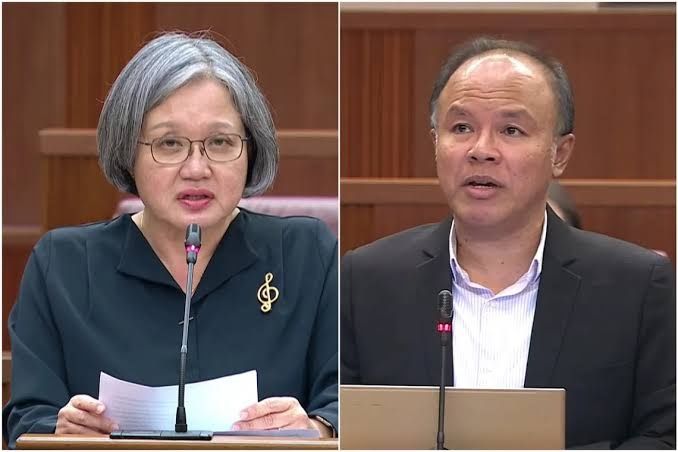
Singapore's Parliament has formally concluded its protracted investigation into Workers' Party leaders Sylvia Lim and Faisal Manap, determining that no further penalties can be imposed against them for misleading a parliamentary committee. Leader of the House Indranee Rajah delivered this outcome in a ministerial statement on July 7, marking the end of a controversy that has dominated Singapore politics since 2021 and casting light on the technical intricacies of parliamentary privilege law in the city-state.
The case traces back to former Sengkang GRC MP Raeesah Khan's fabrication of a police anecdote during parliamentary remarks in 2021. A subsequent parliamentary investigation found that Khan had knowingly deceived Parliament, and that Lim, Faisal, and party leader Pritam Singh had either encouraged the deception or lied about discussing it when questioned by Parliament's Committee of Privileges. The committee's findings subjected all three to potential sanctions under the Parliament (Privileges, Immunities and Powers) Act, a statute designed to preserve the integrity of legislative proceedings by punishing those who deliberately mislead Parliament or its committees.
The legal impediment that now prevents action against Lim and Faisal exemplifies the procedural constraints embedded within Singapore's parliamentary system. Under Section 22 of the PPIPA, Parliament possesses the authority to penalize offences occurring either during the current session or the immediately preceding session of Parliament. Because Lim and Faisal's misconduct transpired during the first session of the 14th Parliament, and because the 15th Parliament—which commenced following the 2025 general election—has now begun a new session, the temporal window for imposing disciplinary measures has definitively closed. Indranee acknowledged this constraint with candour, stating that had the timeline been different, she would have proposed a more stringent course of action.
The delay that ultimately rendered sanctions impossible stemmed from Parliament's earlier decision to exercise clemency toward Lim and Faisal while allowing Pritam Singh's case to proceed through the criminal justice system. Because Pritam's conduct was deemed substantially more culpable—he allegedly instructed Khan to conceal her lie—Parliament chose to treat his case through prosecution by the public prosecutor rather than through parliamentary discipline, affording him the formal protections of criminal proceedings and legal representation. Lim and Faisal, characterized as playing merely a subsidiary role in the misconduct, were permitted to await the outcome of Pritam's legal proceedings. This magnanimous approach proved consequential, as the intervening years witnessed Pritam's conviction by the District Court in February 2025, an appeal to the High Court, and final upholding of his conviction in December 2025.
Pritam Singh's judicial conviction represented a watershed moment, as it independently confirmed the Committee of Privileges' original findings regarding Lim and Faisal's dishonesty. The High Court's determination that Pritam had lied to Parliament simultaneously validated the committee's conclusion that both Lim and Faisal had similarly deceived the institution by denying that discussions concerning Khan's falsehood had occurred during their meeting with Pritam. Indranee explicitly noted that this judicial confirmation should have triggered her instigation of disciplinary proceedings under the PPIPA, a process that ordinarily concludes swiftly within a single parliamentary session.
The expiration of the statutory time limit reflects a fundamental tension within parliamentary governance: the balance between procedural fairness and timely resolution. Indranee's statement acknowledged that while Parliament had acted with restraint in allowing Pritam's criminal case to conclude before addressing Lim and Faisal, this restraint inadvertently permitted the technical requirements of the law to render the intended discipline unenforceable. The dissolution of the 14th Parliament and commencement of the 15th Parliament created a new parliamentary term, resetting the clock for prosecuting parliamentary offences. This outcome illustrates how parliamentary proceedings cannot indefinitely defer action without risking legal defences based on temporal limitations, a principle Indranee emphasized when she noted that even though circumstances might have warranted different treatment, the statutory provisions of the PPIPA must be respected.
Parliament retains one residual avenue for expressing institutional displeasure: the passage of a motion signalling disapproval of Lim and Faisal's conduct. However, Indranee contended that such a measure would prove redundant, given that Parliament had already demonstrated unambiguous repudiation of parliamentary dishonesty through its January motion declaring Pritam Singh unsuitable as Leader of the Opposition. This earlier motion served as Parliament's categorical statement that those who mislead Parliament or its investigative bodies forfeits fitness for senior roles, effectively communicating the House's moral judgment without imposing formal penalties.
For Malaysian observers, this episode offers instructive parallels regarding parliamentary accountability mechanisms and the interplay between formal procedure and substantive justice. Malaysia's own Parliamentary Privileges Act similarly constrains parliamentary action through temporal limits and procedural requirements, meaning that protracted proceedings can render statutory remedies unavailable regardless of proven culpability. The Singapore case demonstrates that even in a developed Westminster-derived system with robust institutional structures, technical legal provisions can frustrate accountability efforts when investigations proceed through multiple stages over extended periods.
The Workers' Party itself had begun moving past the controversy even before Parliament's formal closure, with party members voting on June 28 to retain Pritam Singh as leader despite his conviction. This internal endorsement, coupled with Lim's statement that she had already articulated her response during January's motion, suggests that the political controversy has largely exhausted its immediate potency, even as the legal technicality now prevents formal parliamentary sanction. Lim emphasized that she had never been afforded the opportunity to present her defence in Pritam's criminal trial, having not been called as a witness, underscoring the asymmetry between court findings and her actual participation in proceedings.
Indranee's final remarks encapsulated the resignation inherent in this outcome: "Even though the Committee's findings have now been effectively confirmed by the High Court Judgement, the law, in this case the time bar provisions of PPIPA, must be observed." This statement captures the peculiar position of parliamentary institutions constrained by their own procedures—Parliament possessed both the authority and, arguably, the moral imperative to sanction Lim and Faisal once their misconduct was judicially confirmed, yet technical provisions rendered such action legally impossible. The incident underscores how legislative bodies worldwide must navigate the tension between maintaining flexible, summary disciplinary powers and adhering to fair procedural constraints that prevent arbitrary or delayed punishment.
For Singapore's political system, the closure of this four-year saga represents a transition from active controversy to historical precedent. The case has established that parliamentary oversight of member conduct, while powerful, operates within temporal bounds that may occasionally prevent formal sanction despite proven wrongdoing. As Southeast Asian legislatures continue examining their own parliamentary privileges regimes, Singapore's experience demonstrates both the utility of such mechanisms in protecting institutional integrity and the unintended consequences that can arise when investigations span multiple parliamentary terms. The episode ultimately illustrates that procedural adherence and substantive accountability do not always align perfectly, a reality that democratic institutions must acknowledge even as they strive to balance both objectives.

