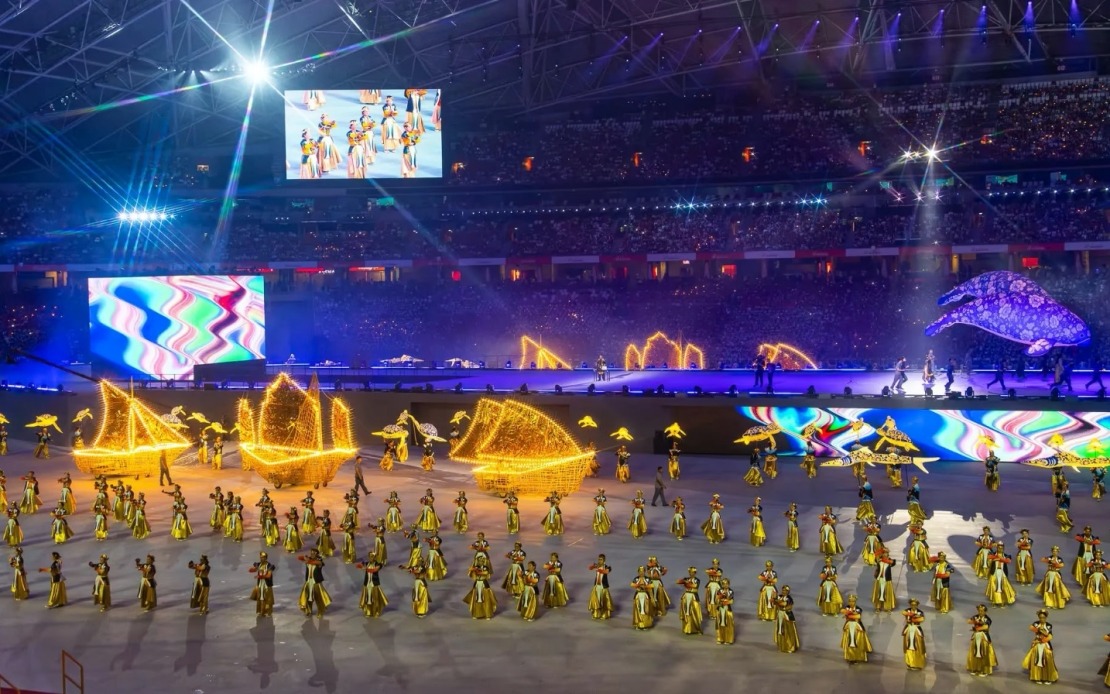
Singapore's 61st National Day celebration on August 9 marked a significant milestone for the city-state, with the National Day Parade making its long-awaited return to the National Stadium after an absence of ten years. Under the theme "Majulah Singapura, Go Beyond!", the ceremony drew approximately 42,000 members of the public, who filled the stadium in the traditional red and white colours that define the island nation's patriotic identity. The presence of President Tharman Shanmugaratnam and Prime Minister Lawrence Wong, alongside Cabinet ministers and Members of Parliament, underscored the national importance of the occasion and reflected the government's commitment to reviving this central ceremonial tradition.
What distinguished this year's celebrations was an innovative expansion of the traditional parade format. For the first time in Singapore's six-decade history, the Presidential Gun Salute and State Flag Flypast were conducted at Kallang Basin rather than solely within the stadium confines. This geographical extension allowed the spectacular elements of the ceremony to reach a far broader audience spread across the Kallang precinct, democratising access to the pageantry beyond those fortunate enough to secure stadium seating. The symbolic significance of this shift reflects contemporary thinking about inclusive national celebration—ensuring that geographical or socioeconomic constraints do not prevent Singaporeans from participating in shared moments of national identity.
The ceremonial centrepiece involved an unconventional deployment of military hardware on water. Four 25-pounder Howitzer guns, mounted on Mobility 3rd Generation rafts, circumnavigated Kallang Basin as part of the salute sequence, creating a visual spectacle that combined traditional martial ceremony with modern logistical innovation. This arrangement brought the experience considerably closer to thousands of additional spectators gathered across the wider Kallang area, extending the reach of what might have remained a stadium-bound event. The 151 participants from the 23rd Battalion of the Singapore Artillery and 35th Battalion of Singapore Combat Engineers who executed the traditional 21-gun salute represented the disciplined coordination characteristic of Singapore's military institutions.
The parade and ceremony segment commenced at approximately 6 pm and operated under the thematic framework of "Go Beyond Self", featuring 32 distinct contingents comprising more than 2,000 participants. This architecture of performance included six Guard of Honour contingents escorting the Singapore Armed Forces Colours Party, drawn proportionally from the Singapore Army, Republic of Singapore Navy, Republic of Singapore Air Force, newly established Digital and Intelligence Service, Singapore Police Force, and Singapore Civil Defence Force. The inclusive composition of the guard party reflects Singapore's contemporary security architecture, incorporating digital and intelligence capabilities alongside traditional military and civil defence branches—a recognition that modern national security transcends conventional military definitions.
The ten contingents from uniformed youth organisations and sixteen supporting contingents demonstrated the deep integration of youth engagement within Singapore's national ceremonial framework. This approach reflects a deliberate strategy of instilling national consciousness and civic responsibility in younger generations, channelling them through structured, uniformed organisations that combine discipline with patriotic purpose. For Malaysian observers, this structure offers insights into how Singapore maintains cohesion across a highly diverse population through carefully calibrated national rituals and youth mobilisation.
The evening's show segment, which followed the ceremony, represented a substantial theatrical production involving 36 artistes and more than 2,600 performers. This entertainment component served not merely as festive accompaniment but as a narrative vehicle communicating contemporary Singapore's self-image and aspirations. The performance centred on the broader "Majulah Singapura, Go Beyond!" theme, weaving together authentic Singaporean stories with displays of innovative technology and carefully composed musical accompaniment. The scale of this production—exceeding 2,600 performers—indicates the mobilisation of considerable artistic and logistical resources toward national celebration.
A particularly noteworthy element of this year's performance was the deliberate inclusion of dancers from diverse backgrounds, including an autistic dancer and a performer with Down syndrome. This choice carried profound symbolic weight, communicating an official message that every Singaporean possesses capacity to contribute meaningfully toward the nation's collective future, irrespective of background or ability status. Such visibility of differently-abled performers in the nation's premier ceremonial spectacle represents a progressive statement regarding inclusion and social values—positioning accessibility not as charitable afterthought but as integral to national identity and capability.
The return of the parade to the National Stadium after a decade-long absence carries significance beyond mere venue selection. The stadium functions as a potent symbol of Singapore's national gathering space, and its reclamation for National Day purposes represents a recommitment to large-scale, physically assembled national celebration at a moment when digital and dispersed forms of commemoration have become increasingly common. This choice implicitly affirms the irreplaceable value of co-present, embodied national ritual—the gathering of thousands in unified space, dressed in national colours, experiencing shared ceremonial moments.
For the regional context within which Malaysia operates, Singapore's National Day evolution offers instructive parallels and contrasts. Both nations employ military pageantry, youth organisation contingents, and carefully curated performances as components of national day ceremonies. However, Singapore's willingness to adapt traditional formats—as evidenced by the Kallang Basin expansion and the deliberate inclusion of differently-abled performers—suggests an ongoing negotiation between tradition and contemporary social values. The ceremonial architecture communicates messages about national identity, inclusion, security priorities, and societal aspirations to both domestic and international audiences.
The theme "Majulah Singapura, Go Beyond!" itself merits analytical attention as it suggests forward-looking ambition transcending existing boundaries or limitations. In the context of a mature, highly developed city-state, such messaging arguably addresses questions of continued relevance and dynamism in the coming decades—how Singapore maintains competitive advantage, social cohesion, and national purpose amid ongoing regional and global transformation. The ceremonial emphasis on "going beyond" may be interpreted as addressing anxieties about stagnation or the adequacy of past models for future challenges.
The logistical complexity underlying these celebrations—coordinating 42,000 public spectators, over 2,600 performers, multiple military units, diverse youth organisations, and extended ceremonial spaces across Kallang Basin—reflects Singapore's considerable capacity for large-scale civic organisation. This capability, grounded in institutional efficiency and planning sophistication, represents a distinctive governmental competence that shapes the broader character of the city-state's approach to national governance and public engagement.
Ultimately, Singapore's 61st National Day celebration, with its return to the National Stadium and expansion into Kallang Basin, demonstrates how ceremonial tradition can evolve to accommodate contemporary values regarding inclusion, accessibility, and expanded civic participation while maintaining connection to established symbols and formats. The event functioned simultaneously as historical commemoration, national identity affirmation, and forward-looking statement about Singapore's trajectory and character.

