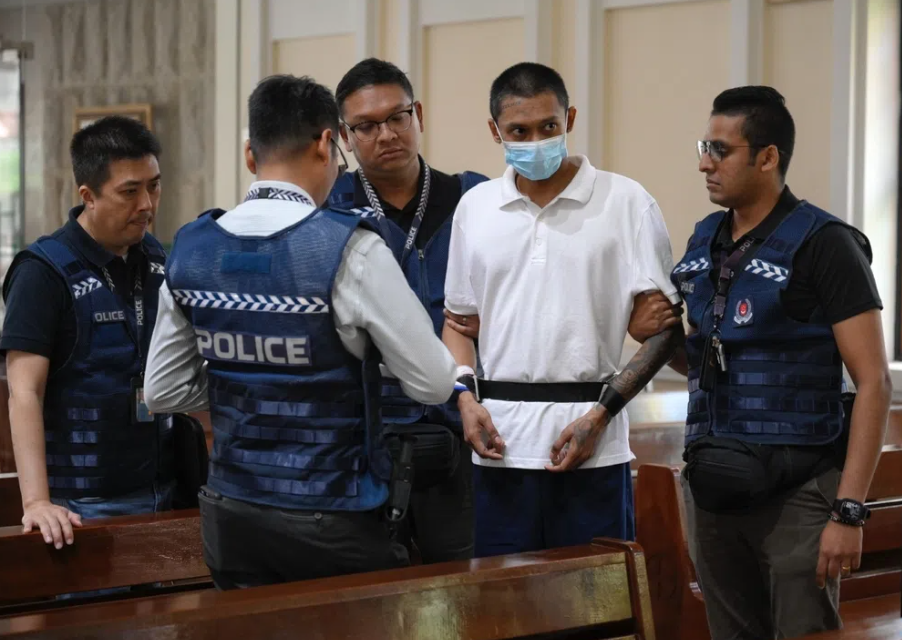
A Singapore court has imposed a sentence of four years and three months' imprisonment and nine strokes of the cane on Basnayake Keith Spencer, 38, for the violent attack on Reverend Christopher Lee at St Joseph's Church during an evening mass attended by approximately 900 parishioners. The case, which culminated in Friday's sentencing via video link, underscores the severe consequences for unprovoked violence in a place of worship and raises questions about mental health interventions and security in religious institutions across Southeast Asia.
The assault took place on November 9, 2024, during a children's mass when Basnayake, who had arrived at the church alone around 5.30pm, suddenly produced a 23-centimetre foldable knife with a 10-centimetre blade and stabbed Father Lee in the mouth as the priest administered communion. The attack occurred at the precise moment of this sacred ritual, a detail that District Judge Shaiffudin Saruwan emphasised carried particular gravity—the judge noted the "wholly unprovoked" nature of the incident and the "severe physical harm" inflicted on the "defenceless" priest. The incident left Father Lee with an 8-centimetre laceration on his tongue, a 3-centimetre wound on his upper left lip, and a 4-centimetre cut at the corner of his mouth, injuries that required hospitalisation and subsequent speech therapy.
Court proceedings revealed a troubling pattern regarding Basnayake's mental state and substance use. According to Deputy Public Prosecutor Xu Sijia's statement, Basnayake had consumed five pills in total before the assault—two to maintain focus upon arrival, and three more before communion to calm himself after realising the mass was specifically for children. The prosecution established that he was intoxicated and in a drug-induced psychotic state at the time of the offence, though the court determined he retained "a degree of awareness" when perpetrating the attack. This distinction proved crucial in the sentencing decision, as it positioned the act as volitional rather than entirely involuntary, warranting the substantial custodial sentence.
The incident itself unfolded with harrowing speed. When Basnayake initially queued behind a different priest, he inexplicably repositioned himself in Father Lee's line. Upon reaching the front, he withdrew his concealed knife and thrust it into the priest's mouth without warning. Father Lee's immediate reaction—stepping backward while bleeding heavily and grabbing Basnayake's rear pocket to prevent further violence—likely prevented escalation. Nearby congregants, including an off-duty police officer, quickly restrained Basnayake and alerted authorities. He was apprehended at the scene and subsequently denied bail in December 2024 after prosecutors described him as "a highly dangerous person with a high risk of reoffending."
Basnayake's criminal history compounds the seriousness of the St Joseph's Church incident. In 2019, he had been convicted of voluntarily causing hurt with a dangerous weapon following an assault on his then-girlfriend, whom he stabbed in the buttocks with a kitchen knife while under the influence of methamphetamine. That conviction resulted in a one-year jail sentence. His reoffending after serving that term, combined with evidence of multiple weapons discovered on his person—a 14.5-centimetre penknife, a flip knife, and a fishing gaff with a sharp hook—painted a portrait of an individual with persistent violent proclivities and concerning access to weaponry.
The sentencing process saw the prosecution seek a term between four years and three months and four years and eleven months, coupled with nine strokes of the cane. Basnayake's defence counsel from the Public Defender's Office, Ashwin Ganapathy, argued for a sentence of less than four years alongside the same caning, emphasising his client's remorse, regret, and shame. The judge ultimately sided substantially with the prosecution's recommendation, settling on the lower end of the suggested range at four years and three months. District Judge Shaiffudin Saruwan's reasoning focused on the unprovoked nature of the assault, the severity of injuries inflicted upon a vulnerable victim, and critically, the timing of the attack during administration of communion—an act with potential to trigger mass panic in a crowded venue of worshippers.
Father Lee's path to recovery underscores the lasting impact of violent crime on victims. Discharged from hospital six days after the November 9 attack, he was granted 40 days of hospitalisation leave and subsequently required speech therapy to address injuries to his mouth and tongue. The psychological trauma of such an assault, combined with the physical recovery process, represents a substantial burden that extends well beyond the initial wound treatment. For a priest in an active ministry, such injuries carried particular occupational implications, affecting his capacity to deliver sermons and administer religious functions.
The case resonates within Singapore's broader context of public safety in houses of worship. Churches, temples, mosques, and synagogues are generally regarded as sanctuaries, yet this incident demonstrates that religious institutions remain vulnerable to individuals experiencing mental health crises or substance abuse issues. The confluence of Basnayake's apparent undiagnosed or unmanaged psychological condition, access to multiple weapons, and substance consumption presents a cautionary scenario relevant not only to Singapore but to the wider Southeast Asian region, where similar incidents have prompted discussions about mental health infrastructure and security protocols in faith communities.
Having spent more than a year and nine months in remand awaiting trial and sentencing, Basnayake's total incarceration will extend to approximately six years from the date of arrest. The nine strokes of the cane, while significant, represents the maximum caning permitted for his particular offence without requiring judicial discretion to increase it. The sentence reflects judicial determination that the offence warranted punishment at the severe end of the permissible range, signalling that violent attacks on religious leaders constitute a category of crime demanding substantial deterrence. As Southeast Asian countries grapple with rising mental health challenges, substance abuse epidemics, and questions surrounding rehabilitation versus purely punitive approaches, the Basnayake case offers a sobering reminder that effective early intervention, accessible mental health services, and weapon control mechanisms remain critical to public safety.

