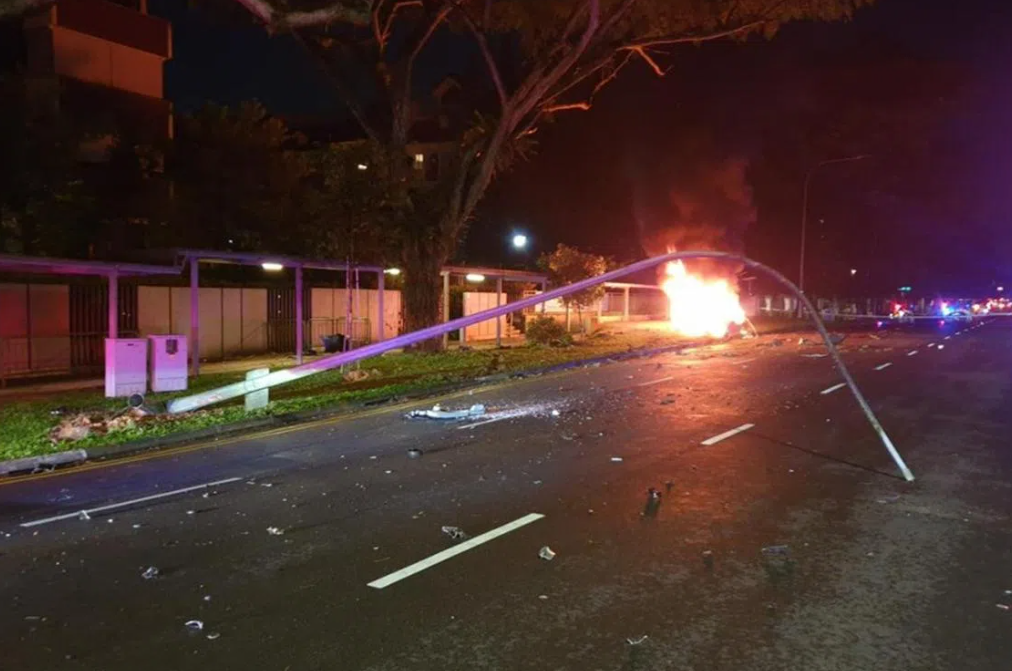
A Singapore man faces five serious driving charges stemming from a chaotic early-morning incident that endangered the lives of schoolchildren and multiple road users. Aaron Tan Yao Cong, 29, was charged in court on June 18 following the March 6, 2024 incident, which saw his vehicle collide with a private bus carrying two young passengers, aged nine and 10, resulting in injuries to both children.
The sequence of events reveals a pattern of escalating dangerous behaviour. Court documents indicate that Tan initially failed to follow a directional traffic sign along Cavenagh Road towards Bukit Timah Road at 5.50am, instead negotiating a left bend to drive directly into oncoming traffic. This initial manoeuvre resulted in his vehicle stopping on the left side of the two-lane road, but rather than remaining stationary or seeking help, Tan deliberately restarted his car and fled the scene shortly after.
The subsequent chase unfolded across several key Singapore thoroughfares. Police records show that at 6.16am, approximately 16 minutes after the initial infraction, Tan was clocked travelling along Bukit Timah Road towards Upper Bukit Timah Road at an average speed of 114 kilometres per hour—well above reasonable speed limits for urban driving. During this high-speed passage, he repeatedly weaved through traffic between Coronation Road and Anamalai Avenue, disregarding the safety of other motorists and pedestrians who shared these busy routes.
The incident culminated in a collision at the junction of Sixth Avenue, where Tan allegedly ran a red traffic light and struck a private bus executing a U-turn. The impact with the bus and subsequent collision with a lamp post caused his vehicle to catch fire, forcing Tan and three passengers in his car to flee the burning wreckage. The bus driver and his two young passengers, though injured, also escaped and were transported to hospital for medical evaluation.
Alcohol testing revealed the severity of Tan's intoxication at the time. When arrested, Tan refused to cooperate with a breathalyser test at the roadside—itself a separate criminal offence. However, subsequent blood analysis confirmed alcohol levels of 148 milligrams per 100 millilitres of blood, substantially exceeding Singapore's legal limit of 80 milligrams per 100 millilitres. This finding is particularly concerning given Tan's prior conviction record: he was previously found guilty of drink-driving and driving without due care and attention in 2019, indicating a pattern of reckless behaviour despite prior legal consequences.
The five charges Tan now faces paint a picture of systematic disregard for road safety. Beyond drink-driving, he has been charged with dangerous driving causing hurt—reflecting the actual injuries sustained by the children and bus occupants—leaving a vehicle in a position likely to cause danger, failing to cooperate with the breathalyser test, and driving against the flow of traffic. These charges carry substantial potential penalties, underscoring the gravity with which Singapore's courts treat such behaviour.
Sentencing guidelines for repeat drink-drive offences in Singapore are notably stringent. If convicted of drink-driving as a repeat offender, Tan faces up to two years imprisonment and a fine of up to $20,000. The dangerous driving causing hurt charge carries potential terms of up to two years' jail and fines reaching $10,000 for a first offence, or up to $20,000 for repeat offenders. The lesser charges—failing to leave the scene safely and driving against traffic—each carry potential jail sentences ranging from three to six months, with fines up to $2,000.
Tan's case resonates beyond Singapore's borders, offering Southeast Asian neighbours a cautionary example of how repeat offenders can escalate their reckless behaviour. The involvement of school-aged children adds a deeply troubling dimension: both children hospitalised represent innocent victims of an adult's deliberate choices. In Malaysia, similar incidents have triggered public discourse about mandatory rehabilitation programmes for repeat drink-drivers and enhanced monitoring systems for previous offenders.
The investigation documents reveal meticulous police work in reconstructing the incident timeline. Traffic camera footage, speed detection technology, and witness statements corroborated the charges, demonstrating how modern enforcement mechanisms can build compelling cases against dangerous drivers. However, the incident also highlights potential gaps in intervention—the fact that Tan managed to flee and continue driving for 16 minutes after the initial traffic violation suggests that immediate notification systems to traffic enforcement units might warrant review.
Tan is scheduled to return to court on July 16, and has not yet indicated whether he will plead guilty to any of the five charges. His legal representation will likely explore mitigating factors, though his prior conviction and the seriousness of the injuries inflicted will weigh heavily against him. For Malaysian readers, this case underscores why serious consideration of drink-drive legislation reform remains pressing, particularly regarding mandatory custodial sentences for repeat offenders and real-time vehicle immobilisation technologies.
The emotional toll on the affected families cannot be quantified in legal documents. Two families with young children now grapple with trauma and medical recovery stemming from an entirely preventable incident. The bus driver and his colleagues face the psychological aftermath of navigating a collision caused by an impaired motorist. These human dimensions often remain invisible in criminal proceedings but represent the true cost of permitting dangerous drivers to remain on our roads.

