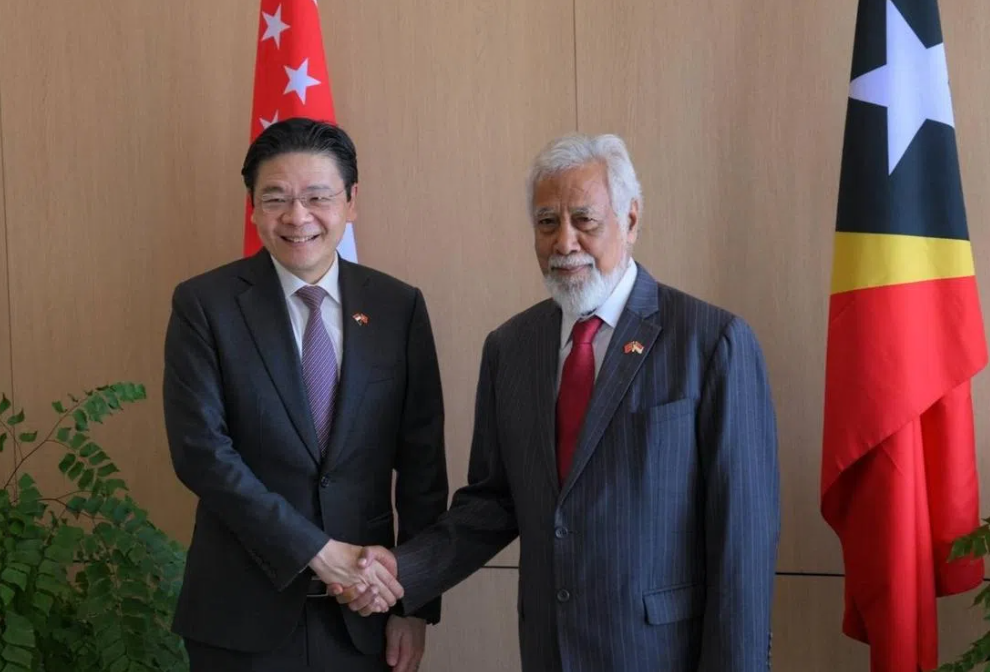
Prime Minister Lawrence Wong has unveiled an ambitious agenda to deepen Singapore's engagement with Timor-Leste, marking a significant escalation in bilateral relations during the first official visit by a Singapore premier to the Southeast Asian nation. The announcement reflects Singapore's strategic commitment to supporting Timor-Leste's development trajectory, particularly following its recent admission to the Association of Southeast Asian Nations in October 2025. A new bilateral framework agreement, signed on July 3 at the Government Palace in Dili, establishes institutional mechanisms for sustained cooperation across multiple domains, underscoring both nations' determination to build a comprehensive partnership despite their modest populations.
The cornerstone of the new arrangement is a regular consultation mechanism between the foreign ministries of both countries, which will enable structured dialogue on bilateral matters alongside regional and international strategic developments. This institutional innovation represents a clear signal that Singapore regards Timor-Leste not merely as a neighbouring state requiring developmental assistance, but as a consequential partner worthy of high-level engagement and policy coordination. PM Wong's observation that small nations need not be constrained by their size resonates particularly in the Southeast Asian context, where island states and smaller economies have repeatedly demonstrated their capacity to punch above their demographic and geographic weight through strategic partnerships and institutional innovation.
Economically, Singapore has positioned itself as one of Timor-Leste's largest foreign investors, with companies actively exploring ventures spanning wholesale commerce, renewable energy development and infrastructure projects. This investment pipeline reflects genuine confidence in the country's economic prospects and diversification potential. PM Wong's announcement that Singapore will commence accepting Timorese workers in selected sectors from the second half of 2027 represents a tangible expression of this confidence while simultaneously addressing labour market realities in Singapore. The move grants employers in construction, marine shipyards and related industries access to an expanded talent pool precisely when regional demographics and domestic labour constraints create persistent manpower challenges.
The labour mobility initiative carries profound implications for both economies. For Timor-Leste, remittances from workers abroad represent a significant revenue stream, while exposure to Singapore's workplace culture and professional standards contributes to human capital development and institutional learning. Skilled Timorese workers returning home bring technical expertise and operational knowledge that can catalyse broader economic development. Singapore's Manpower Ministry has already detected strong employer interest, particularly from construction firms, suggesting the programme will achieve rapid uptake and meaningful employment gains. The phased approach, beginning in 2027, allows both governments adequate time to establish regulatory frameworks, skills certification standards and bilateral labour agreements that protect workers whilst meeting employer expectations.
Healthcare cooperation represents another pillar of expanded engagement. The National University Hospital and Timor-Leste's Ministry of Health intend to formalise a five-year collaborative arrangement focusing on workforce development, healthcare training, public health capacity building and health systems strengthening. The partnership targets priority areas identified by Timorese authorities, including emergency medicine, pre-hospital care, paediatrics, ophthalmology, maternal and gynaecological services and supportive care infrastructure. This approach respects Timorese national preferences whilst leveraging Singapore's advanced healthcare systems and institutional expertise. For a nation still consolidating its post-independence institutional architecture, access to peer learning opportunities with a high-income country's flagship teaching hospital provides invaluable developmental benefits.
Educational cooperation complements the healthcare dimension. Singapore's initiatives focus particularly on supporting Timor-Leste's teacher training institutes and educational leadership development programmes. Recognising that quality education requires capable school administrators and pedagogically sound instructional practices, Singapore targets institutional capacity building rather than merely individual training. This systems-level approach addresses the deeper structural requirements for sustainable educational improvement. Given Timor-Leste's linguistic diversity and the legacy of different colonial educational traditions, external support in developing cohesive national teacher training standards and leadership preparation programmes carries significant value.
Timor-Leste's recent accession to ASEAN fundamentally alters the strategic calculus governing regional relationships. The country's full participation in the regional architecture requires both institutional preparation and diplomatic skill, creating space for experienced ASEAN members to provide mentoring and practical assistance. Singapore's earlier launch of the Singapore-Timor-Leste Asean Readiness Support package in December 2022, subsequently enhanced in July 2025, has already provided training in ASEAN protocols and decision-making procedures. PM Wong's commitment to expand this support reflects recognition that Timor-Leste's successful ASEAN integration serves Singapore's interests by strengthening the organisation's institutional coherence and demonstrating the bloc's capacity to absorb new members seamlessly.
The announcement of tailored chairmanship preparation workshops and opportunities for Timorese officials to observe Singapore's ASEAN chair operations in 2027 acquires particular significance given Timor-Leste's scheduled turn as chair in 2029. This compressed timeline requires intensive preparation, and Singapore's willingness to provide hands-on mentoring in the mechanics of regional leadership demonstrates substantial confidence in Timorese capacity to assume the role. Such support also benefits Singapore indirectly by ensuring that ASEAN's rotating leadership operates smoothly and enhances the organisation's collective effectiveness.
PM Xanana Gusmao's characterisation of Singapore as a "trusted friend and partner" underscores the personal and institutional relationships undergirding the bilateral engagement. Gusmao's own political trajectory and his country's journey to independence inform this assessment. His emphasis on Singapore's support for Timor-Leste's ASEAN aspirations and institutional development reflects genuine appreciation for practical assistance delivered over decades rather than mere rhetorical solidarity. The award of the Order of Timor-Leste's highest honour to PM Wong, presented by President Jose Ramos-Horta at the Presidential Palace, formalises this mutual regard and acknowledges Singapore's sustained commitment.
Wong's gracious response, attributing the award to the Singaporean civil servants, military personnel, healthcare professionals and technical experts who have worked in Timor-Leste, reveals the human dimension underlying this partnership. Large-scale institutional cooperation ultimately depends on individuals willing to serve abroad, share knowledge without condescension, and engage respectfully with local contexts. This person-to-person foundation, combined with strategic institutional arrangements and economic cooperation frameworks, creates the multiple reinforcing layers necessary for enduring partnerships between unequal-sized nations.
For Malaysia and other Southeast Asian observers, Singapore's approach to Timor-Leste partnership offers instructive lessons. The combination of targeted technical assistance, structured institutional dialogue, economic opportunity creation, and respect for partner nation sovereignty provides a model for mutually beneficial engagement. Singapore's recognition that small nations' destinies need not be determined by size, but rather shaped through strategic partnership and institutional innovation, reflects a conviction increasingly shared across ASEAN as the bloc consolidates its internal cohesion and external positioning. Timor-Leste's successful integration into regional structures validates ASEAN's openness and underscores the organisation's relevance in facilitating development and cooperation across diverse member states.

