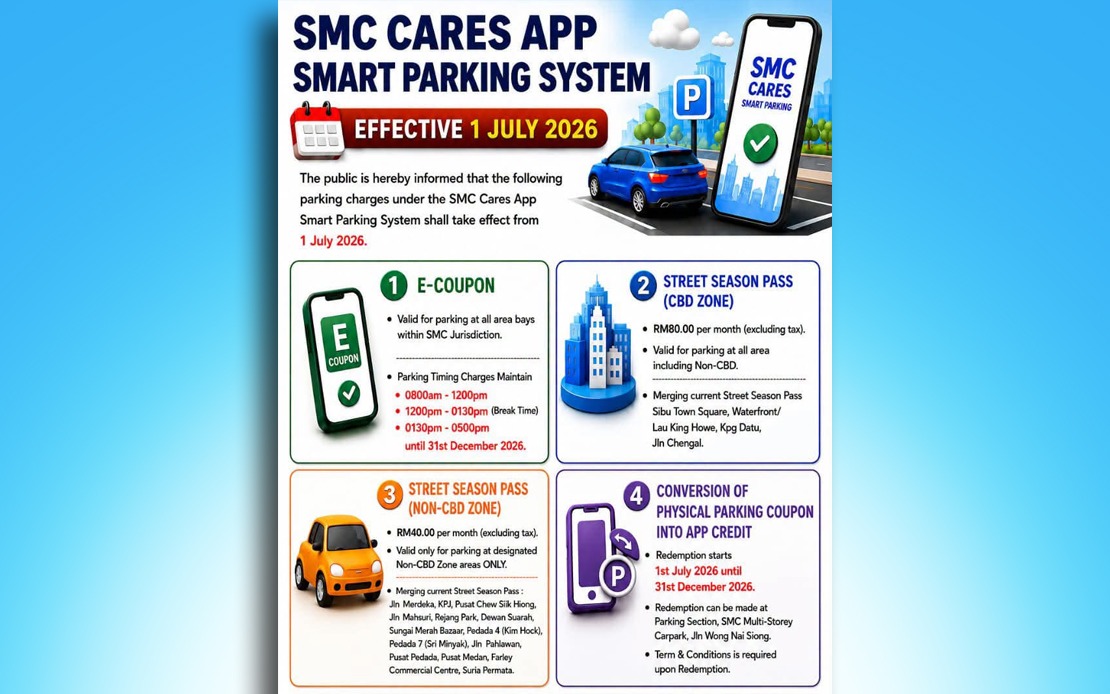
The Sibu Municipal Council has announced significant adjustments to its controversial SMC Cares Smart Parking system, introducing a grace period that will give drivers between five and ten minutes to activate the mobile application after parking before an Over Parking Notice is issued. The move represents a direct response to mounting public dissatisfaction following the system's full rollout earlier this month, when users encountered numerous operational difficulties and felt penalised by swift compound issuance. SMC Chairman Clarence Ting Ing Horh outlined the changes during a press briefing, emphasising that the council recognises the practical challenges users face when transitioning from parking their vehicles to launching the application.
Ting explained that the council instructed the system provider, Primal Solution Sdn Bhd, to evaluate how a grace period could function within the existing framework, acknowledging that motorists require adequate time not only to park but also to exit their vehicles and navigate the application interface. His comments directly addressed one of the most persistent complaints, where drivers reported receiving compounds within seconds of the parking period officially commencing, before they had reasonable opportunity to complete the payment process. The council's framing emphasises user convenience rather than revenue generation, signalling a philosophical shift toward viewing the system as a service rather than a punitive enforcement mechanism.
Beyond the grace period, SMC will introduce a Senior Citizen Parking Pass beginning in August for drivers aged 60 and above, though specific details regarding eligibility criteria, pricing, and operational mechanics remain to be announced. This initiative directly addresses the demographic group that reported experiencing the most difficulty with digital registration and application usage. The introduction of a dedicated pass system suggests the council recognises that a one-size-fits-all digital solution inadequately serves an ageing population, many of whom either lack smartphone familiarity or prefer traditional payment methods.
Ting publicly encouraged residents to engage directly with SMC regarding system improvements rather than circulating unverified claims through social media channels, effectively acknowledging the role online platforms played in amplifying public discontent. The statement reflects growing tension between municipal authorities and digitally-connected populations who rapidly organise and share grievances. The council also clarified the appeals mechanism available to motorists who believe notices have been issued in error, whether due to registration number inaccuracies or other legitimate reasons, with each notice backed by photographic evidence within the system.
A critical distinction emerged regarding enforcement responsibilities, with Ting clarifying that parking wardens employed by the contractor enforce only parking-related violations including non-payment, time expiration, and overstaying. Separate enforcement divisions within SMC and the police retain responsibility for illegal parking infractions such as traffic obstruction. This clarification addresses specific social media allegations that private wardens were issuing compounds for offences beyond their authority, a concern that had eroded public confidence in the system's legitimacy.
The council mandated that parking wardens adopted more approachable demeanours when assisting members of the public unfamiliar with the application, while directing them to refrain from wearing face coverings except for valid medical reasons, thereby facilitating easier identification and presumably reducing confrontational interactions. Furthermore, SMC established a dedicated support counter at Sibu Public Library with staff trained to guide users through registration and application functionality, recognising that digital literacy gaps represented a significant barrier to smooth system operation.
Ting directly addressed allegations that Sibu imposed the state's highest parking charges by presenting comparative data demonstrating that the city's rates remained competitive with those levied by other Sarawak local authorities. He also clarified the financial arrangements, explaining that all revenue collected flows directly to SMC while the contractor receives separate compensation through a service contract, thereby distinguishing between the council's financial interests and the provider's operational incentives.
The SMC Cares Smart Parking system has already achieved more than 93,000 user registrations since launch, with projections indicating the total will surpass the initial 100,000-user target by year-end. These numbers suggest that despite the controversies and technical frustrations, significant adoption has occurred, indicating either compulsion through enforcement necessity or genuine recognition that digital parking management addresses genuine municipal challenges.
The public complaints documented numerous system deficiencies including overcomplicated registration procedures particularly affecting older users, unintuitive interface design, sluggish performance, unexpected automatic logouts, payment processing delays, and most critically, the issuance of compounds before motorists could complete their parking payments. These technical and design failures represented systemic failures rather than isolated incidents, suggesting either inadequate testing before implementation or resource constraints that prevented proper system refinement prior to full deployment.
The council's announcement implicitly acknowledges that introducing digital systems serving diverse populations requires more sophisticated implementation strategies than technologically-focused developers typically provide. The grace period, senior citizen pass, and enhanced user support represent attempts to retrofit solutions addressing problems that better initial planning might have prevented. For other Malaysian municipalities considering similar smart parking implementations, Sibu's experience demonstrates both the necessity of such systems for urban management and the critical importance of user experience design and adequate support infrastructure during rollout phases.
These adjustments signal that Malaysian local authorities are becoming more responsive to public feedback delivered through digital channels, even while encouraging communities to engage through official channels. The simultaneous acknowledgement of social media's role in amplifying grievances whilst requesting users reduce reliance on such platforms reflects municipal authorities navigating tension between embracing feedback mechanisms and managing their public messaging. Ultimately, whether these measures adequately address underlying technical and design issues affecting user experience will determine the system's long-term success and shape public acceptance of comparable initiatives across Malaysia.

