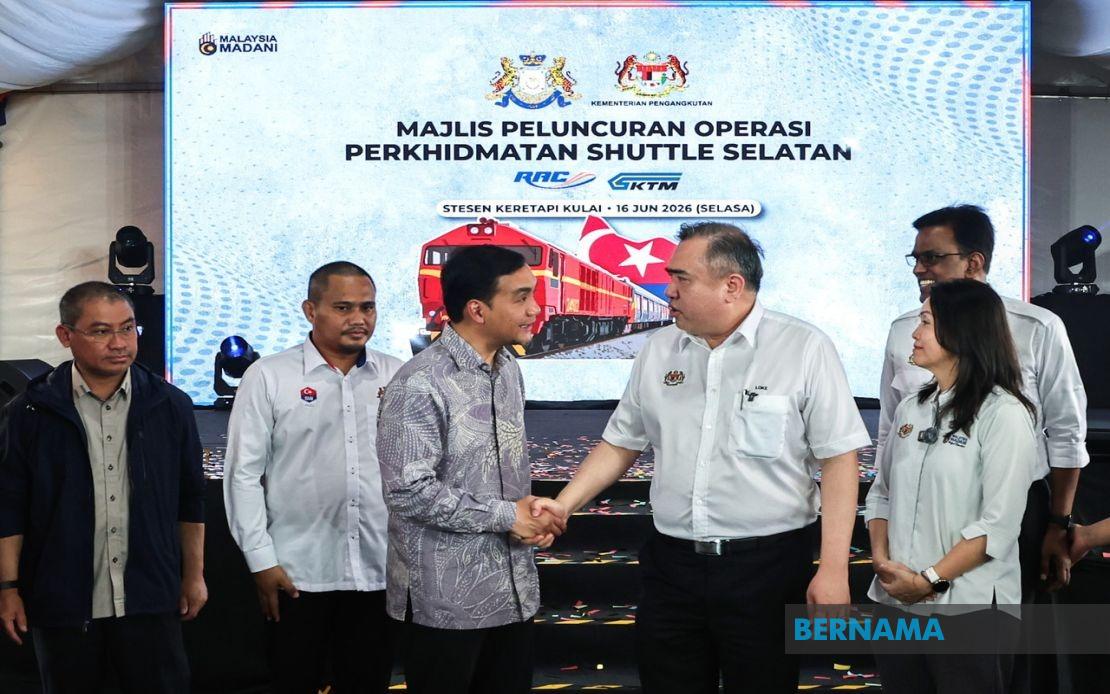
The Shuttle Selatan service commenced operations today, marking a significant milestone in Johor's public transport expansion. The rail-based shuttle links three strategically important areas—Kulai, JB Sentral and Pasir Gudang—and is projected to benefit more than two million residents across these municipalities. Transport Minister Anthony Loke unveiled the service at Kulai KTM station, accompanied by Johor Menteri Besar Datuk Onn Hafiz Ghazi and state infrastructure officials, underscoring the political importance of this connectivity project in the region's development agenda.
Initially, Shuttle Selatan will operate along two distinct corridors designed to address the distinct mobility needs of commuters in different parts of Johor. The first route runs between Kulai and JB Sentral, while the second connects Kempas Baru with Pasir Gudang. These primary services form the foundation of what authorities envision as a comprehensive rail network that will eventually expand southward. The government has already charted plans to extend operations along a new corridor stretching from Paloh through Kulai, incorporating intermediate stations at Kluang, Renggam and Layang-Layang. This phased expansion strategy reflects a pragmatic approach to rolling out infrastructure while managing financial and operational constraints.
Beyond the initial two routes, the government is positioning three additional stations for future development: Taman Daya, Bandar Baru Sri Alam and Pasir Putih. These planned stops represent an effort to broaden the service's geographic reach and ensure that more communities gain access to rail-based public transport. For a state with Johor's economic profile and rapid urbanisation trajectory, the strategic placement of these stations is crucial to capturing commuter demand from residential expansion areas.
The service specifications reveal a competitive advantage over existing transport modes. The Kulai to JB Sentral journey takes approximately 40 minutes, while the Kempas Baru to Pasir Gudang route requires 40 to 45 minutes. These travel times position rail as an attractive alternative to private vehicles for residents and workers commuting between these centres. The reliability and comfort benefits of rail transport over road-based alternatives address long-standing congestion concerns that have plagued Johor's growing urban corridors.
Recognising that modern public transport systems succeed only when users can easily access entry points, the government has implemented complementary first- and last-mile solutions. Feeder bus services, coordinated Bas.My routes, and dedicated shuttle operations at Kempas Baru create a multi-modal network. The park-and-ride facility at AEON Bandar Dato' Onn particularly caters to motorists willing to abandon their vehicles partway through their journey, a pragmatic approach to encouraging modal shift among commuters accustomed to private transport.
To accelerate public acceptance and drive initial patronage, authorities have distributed 3,000 complimentary Commuter MADANI Shuttle Selatan Cards to Johor residents. Each card, valued at RM50, grants unlimited travel on the service for a specified duration. The Railway Assets Corporation allocated more than RM150,000 to fund this incentive programme, reflecting a calculated investment in habit formation. This strategy targets behavioural change by removing financial barriers during the crucial early adoption phase, a tactic proven effective in transit systems elsewhere.
Johor's economic context frames why transport infrastructure has become a priority for state and federal planners. The state ranks among Malaysia's fastest-growing regions, with expanding industrial parks, logistics hubs, port operations and educational institutions driving employment growth. These sectors require workforce mobility solutions that existing transport networks struggle to provide adequately. Shuttle Selatan directly addresses this gap by strengthening the connective tissue between residential neighbourhoods, commercial city centres and the industrial zones that generate economic opportunity.
The service represents a collaborative achievement involving multiple stakeholders. The Ministry of Transport, Keretapi Tanah Melayu Berhad and the Railway Assets Corporation coordinated to translate planning into operational reality. This institutional arrangement, with RAC handling assets while KTMB operates services, reflects Malaysia's evolving approach to public transport governance, where asset ownership and operational management are separated to improve efficiency and accountability.
For Malaysian readers and Southeast Asian observers, Shuttle Selatan exemplifies how regional transport planning increasingly recognises that economic competitiveness depends on seamless connectivity. As Johor positions itself as a manufacturing and logistics hub, the ability to move workers efficiently within and between population centres becomes a competitive necessity. The service also signals government commitment to transitioning commuters away from private vehicles toward sustainable public transport—a priority underscored by climate considerations and urban air quality concerns that affect the broader region.