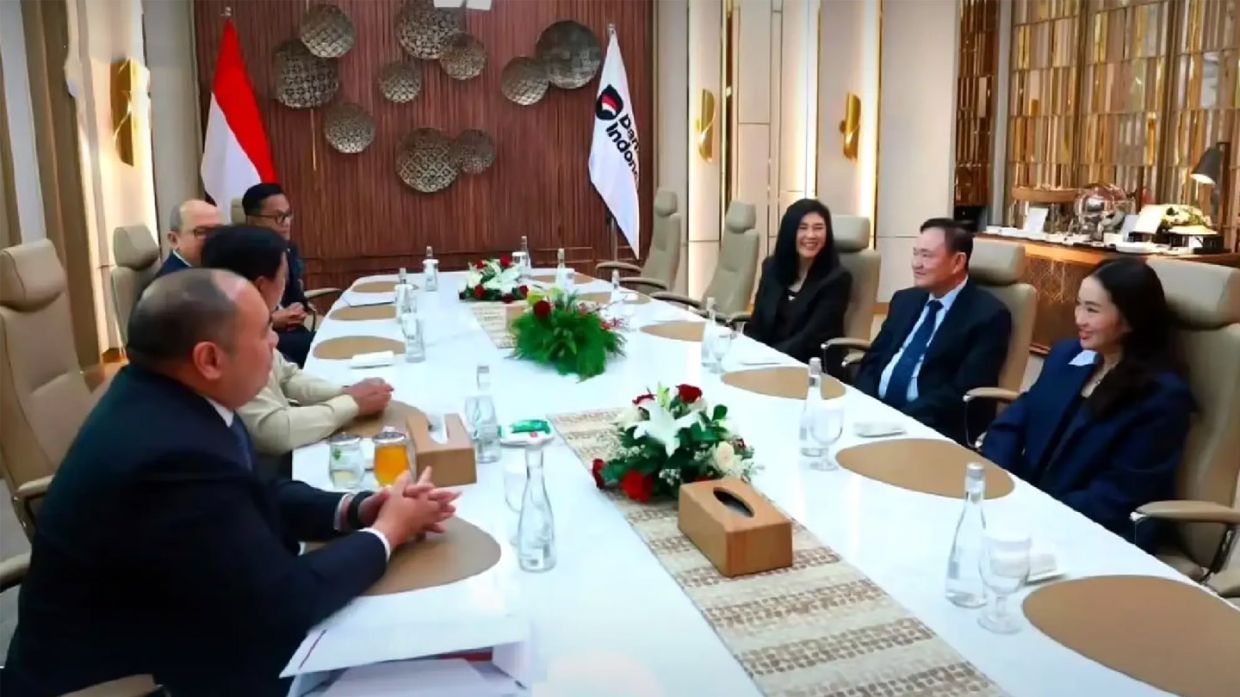
Three members of Thailand's influential Shinawatra family—all former prime ministers—gathered with Indonesian President Prabowo Subianto in Jakarta this week to explore cross-border investment avenues and coordinate on regional economic strategy. The July 9 meeting brought together Thaksin Shinawatra, his sister Yingluck Shinawatra, and Paetongtarn Shinawatra at the Danantara building, marking a significant alignment of political and business interests between two major Southeast Asian economies at a time of shifting regional dynamics.
According to Indonesian Cabinet Secretary Teddy Indra Wijaya, the gathering centred on identifying investment opportunities, asset management techniques, and frameworks for sustainable economic growth. Officials released photographs of the meeting showing the three Thai figures alongside Prabowo and senior leadership from Danantara Indonesia, the state-owned institution that oversees the country's strategic asset portfolio. The tone was characterised as warm and informal, underscoring the personal rapport that has developed among the participants over time.
The trio represents substantial Thai political and business capital. Thaksin held the premiership from 2001 until 2006, when he was ousted in a military coup—an event that fundamentally reshaped Thai politics for two decades. Yingluck, his younger sister, later served as prime minister between 2011 and 2014 before herself facing political turbulence and eventually going into self-imposed exile. Paetongtarn, Thaksin's youngest child, more recently occupied the top office from 2024 to 2025, representing a generational transition within the family's political influence.
Thaksin's position carries particular significance in this context. He sits on Danantara's advisory council, a role that gives him institutional influence over Indonesia's long-term investment strategy. This appointment places him at the intersection of Thai business interests and Indonesian state economic planning, allowing him to shape discussions around how both countries can leverage their complementary strengths. During the July 9 meeting, he contributed recommendations on strategic matters and exchanged perspectives with Prabowo and Danantara's executive team on economic pathways forward.
Danantara Indonesia functions as the custodian of the state's most valuable strategic assets, managing and optimising holdings meant to underpin the country's broader economic transformation agenda. The institution wields considerable influence over how Indonesia deploys its wealth across sectors ranging from infrastructure to technology to natural resources. By engaging with the Shinawatra family—which controls substantial business enterprises across Thailand and the region—Prabowo's administration signals its intent to draw on international expertise and capital networks in executing its vision for national development.
The senior Danantara team present at the meeting included Rosan Roeslani, the organisation's group chief executive officer; Dony Oskaria, who oversees operations; and Pandu Sjahrir, the chief investment officer. Their involvement underscores the meeting's substance: this was not a ceremonial courtesy call but a working session involving decision-makers capable of translating discussions into actual capital flows and partnership frameworks.
For Malaysia and the broader Southeast Asian region, this gathering carries implications for how cross-border economic collaboration may evolve. Thailand and Indonesia represent the region's two largest economies by nominal GDP, and coordinated investment strategies between them can shape capital flows, technology transfer, and sectoral development across the entire region. The Shinawatra family's historical business footprint spans telecommunications, retail, and infrastructure—sectors where Malaysian firms often compete or collaborate. Any formalisation of investment partnerships brokered through these discussions could alter competitive dynamics in the region.
Beyond the formal agenda, the July 9 meeting was preceded by a separate engagement at Prabowo's private residence in Jakarta, where he hosted Thaksin and family members in what officials described as a cordial and warm setting. These informal interactions often prove as consequential as formal boardroom discussions, as they establish personal trust and understanding that can facilitate smoother future negotiations. The willingness of Indonesia's new president to dedicate personal time to the Shinawatra family reflects the weight Jakarta places on cultivating durable relationships with influential Thai actors.
The Indonesian government has framed such meetings as integral to its strategy of expanding international cooperation amid an increasingly complex global environment. As geopolitical competition intensifies and trade patterns shift, Jakarta recognises that building robust networks with proven economic operators—such as the Shinawatra family—provides institutional insurance and diversifies its partnership portfolio. Thailand, facing its own economic headwinds and political uncertainties, stands to benefit from closer alignment with Indonesia's resource-rich economy and growing consumer market.
Thaksin's advisory role at Danantara represents a broader phenomenon of post-political careers for former national leaders who retain substantial business acumen and networks. Rather than fading into private life, figures like Thaksin position themselves as intermediaries and strategists for multinational development initiatives. This model allows them to maintain influence while operating outside formal governmental structures, which in Thailand's fractious political environment offers both protection and opportunity.
The investment and asset management topics that dominated discussion reflect pressing concerns for both nations. Indonesia faces pressure to diversify its revenue streams beyond commodities, while Thailand seeks to attract capital into high-value manufacturing and services sectors. A coordinated approach through state investment vehicles like Danantara could catalyse partnerships that move beyond traditional trade relationships into deeper structural integration.
As these discussions progress, Malaysian observers should monitor whether formal investment partnerships or coordinated frameworks emerge. Such arrangements could shape the competitive terrain across Southeast Asia for years to come, particularly in sectors where Malaysia has traditionally held advantages. The Shinawatra family's proven track record in scaling businesses regionally, combined with Indonesia's resource base and state capital, represents a formidable combination that could accelerate economic consolidation within the region's largest economies.

