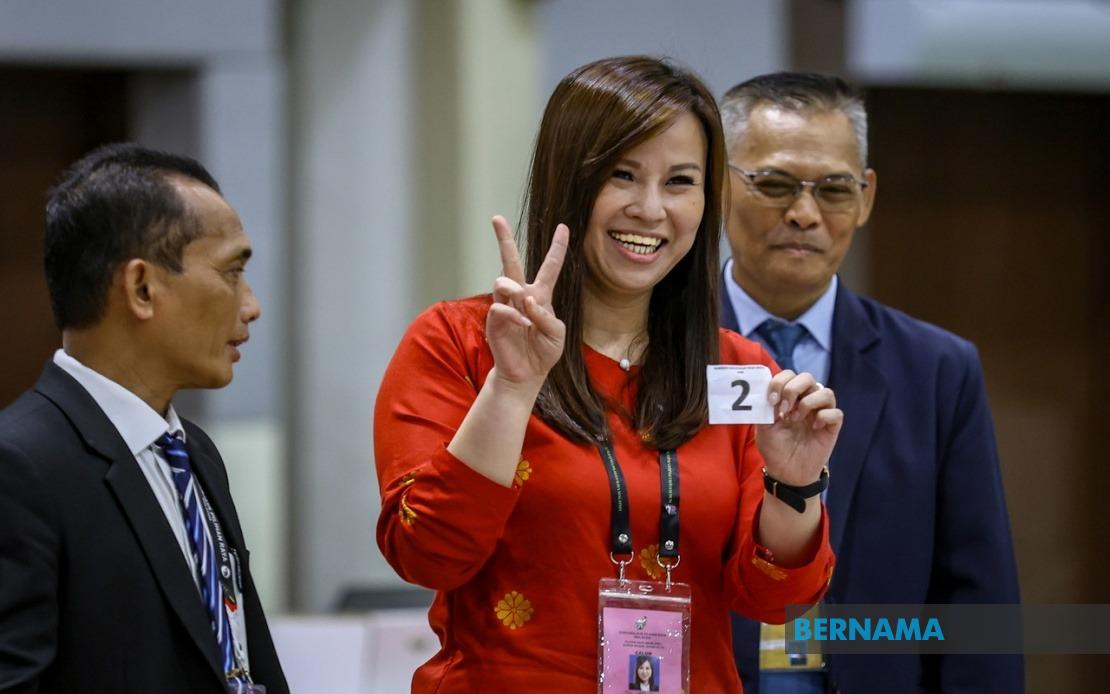
Sharon Teo has formally entered the race for the Permas state constituency in Johor's 16th state election, positioning her campaign squarely on resolving the area's most pressing infrastructure concerns and strengthening the social safety net for residents. The Pakatan Harapan candidate, who serves as chief of the Johor Amanah Women's Youth (Warda), emerged from the nomination process at Dewan Muafakat in Taman Mawar determined to address grievances she has consistently encountered during ground visits throughout the constituency.
During her campaign launch, Teo underscored that road quality and safety represents an urgent priority that cannot be deferred. She has identified inadequate and deteriorating road conditions as a genuine public safety hazard affecting daily commutes and emergency response times across Permas. This issue has proven to resonate strongly with constituents, who view transport infrastructure as fundamental to economic activity and family safety. Her emphasis on this tangible concern reflects a deliberate strategy to anchor her campaign in bread-and-butter issues rather than abstract political messaging.
Teo brings relevant experience from her previous role as an aide within the Pulai parliamentary constituency, where she worked under the late Amanah deputy president Salahuddin Ayub. This background provides her with firsthand exposure to constituent services and parliamentary advocacy mechanisms. She has indicated that a comprehensive manifesto detailing her specific vision and mission for Permas voters will be released shortly, suggesting her campaign team is developing detailed policy proposals beyond the headline themes already articulated.
Defending the seat is incumbent Baharudin Mohamed Taib from Barisan Nasional, who successfully held Permas in the 2022 state election. Baharudin has acknowledged the competitive nature of the contest, recognising that each of his opponents brings distinct capabilities and voter appeal to the race. His candid assessment that he cannot afford complacency and must exert considerable effort to secure a BN victory signals realistic recognition that incumbent advantage alone may prove insufficient in this particular electoral battleground.
Barahuddin's campaign strategy diverges from Teo's in one notable respect: he has opted against launching a personal manifesto, instead anchoring his candidacy to the broader Barisan Nasional platform and party directives. This approach reflects the traditional BN model of emphasising party unity and collective messaging rather than individual candidate differentiation. Whether this strategy will satisfy voters seeking specific local commitments or prove disadvantageous compared to opponents offering detailed, constituency-specific promises remains an open question.
The Permas contest is unfolding as a four-cornered battle extending beyond the customary two-party dynamics. Perikatan Nasional has fielded T. Vela as its candidate, while Parti Bersama Malaysia has nominated Dr Zamil Najwah. The fragmentation of opposition votes across multiple parties could potentially advantage the incumbent, though it may also reflect genuine voter demand for alternatives to the traditional BN-PH dichotomy that has dominated Malaysian electoral politics in recent cycles.
The constituency itself holds significant electoral weight, encompassing 113,963 eligible voters and falling within the Pasir Gudang parliamentary district. Permas voters represent a substantial segment of the Johor electorate, making the outcome there potentially indicative of broader state-level trends. The composition of Permas voters—spanning urban, suburban, and potentially semi-rural areas within the Pasir Gudang zone—suggests a diverse demographic profile with varied priorities ranging from urban amenity improvements to preservation of more traditional community values.
The timing of the Johor state election on July 11, with early voting scheduled for July 7, provides candidates with approximately two weeks to consolidate their messaging and mobilise grassroots support. This compressed campaign period typically advantages well-resourced established parties with existing electoral machinery, though energised grassroots campaigns by opposition candidates have demonstrated capacity to overcome structural disadvantages in recent Malaysian elections. The early voting option may also reshape turnout patterns and strategic voter mobilisation approaches.
For Malaysian and Southeast Asian observers, the Permas race encapsulates recurring tensions within contemporary Malaysian politics: the debate over whether candidate-driven, localised campaign promises or party-level platforms better serve voter interests; the challenge facing incumbent administrations in justifying their stewardship while facing renewed opposition energy; and the ongoing fragmentation of the opposition vote across multiple parties rather than consolidation behind unified coalitions. The outcome may offer insights into whether local infrastructure grievances prove decisive in voter calculations or whether partisan affiliation continues overwhelming other considerations.

