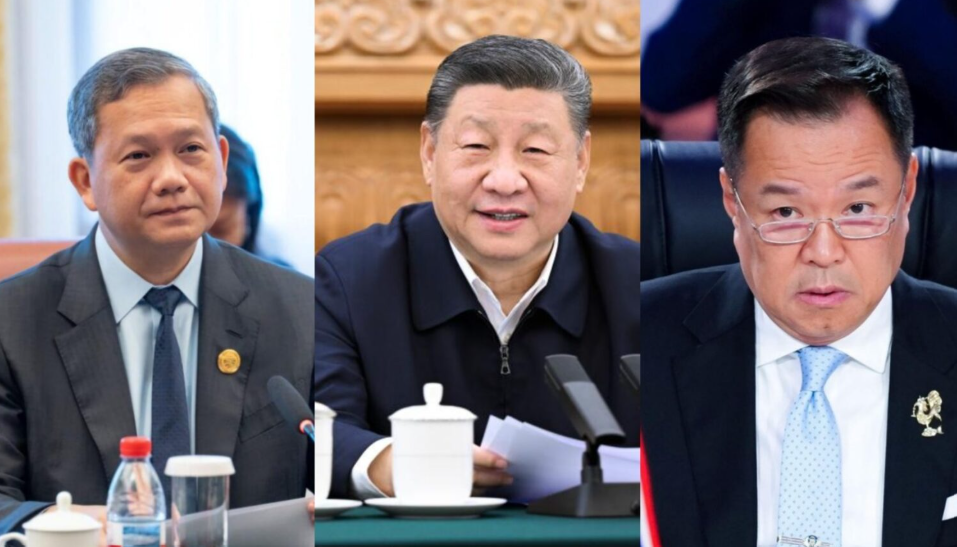
Cambodia and Thailand's prime ministers are converging on Shanghai in mid-July for what observers see as a critical diplomatic moment, with Chinese President Xi Jinping's invitation to the World AI Conference 2026 providing a carefully timed platform for regional fence-mending. Hun Manet and Anutin Chanvirakul both face pressure to address a festering border dispute that has left roughly 20,000 Cambodian civilians displaced from their homes in occupied territories. The two leaders last sat across a negotiating table in December, and their appearance at the conference signals potential momentum for resolving one of Southeast Asia's most intractable territorial disagreements.
Hun Manet's delegation arriving July 15-17 carries considerable diplomatic weight beyond the ceremonial AI conference attendance. Alongside foreign minister Prak Sokhonn and defence minister Tea Seiha, the Cambodian premier will bring Sun Chanthol, first vice-chairman of the Council for the Development of Cambodia, a signal that substantive cooperation discussions are anticipated. Thailand's Anutin plans to bring foreign minister Sihasak Phuangketkeow, matching Cambodia's senior-level representation. Both prime ministers have scheduled separate meetings with Xi and Chinese Premier Li Qiang, suggesting Beijing intends to engage each nation individually before facilitating any joint discussion. Such bilateral formats often precede breakthrough multilateral talks, though observers remain cautious given the diplomatic stalemate of recent months.
Cambodia's foreign ministry framed the visit through the lens of deepening strategic partnership, invoking the Comprehensive Strategic Partnership of Cooperation and the Diamond Cooperation Framework—language that masks urgent underlying tensions. The emphasis on building an "all-weather Cambodia-China Community with a Shared Future" reflects Phnom Penh's desire to position itself squarely within Beijing's sphere of influence, a positioning that carries implications for how China might broker a settlement. Similarly, Bangkok's statement about strengthening the "Comprehensive Strategic Cooperative Partnership" demonstrates that Thailand also views its relationship with China as foundational, albeit on different terms than Phnom Penh.
The timing of this Shanghai summit follows a telling encounter at the Asean Future Forum in Hanoi last June, where Hun Manet and Anutin managed only a handshake for photographers while avoiding substantive discussion of their border conflict. That performance of diplomatic normalcy without progress underscores how both capitals have been treating the dispute—as a managed rather than resolved problem. By convening them in Shanghai rather than through existing ASEAN mechanisms, China subtly signals that regional organisations have proven insufficient for moving these discussions forward. Such an approach carries both opportunity and risk, as it potentially elevates the dispute from a bilateral matter to one of strategic importance for Beijing's regional stability agenda.
Analysts believe China's primary leverage rests on economic interdependence. Both Cambodia and Thailand maintain extraordinarily important trade relationships with Beijing, and both rely on Chinese investment and infrastructure development. According to experts, Beijing can credibly threaten to adjust the terms of cooperation or slow promised development projects if either nation proves obstinate on reaching a settlement. This economic muscle has proven effective in other disputes across the region, though it operates most smoothly when applied with subtlety rather than overt coercion. The question for Shanghai is whether China will use the multilateral setting to encourage movement or remain content with symbolic engagement.
Yet structural obstacles persist that transcend what Beijing can resolve through bilateral negotiations. Kin Phea, director of the Royal Academy of Cambodia's International Relations Institute, identifies a troubling dynamic: while Thailand's civilian government may demonstrate willingness to negotiate, Thailand's military establishment operates with considerable autonomy in implementing border policy. The Thai armed forces have persistently occupied Cambodian territory and continued encroachments despite civilian agreements with Phnom Penh. This civil-military divide within the Thai government creates an asymmetry that complicates negotiations, as Cambodian diplomats cannot be certain that agreements reached with Bangkok's political leadership will be implemented by its security apparatus. Such structural dysfunction within one negotiating partner significantly impairs the entire diplomatic process.
Kin Phea has explicitly called on China to assume a more activist role as mediator and arbitrator, moving beyond ceremonial gestures toward substantive enforcement of the Fuxian Consensus reached in December 2025. That earlier agreement, brokered by Beijing, established principles for resolving tensions through diplomatic channels and international law. Yet implementation has stalled almost immediately, with Cambodia arguing that Thailand has neither withdrawn troops from occupied areas nor resumed meaningful negotiations through the Joint Boundary Commission. From Phnom Penh's perspective, international agreements without enforcement mechanisms become mere words, and China's silence on Thai non-compliance signals insufficient commitment to the settlement process.
The humanitarian dimension adds urgency to negotiations that might otherwise remain confined to diplomatic channels. Approximately 20,000 Cambodian civilians remain unable to return to homes in disputed territories, with livelihoods disrupted and families fragmented by the occupation. This civilian cost has grown more intolerable over time, and Phnom Penh faces domestic pressure to demonstrate progress in reclaiming territory. For Hun Manet, the Shanghai summit represents an opportunity to show that his government is actively leveraging Cambodia's relationship with China toward concrete results. Failure to produce movement risks undermining his political standing domestically, particularly among constituencies affected by the border dispute.
Thailand faces different but equally complex pressures. The military government in Bangkok must balance its commitment to ASEAN solidarity and international law against security perceptions that might justify continued territorial positions. Thai strategic thinking has traditionally emphasised buffer zones along its borders, a perspective that conflicts with Cambodia's sovereignty claims. Whether Anutin's civilian administration can persuade Thailand's defence establishment to shift this calculation remains uncertain. China's influence would prove most valuable if it could convince Thai military leadership that abandoning the occupation serves Thailand's long-term interests better than perpetuating an unsustainable status quo.
The Shanghai conference's broader context involves ASEAN's struggle to manage intra-regional disputes without external intervention. China's increasing willingness to convene bilateral meetings between ASEAN members suggests that traditional regional mechanisms have lost credibility as conflict-resolution forums. This development carries concerning implications for Southeast Asian autonomy and the region's ability to manage its own affairs. Yet pragmatically, if existing ASEAN structures cannot move Cambodia and Thailand toward a settlement, bringing Beijing into a more prominent mediating role may represent an acceptable cost. The question becomes whether such engagement produces durable solutions or merely substitutes Beijing's preferences for genuine bilateral reconciliation.
Movement on the Cambodia-Thailand border dispute would constitute a significant regional achievement. Such a resolution would demonstrate that major power involvement in Southeast Asian conflicts need not prove destabilising, and that economic leverage combined with diplomatic suasion can overcome historical grievances. Conversely, failure at Shanghai would reinforce pessimistic assessments about the intractability of territorial disputes and the limitations of mediation when core interests diverge. For Malaysia and other ASEAN nations watching this situation, the outcome will signal whether Beijing's involvement in regional disputes proves constructive or whether it creates dependencies that ultimately compromise regional autonomy and stability.

