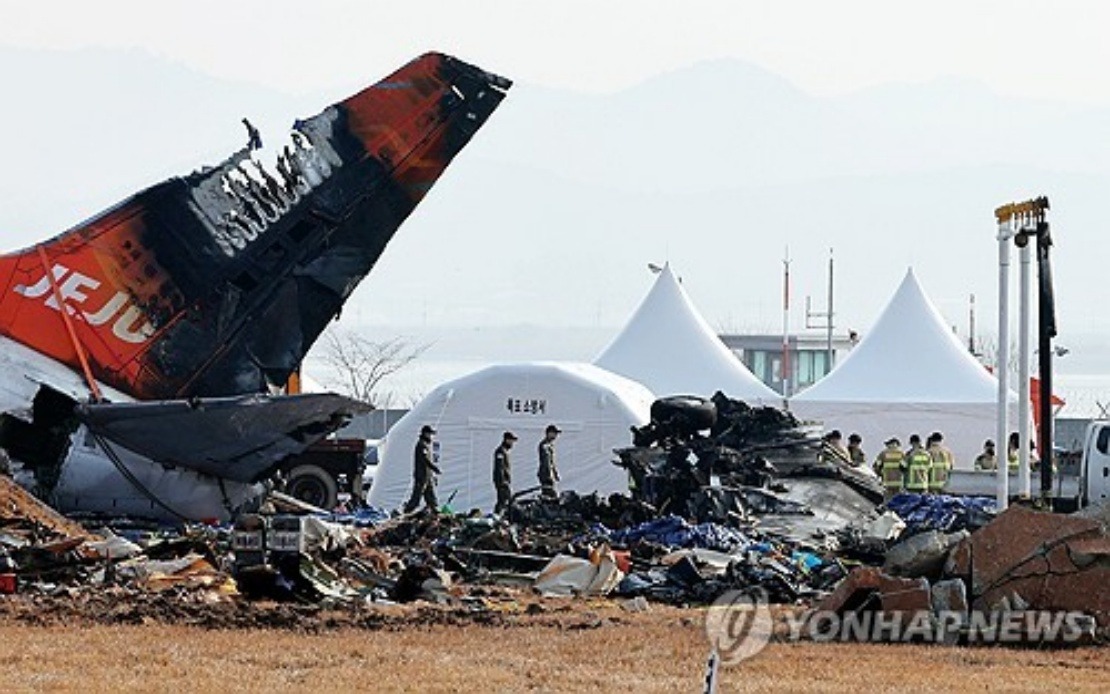
South Korea's transport ministry faces an accountability crisis as prosecutors prepare cases against seven officials accused of orchestrating a cover-up surrounding the Jeju Air flight disaster that claimed 179 lives in late December 2024. Police investigations have established that these officials allegedly concealed critical safety defects in airport navigation equipment while publicly misrepresenting its compliance status, raising serious questions about institutional responsibility and governmental transparency in aviation safety oversight.
The catastrophe unfolded on December 29, 2024, when Jeju Air Flight 2216 made a desperate belly landing at Muan International Airport, a regional facility situated approximately 290 kilometres south of Seoul. During this emergency descent, the aircraft struck a concrete structure housing a localiser—a sophisticated navigation instrument designed to guide pilots during instrument-based landings—resulting in the deaths of 179 passengers and crew members. The collision immediately sparked investigation into whether the localiser's positioning and structural design amplified casualties that might otherwise have been prevented.
A special police investigation unit has concluded that the seven officials deliberately misled the public through coordinated communications efforts. According to investigators, these individuals prepared and disseminated official press statements falsely asserting that the localiser installation adhered to all applicable safety regulations, despite possessing internal knowledge that the equipment did not meet mandatory compliance standards. The referral to prosecution occurred on Tuesday, with the police team detailing the systematic nature of the alleged deception.
The localiser placement controversy has become central to understanding the crash's devastating toll. Unlike standard installations, this navigation equipment was positioned within a concrete mound at Muan International Airport, a design choice that subsequent investigation has suggested may have materially worsened the accident's outcome. When the aircraft's fuselage impacted this obstruction during the landing attempt, the collision's force was concentrated rather than distributed, potentially contributing to the high fatality rate.
For Malaysian and Southeast Asian aviation observers, this case carries profound implications regarding regulatory oversight and institutional accountability. Many regional airports operate under similar structural configurations and maintenance protocols, inherited from or influenced by Korean aviation standards. The exposure of such deliberate concealment at a government ministry level highlights the critical importance of independent auditing mechanisms and whistleblower protections within aviation authorities across the region.
The investigation's findings demonstrate how bureaucratic pressure to maintain operational approvals can override safety considerations. These officials appear to have prioritized protecting the airport's operational status and the equipment's approved standing rather than addressing legitimate safety concerns. This institutional pathology—where admitting safety deficiencies becomes perceived as organisational failure rather than responsible governance—represents a fundamental governance problem affecting multiple Asian aviation systems.
The referral of seven officials simultaneously underscores the investigation's conclusion that this was not isolated misconduct by individuals, but rather a coordinated institutional response. The preparation and distribution of misleading press releases required organizational infrastructure and multiple decision points, suggesting that responsibility extends beyond individual actors to systemic failures in oversight and accountability mechanisms within South Korea's transport ministry.
For Southeast Asian countries, this case serves as a cautionary reminder of aviation safety vulnerabilities. Indonesia, Thailand, Vietnam, and the Philippines all operate extensive airport networks with varying levels of regulatory infrastructure. The Jeju Air investigation demonstrates that nominal compliance with international aviation standards may mask underlying safety compromises, particularly when institutional cultures normalize the concealment of deficiencies rather than their transparent remediation.
The specific charge of drafting misleading press releases represents a particularly troubling element of public governance. Democratic societies depend upon accurate government communications to enable informed public discourse and legislative oversight. When transport ministry officials systematically deceive about aviation safety matters, they undermine not only passenger safety but also the foundational trust necessary for democratic accountability in technical regulatory domains.
Investigators face the additional challenge of determining whether these seven officials acted independently or received direction from superior administrators. The scope and coordination of the alleged cover-up suggests potential involvement of higher organizational echelons, though formal charges and investigation outcomes remain pending. This distinction matters significantly for understanding whether systemic reform or targeted individual accountability will address the underlying governance failures.
The prosecution phase will likely expose additional details about decision-making processes at Muan International Airport and within the transport ministry's regulatory divisions. Malaysian aviation officials and policymakers should monitor these proceedings closely, as they may reveal transferable lessons regarding localiser installation standards, emergency landing procedures, and the regulatory frameworks governing airport infrastructure safety across the region.
Ultimately, the Jeju Air crash and subsequent cover-up allegations represent a convergence of technical aviation failures and institutional governance breakdowns. Seven officials facing prosecution must answer for their roles in allegedly misrepresenting safety conditions, but the broader question concerns how South Korea's aviation system permitted such concealment to occur and how regional aviation authorities can implement safeguards to prevent similar institutional failures in the future.

