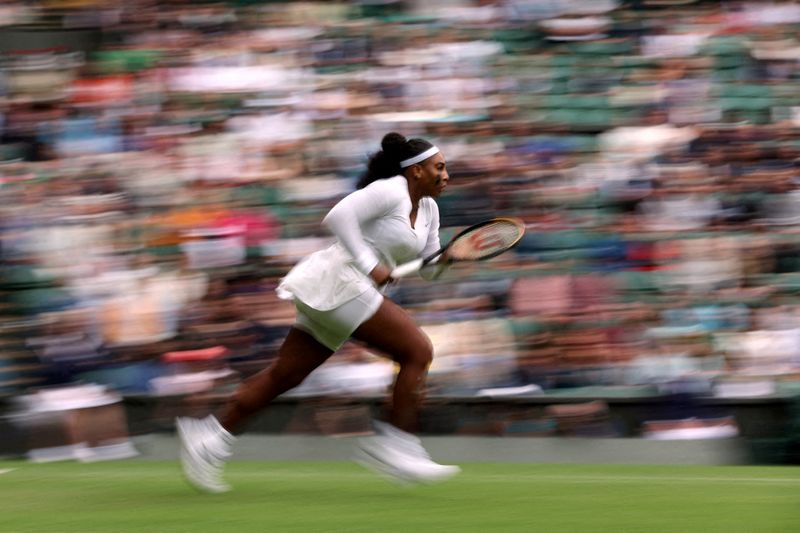
When Serena Williams takes to Centre Court at Wimbledon next week, the narrative of women's tennis will shift dramatically, regardless of how far the 44-year-old American progresses. Her comeback represents far more than another entry in the draw—it fundamentally reframes what had been shaping up as a wide-open competition where multiple contenders harboured legitimate championship ambitions. The four-year absence since her final appearance at the 2022 U.S. Open makes this moment unprecedented: a player whose seven Wimbledon singles titles remain unmatched by any woman in the modern era returning to the grass surface that made her legacy.
The women's draw arriving at the All England Club this year presented a genuinely fragmented landscape. Since Williams claimed her seventh title in 2016, eight different first-time champions have won Wimbledon, a statistical reality that underscores how thoroughly the sport's power dynamics have dispersed. World number one Aryna Sabalenka carries the weight of favourite's status, yet her recent trajectory suggests vulnerability rather than inevitability. Her collapse at Roland Garros, where she squandered a position two points from the semi-finals before losing the final ten games consecutively, exposed mental and technical frailties that grass may well exacerbate. More concerning for her prospects was her Berlin preparation, where she surrendered a deciding set 6-0 to Jessica Pegula—a scoreline that speaks volumes about her emotional resilience under pressure.
Others among the leading contenders arrive with genuine credentials but unproven grass-court pedigree. Iga Swiatek, Poland's clay-court virtuoso, attempts to become the first player since Williams herself to capture back-to-back Wimbledon titles, a feat requiring a stylistic transformation on fast courts that have historically troubled baseline-oriented players. Russian teenager Mirra Andreeva, at just nineteen years old, brings the audacity of youth and a newly minted French Open title to the manicured lawns, yet her inexperience on grass represents a substantial unknown. Elena Rybakina, the defending champion, possesses an unplayable power game but carries the understated confidence of someone who strikes rather than overwhelms opponents. Meanwhile, Coco Gauff continues her long search for the one Grand Slam crown on grass that has eluded her, whilst Britain's Emma Raducanu seeks to harness home support into a first British women's title since Virginia Ruffin in 1977.
Into this fractured landscape arrives Williams, bearing the eighth and final wildcard granted by Wimbledon organisers. Her presence immediately reshapes the psychological terrain. As a 23-time Grand Slam singles champion, she occupies a rarefied space in sporting consciousness—a figure whose legend transcends tennis rankings and contemporary form. That her comeback details have proven an open secret within the sport matters little. Her December re-entry into the anti-doping pool, the reported twenty-pound weight loss achieved through pharmaceutical intervention, and her recent doubles appearance alongside Victoria Mboko at Queen's Club all signaled preparation for precisely this moment. Former world number one Andy Roddick captured the audacity of her decision when reflecting on her wildcard confirmation, highlighting how most players would schedule seven tune-up events before attempting singles competition at the sport's most elite level.
Williams's 120-mile-per-hour serve—arguably the most potent weapon in women's tennis history—demonstrated its enduring danger during her doubles outing, accompanied by the baseline power that once terrorized opponents across the sport. Yet the transition from doubles to singles competition on grass represents a qualitatively different challenge. The surface's characteristics—the rapid ball trajectory, the low bounce, the demanding footwork—have historically disadvantaged players returning from extended absences. Fellow Grand Slam champion Lindsay Davenport acknowledged these obstacles whilst simultaneously recognizing Williams's unique capacity to overcome them, telling BBC commentators that grass represents an unforgiving surface for a player re-entering competition, though none possess the credentials or confidence to attempt what Williams is attempting.
The records suggest she could become the oldest woman to win a singles match at Wimbledon since Martina Navratilova achieved the feat at age forty-seven in 2004. Such benchmarks, whilst symbolically resonant, obscure the deeper significance of her presence. Williams's return generates commercial and cultural impact that no other player currently commands. Television ratings will soar; social media engagement will spike; the global tennis conversation will pivot toward her performance rather than the accumulated narrative of the women's championship. This concentration of attention arguably disadvantages her more serious rivals whilst affording her psychological space—if she loses early, the narrative becomes her valiant comeback rather than her elimination.
The scenario that most troubles the championship favourites involves a Sabalenka-Williams encounter. Such a matchup presents a no-win proposition for the world number one. Should Williams, having not played competitive singles in four years, emerge victorious or even take sets after securing service holds, the psychological damage to Sabalenka would be substantial. Defeat to the comeback legend would raise questions about her mental fragility and readiness. Victory, conversely, would carry less lustre, achieved against an opponent returning to competitive tennis rather than against the tournament's most dangerous current practitioners. Few athletes wear their emotional state as transparently as Sabalenka, and Wimbledon's pressure-cooker environment will test her composure thoroughly, particularly if her preparation proves as inconsistent as her recent form suggests.
For Malaysian and Southeast Asian readers, Williams's return carries particular resonance. Her career has transcended tennis, representing athletic excellence and longevity that transcends cultural boundaries. Her comeback narrative speaks to persistent questions about age, relevance, and the possibility of meaningful comeback, themes that resonate across Asian sporting cultures. The Wimbledon draw's unpredictability means regional interest could extend beyond Williams's personal performance, particularly if lesser-known players advance or establish-seeming favourites underperform. The championship's commercial broadcasting reach across Southeast Asia ensures her matches will command substantial viewership, elevating the sport's profile across the region.
The deeper implication of Williams's return involves what her success or failure suggests about contemporary women's tennis. If she advances meaningfully despite her four-year absence, the question of whether the sport's current elite possesses the concentration of talent and dominance that marked the Williams era becomes unavoidable. If she exits early, the narrative instead emphasizes how thoroughly the sport has evolved and deepened. Either outcome carries significance beyond individual tournament results. Wimbledon 2024 will record its story through the lens of Serena Williams's competitive return, even if ultimately she proves merely a historical footnote in a championship decided by one of her potential rivals. That capacity to reshape narrative without necessarily reshaping outcomes represents the peculiar power of sporting comeback narratives.

