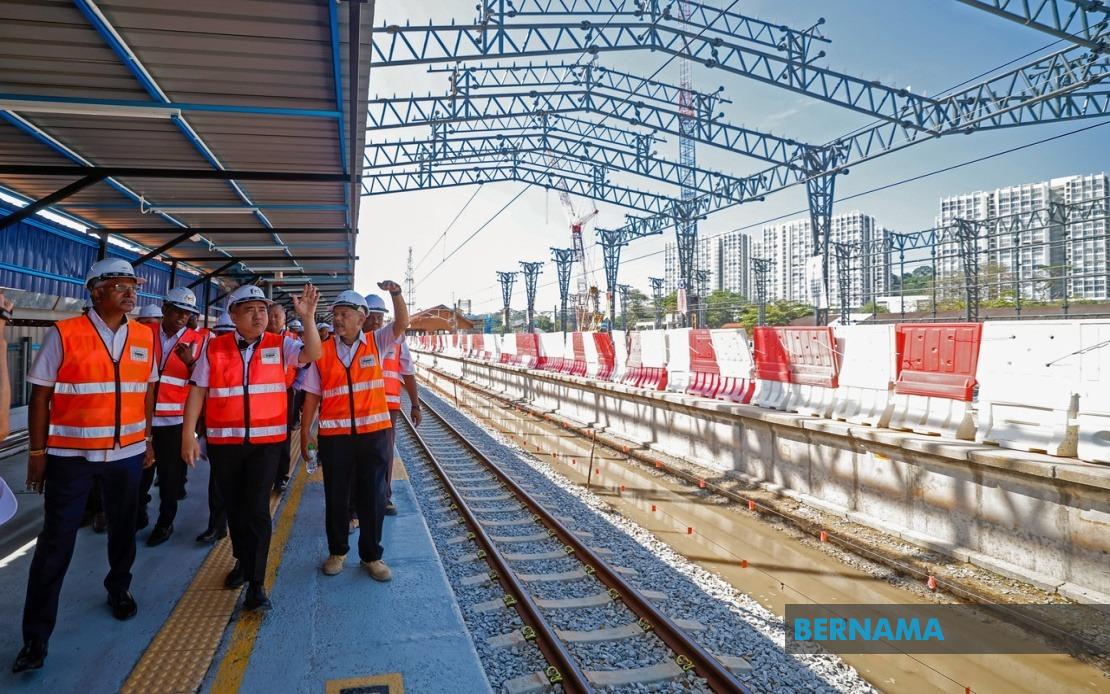
Transport Minister Anthony Loke announced that the Seremban Sentral railway station development has advanced to 35 per cent completion, with the ambitious integrated transport hub now on track to welcome its first passengers in March 2027. The RM100 million project represents a significant investment in Negeri Sembilan's transport infrastructure and reflects the government's commitment to modernising Malaysia's rail network beyond the Klang Valley and major urban centres.
The initial phases of the Seremban Sentral project proved substantially more time-consuming than originally anticipated, a reality that Loke attributed to the intensive foundation work required beneath the city centre. The extensive piling operations, coupled with the complex task of relocating underground utilities including electrical cables and water infrastructure, consumed considerably more time than typical construction phases. These preliminary works are now substantially complete, marking a crucial turning point that will enable contractors to accelerate the visible construction phases in the coming months.
With the foundational challenges behind them, the project will now shift focus to the installation of the station's distinctive roof structures, expansive glass facades, and interior finishes. The architectural design draws inspiration from Minangkabau heritage elements, integrating traditional aesthetic principles with contemporary green building standards. This cultural dimension distinguishes Seremban Sentral from utilitarian transport hubs elsewhere in Malaysia, positioning it as both a functional facility and a landmark reflecting the state's identity.
The station's capacity will be substantial from inception, designed to process up to 30,000 passengers daily in its initial operational phase. However, planners have constructed the facility with considerable scalability, engineering it to eventually accommodate 120,000 daily passengers as demand grows. The station's configuration includes six platform positions, though only three will be constructed initially, with the remaining three held in reserve for future expansion. This modular approach allows the facility to grow incrementally as rail ridership increases and regional population patterns shift, potentially serving the Seremban area effectively for the next three to five decades.
The transport hub incorporates dual entry points strategically positioned at Jalan Tunku Antah to the front and at the station's rear, complemented by designated drop-off zones designed specifically to manage traffic flow and minimise congestion in surrounding streets. These operational considerations reflect lessons learned from congestion problems at other Malaysian transport terminals. The design philosophy extends beyond mere movement of people, incorporating commercial spaces that will generate revenue for operational sustainability while providing retail and dining amenities for commuters.
A distinctive feature of Seremban Sentral is its integration with the existing Seremban KTMB station, a heritage structure that has served the city for more than a century. Rather than demolition, the government chose conservation, combining preservation with modernisation. The historic station's renovation, completed last month, involved upgraded electrical systems and rewired infrastructure to ensure the heritage building meets contemporary safety standards while retaining its historical character. This dual-station approach creates a seamless transport experience bridging past and future.
Flood mitigation has received particular attention in the project's design. The new station complex incorporates an independent sewerage system that channels rainwater directly into Sungai Temiang, bypassing the station area entirely. This intervention directly addresses a persistent problem that previously disrupted operations during heavy rainfall, flooding the platforms and tracks. By separating stormwater from the station's operational zones, engineers have eliminated a vulnerability that periodically crippled service during the monsoon seasons, a common challenge across Malaysia's rail network.
Loke's role as both Transport Minister and Seremban Member of Parliament underscores the political significance of this project for the constituency. The completion of Seremban Sentral will enable frequency increases across multiple rail services including Komuter and ETS operations, making rail commuting more attractive to residents. Higher service frequency typically drives modal shift away from private vehicles, supporting broader government objectives for sustainable urban transport and reduced congestion on federal roads serving the Negeri Sembilan capital.
The project sits within a broader ecosystem of rail development affecting the region. The parallel Klang Valley Double Track Phase 2 upgrade has reached 55.8 per cent completion, and temporary reductions in afternoon Komuter services reflect construction requirements on that project. These complementary investments in rail infrastructure across central Malaysia represent coordinated efforts to enhance capacity and frequency across the network, though they create short-term disruptions requiring passenger patience.
The transit-oriented development initiative at Seremban Sentral extends beyond the station structure itself. A significant mixed-use project known as TOD Seremban Sentral is planned to develop the area surrounding the station, integrating commercial, residential, and entertainment facilities within walking distance of the transport hub. This comprehensive approach to urban development aligns with international best practices for maximising the value generated by major transport infrastructure investments while creating vibrant urban destinations.
For Malaysian transport planners and policymakers, Seremban Sentral represents a template for upgrading regional transport infrastructure outside Kuala Lumpur and Klang Valley. The project demonstrates how heritage preservation can coexist with modern facility requirements, how modular design permits future expansion without wasteful oversizing, and how integrated transport and urban development can generate mutual benefits. The March 2027 completion date will establish a benchmark for evaluating similar projects across Peninsular Malaysia's secondary cities seeking to enhance their competitive positioning through improved transport connectivity.

