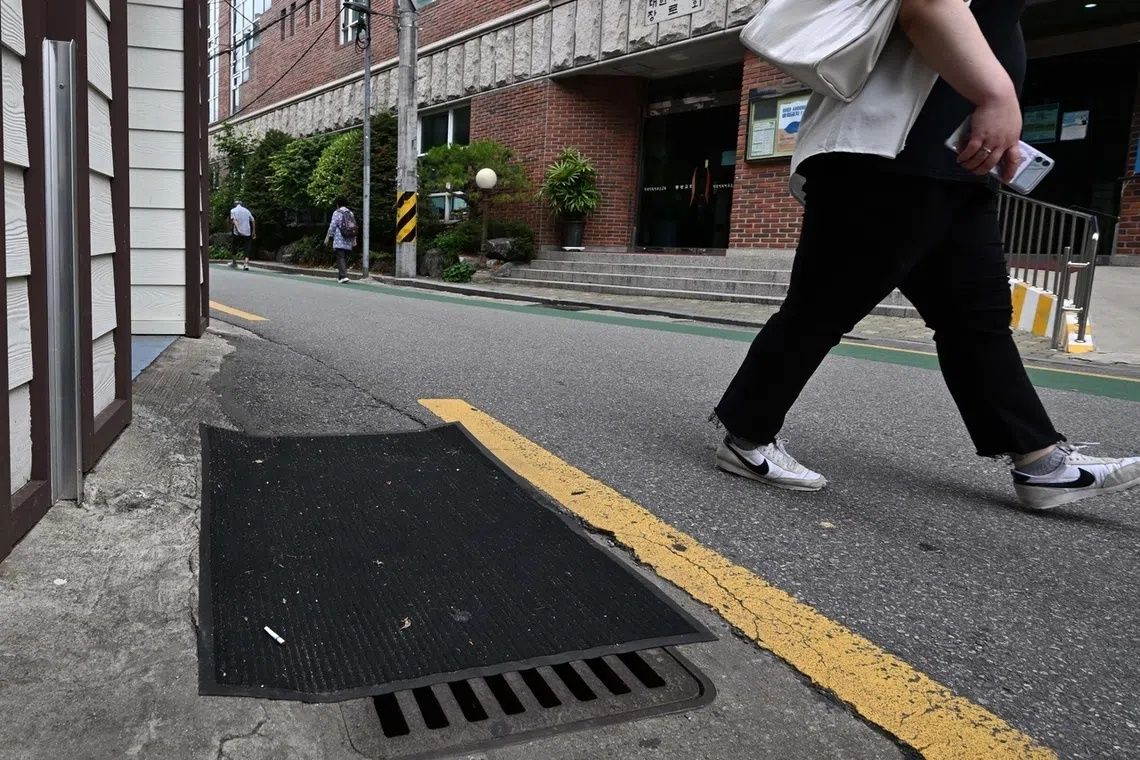
Pedestrians walking through Seoul's neighbourhoods frequently encounter an unpleasant odour that vanishes as quickly as it arrives—but the pattern of complaints reveals a persistent urban problem that the South Korean capital has struggled to resolve. The sharp, rotten egg-like smell that catches visitors and residents off guard at bus stops and street corners has become a recurring civic issue, spawning countless posts across Korean and international online forums. What began as sporadic grievances has evolved into a documented pattern of environmental dissatisfaction that officials acknowledge but struggle to eliminate.
Sewer-related odours form the core of Seoul's urban smell problem, accounting for roughly half of all odour complaints registered with city authorities, according to a 2025 Seoul Institute report. The source of the offensive stench is hydrogen sulfide, a noxious gas produced when organic matter in sewage breaks down in oxygen-scarce conditions. This chemical process occurs naturally whenever wastewater sits in an airless environment, but Seoul's particular circumstances have created conditions where the problem repeats cyclically despite intervention efforts spanning over a decade.
The fundamental challenge traces back to Seoul's urban development trajectory. The city's explosive growth outpaced its sewer infrastructure's capacity, forcing residents and property managers to install septic tanks as interim solutions before waste enters the underground network. These tanks handle solid material effectively, but dissolved organic compounds continue flowing through the city's underground pipes where they decompose and generate hydrogen sulfide. This trapped gas accumulates in maintenance holes, storm drains, and other openings, eventually reaching street level where it becomes unavoidable to pedestrians.
Weather patterns significantly influence the severity of Seoul's odour problem. Rainfall volume and intensity directly affect gas concentration in the sewer system. During heavy downpours, increased water volume moves sewage through pipes more rapidly, flushing out accumulated hydrogen sulfide before concentrations become problematic. Conversely, hot, dry periods with minimal rainfall create stagnation conditions where gases build up unchecked and escape through numerous underground access points scattered throughout the urban landscape.
The structural design of Seoul's sewer network represents another critical factor limiting odour control effectiveness. The city employs a combined system where domestic wastewater and street stormwater travel through identical underground pipes. This design, while economical historically, creates operational challenges because different water volumes and compositions produce conflicting management requirements. Seoul has theoretically recognised this problem since the early 1990s and initiated plans to separate the wastewater and stormwater streams into distinct pipe networks. However, practical implementation has proceeded glacially—by 2025, merely 20.4 per cent of Seoul's total sewer infrastructure had transitioned to the separated system, illustrating how formidable the engineering and financial obstacles prove.
Numeric data on complaint trends underscores the limitations of Seoul's existing mitigation strategy. Following the launch of odour reduction initiatives in 2015, complaints dropped substantially from 3,095 to 1,660 by 2020, suggesting that dedicated effort could address the problem. Yet this improvement proved temporary. By 2024, complaints had climbed back to 2,302, indicating that the gains were either unsustainable or insufficient. This trajectory suggests that reactive responses and device-level interventions cannot permanently resolve a problem rooted in systemic infrastructure deficiencies.
Seoul's current legal and regulatory framework shapes how officials approach the issue, often constraining their ability to take preventive action. Existing ordinances concentrate on managing odours that exceed established thresholds rather than mandating proactive prevention across the entire sewer system. This complaint-driven orientation means the city responds to problems after residents experience them, rather than implementing comprehensive solutions that would eliminate conditions allowing hydrogen sulfide to accumulate. Ki Dong-won, a researcher at the Seoul Institute, emphasises that this reactive posture prevents the city from developing standardised, long-term strategies. The absence of predictive models showing how sewer odours disperse above ground leaves vulnerable neighbourhoods unidentified and unprotected.
Research gaps compound the challenge. Seoul lacks adequate odour mapping systems connected to performance metrics that would allow planners to evaluate whether specific reduction facilities actually deliver benefits. While efforts to create sewer odour maps have commenced, these remain disconnected from measurable standards or accountability mechanisms. This information vacuum makes it difficult for engineers and planners to diagnose problems methodically or allocate resources efficiently. Without sophisticated understanding of where odours originate underground and how they propagate through urban spaces, interventions remain somewhat ad hoc rather than strategically targeted.
Expert recommendations point toward solutions that existing combined sewer cities have successfully implemented. Park Seok-soon, an environmental engineering professor emeritus at Ewha Womans University, proposes artificial circulation of water through sewer pipes to prevent stagnation and decomposition. Rather than waiting for natural water flow from precipitation or usage, the city could draw from hydrants and other municipal sources to maintain continuous movement through pipes, inhibiting the conditions that produce hydrogen sulfide. This approach acknowledges the financial reality that completely replacing Seoul's combined sewer system remains impractical despite its theoretical advantages.
Comparable municipalities in developed nations demonstrate that properly managed combined sewer systems need not generate persistent odour problems. Japan and other countries operate identical infrastructure types without the chronic complaints plaguing Seoul, suggesting that management rigour and technical discipline, rather than infrastructure type alone, determine outcomes. This international context challenges Seoul's assumption that fundamental redesign is the only viable solution. Proactive management practices, systematic monitoring, and rigorous maintenance protocols might achieve acceptable results without the extraordinary cost and disruption of wholesale pipe replacement across a metropolitan area.
For Malaysian and Southeast Asian readers, Seoul's extended struggle offers cautionary lessons about rapid urban expansion and infrastructure planning. Many cities across the region face similar pressures to accommodate explosive population growth within existing frameworks, potentially creating analogous problems. The challenge Seoul faces—balancing development urgency against long-term environmental management requirements—resonates across rapidly urbanising Asian economies. Seoul's experience suggests that interim solutions, while politically expedient, often entrench problems requiring more expensive remediation later, and that fundamental policy frameworks must prioritise prevention over reactive complaint management.
The persistence of Seoul's sewer odour problem ultimately reflects not technical impossibility but institutional choices about priorities and resource allocation. The city's environmental agencies have identified viable solutions ranging from infrastructure separation to artificial water circulation, yet implementation remains slow and incomplete. Whether Seoul's government will escalate commitment to permanent solutions or continue managing the problem through incremental measures remains uncertain. The coming years will reveal whether a major developed economy confronting a persistent civic annoyance will invest in systemic reform or accept the ongoing presence of unwanted odours as an acceptable cost of urban life.

