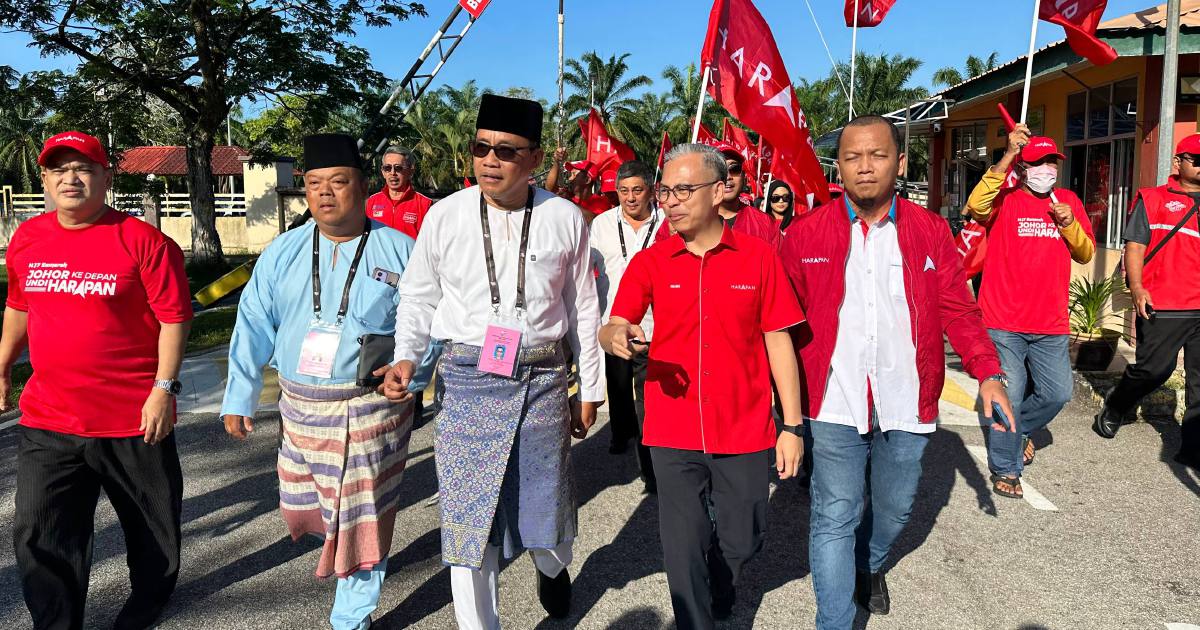
The Semerah state seat in Johor is shaping up for a closely watched rematch between Malaysia's two dominant political coalitions as candidates formally filed their nomination papers at Dewan Mahkota, Maktab Rendah Sains Mara in Batu Pahat this morning. The venue witnessed spirited displays of political enthusiasm, with supporters gathering to cheer on their respective contenders while reciting religious greetings and rallying calls that underscored the intensity of competition in this pivotal constituency.
The prospect of a Barisan Nasional versus Pakatan Harapan face-off in Semerah reflects the broader polarisation of Malaysian politics at the state level, where these two coalitions have established themselves as the primary protagonists in electoral contests across the peninsula. For Johor specifically, the dynamics surrounding Semerah carry particular significance given the state's historical role as a BN stronghold, though recent electoral cycles have demonstrated growing competitiveness across multiple seats.
Nomination day proceedings represent the formal beginning of the campaign phase, during which candidates and their respective machinery mobilise supporters and articulate their policy platforms to persuade voters. The ceremonial nature of the nomination process—where candidates file their papers before returning officers—serves as a crucial checkpoint ensuring only qualified individuals contest, while simultaneously generating considerable public interest and media attention around emerging or returning candidates.
The revival of familiar names and coalitions contesting the Semerah seat suggests both continuity and unresolved electoral competition from previous contests. Malaysian constituencies frequently witness repeat matchups between the same coalitions across successive elections, particularly in constituencies where the margin of victory was narrow or where demographic and political shifts have rendered the outcome uncertain. This pattern reflects the entrenchment of two-coalition dominance in Malaysian politics, where third-force candidates rarely achieve breakthrough victories except under exceptional circumstances.
For Johor voters in Semerah, the choice between BN and PH represents fundamentally different visions for state governance and economic management. Barisan Nasional's traditional emphasis on developmental stability, established administrative machinery, and continuity with federal-level governance appeals to constituencies valuing predictability. Pakatan Harapan, by contrast, positions itself as a reform-oriented alternative emphasising political renewal, anti-corruption measures, and greater accountability, messages that have resonated with urban and younger demographics across multiple state elections.
The nomination process itself unfolds under strict electoral commission guidelines designed to ensure transparency and fairness in candidate registration. Each nominee must satisfy residency requirements, hold citizenship, and meet age thresholds, among other statutory conditions. The returning officer's verification of these credentials occurs publicly, allowing media and observers to confirm that all contenders meet constitutional and electoral standards for candidacy.
Batu Pahat's status as the administrative hub for the Semerah constituency makes Dewan Mahkota an appropriate venue for this significant political ritual. The district encompasses both urban centres and rural areas, presenting candidates with diverse constituencies encompassing traders, professionals, farmers, and manufacturing workers whose economic concerns may diverge substantially. This heterogeneity typically requires candidates to craft messaging that addresses infrastructure development, employment generation, agricultural support, and urban services simultaneously.
The timing of the Johor state election reflects the state government's constitutional dissolution of the assembly, following established electoral cycles and political developments within the ruling coalition. Regular electoral contests remain foundational to Malaysia's parliamentary democracy, providing mechanisms for peaceful power transfers and renewal of political mandates at regular intervals. State elections, though receiving less international attention than federal contests, meaningfully shape governance outcomes affecting daily life for millions of Malaysians through education policy, land management, public services, and local development initiatives.
For political analysts observing Malaysian elections, Semerah represents a microcosm of broader national trends including coalition stability, voter volatility in semi-urban constituencies, and the efficacy of party machinery in converting organisational advantage into electoral performance. The outcome in Semerah will contribute to understanding whether Johor remains aligned with federal-level political preferences or whether state-specific considerations drive voter decisions differently from peninsular electoral patterns.
As nomination day concludes and candidates transition into active campaigning, the Semerah contest will proceed according to the electoral commission's predetermined schedule, culminating in polling day when voters render their ultimate verdict. The rematch scenario suggests both coalitions maintain sufficient organisational infrastructure and local support bases to justify fielding experienced or newly appointed candidates, each confident of competitive viability in what appears destined to become a closely observed state-level battleground.

