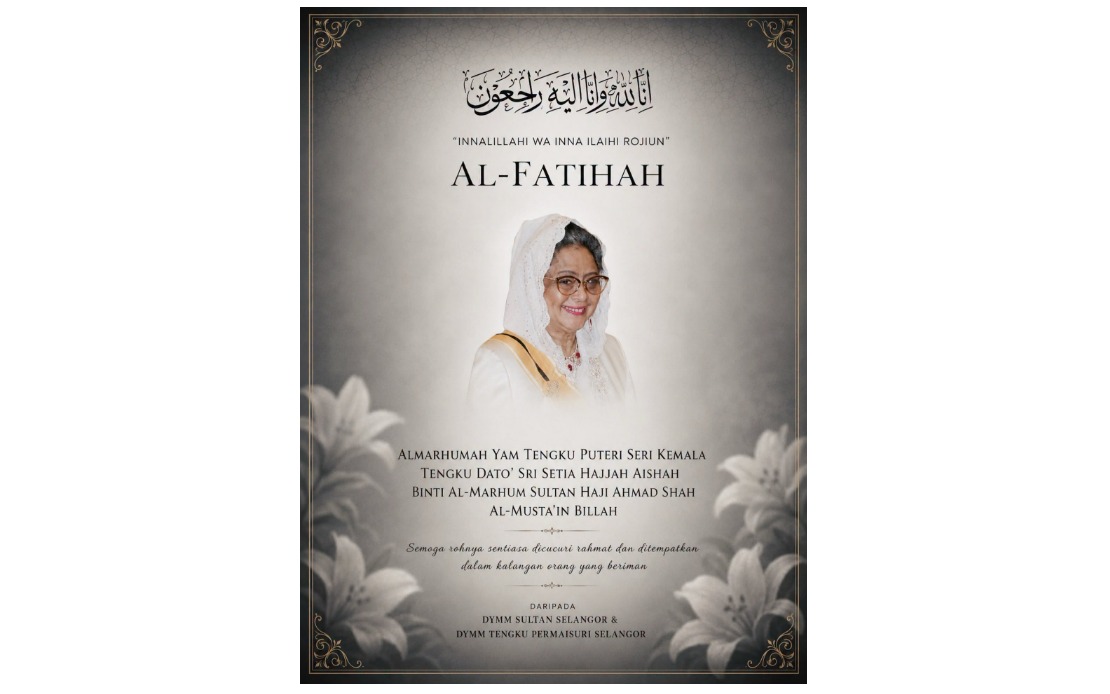
The Malaysian royal establishment observed a solemn moment of collective mourning as the Selangor palace formally acknowledged the death of a senior member of the Pahang royal family. Sultan Sharafuddin Idris Shah and his consort, Tengku Permaisuri Norashikin, issued a statement of sympathy directed toward Al-Sultan Abdullah Ri'ayatuddin Al-Mustafa Billah Shah, the reigning Sultan of Pahang, following the loss of his older sister, Tengku Datuk Seri Aishah, daughter of the late Sultan Ahmad Shah.
The Selangor Royal Office released an official communiqué expressing the deep sadness felt by the Sultan and Tengku Permaisuri at the passing of the distinguished royal figure. Their statement conveyed not merely formal acknowledgement but genuine sorrow, with prayers offered that the deceased's soul would find peace and be received into divine mercy. The sentiment reflected the close bonds that typically characterise relationships within Malaysia's interconnected royal system, where multiple sultanates maintain longstanding ties of kinship and protocol.
Tengku Datuk Seri Aishah breathed her last at a medical facility in Kuala Lumpur at 9.15 pm on the evening preceding the formal announcement. The circumstances of her passing marked the conclusion of a life lived within the parameters of royal responsibility and public service, characteristics that have traditionally defined members of the Pahang royal household across generations. Her death represents the loss of a bridge to an earlier era of Malaysian monarchy, as she was directly connected to Sultan Ahmad Shah, one of the nation's most prominent historical royal figures.
Arrangements for her final respects proceeded according to established royal protocols and Islamic custom. Her remains were transferred to the Pahang Royal Mausoleum situated in Pekan, the traditional resting place for senior members of the Pahang sultanate. The burial ceremony was conducted with the full ceremonial honours typically reserved for royalty of her standing, ensuring that her passing received appropriate recognition within both religious and institutional frameworks.
This exchange of condolences illustrates the formal mechanisms through which Malaysia's monarchical structure maintains cohesion and mutual respect across state boundaries. While each sultanate possesses independent governance and ceremonial authority, occasions such as deaths within the royal families activate networks of sympathy and solidarity that underscore the fundamental unity of the Malaysian royal institution. The Selangor palace's swift and carefully worded response demonstrated the diplomatic attentiveness required in managing relationships between different state monarchies.
The passing of Tengku Datuk Seri Aishah carries broader significance within the context of Malaysia's contemporary monarchy. Her generation witnessed transformative periods in the nation's history, and individuals of her status often served important symbolic and advisory functions within their respective court structures. The loss of such figures inevitably prompts reflection on continuity and succession within royal households, as well as the preservation of institutional memory and historical perspective that senior members uniquely embody.
For the Pahang sultanate specifically, this bereavement affected the immediate family circle of the reigning monarch at a personal level while simultaneously engaging wider formal networks. The Sultan of Pahang, as the reigning head of state for his sultanate, would be supported by expressions of solidarity from counterparts throughout the Federation, a practice that reinforces the institutional character of Malaysian monarchy as a system transcending individual sultanates.
The formal nature of the Selangor palace's statement, including the invocation of Islamic prayers and traditional expressions of sympathy, reflected the religious dimension that invariably accompanies royal deaths in Malaysia. The integration of Islamic observance with royal ceremony remains a defining feature of Malaysian monarchical practice, ensuring that deaths within the royal family are marked with both secular dignity and spiritual reverence appropriate to the nation's constitutional framework.
These expressions of condolence, while ceremonial in nature, serve important functions in maintaining social cohesion and demonstrating the mutual respect that undergirds the Malaysian federal structure. The willingness of one state's leadership to formally acknowledge significant events in another state's royal household reinforces bonds that, while formal, remain substantive in their contribution to national stability and institutional continuity.

