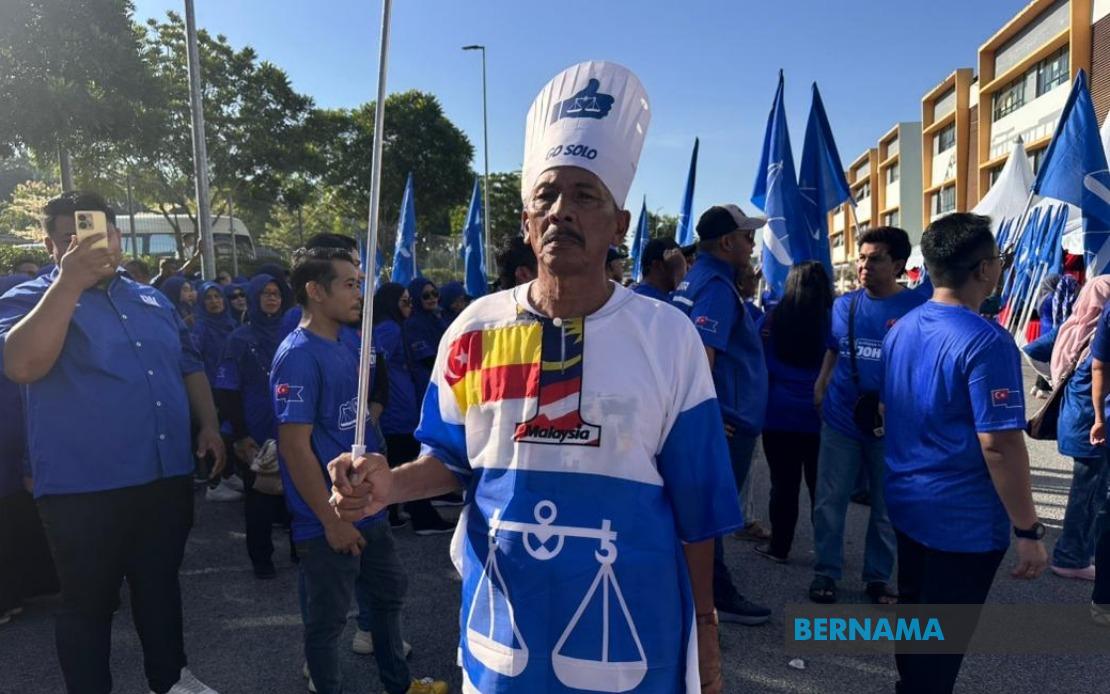
A retiree from Selangor's commitment to supporting Barisan Nasional came into sharp focus during the nomination proceedings for the 16th Johor state election, when he travelled across state lines and dipped into his savings to campaign for Menteri Besar Datuk Onn Hafiz Ghazi. Alias Samad, aged 68, arrived at the Simpang Renggam District Council's Dewan Muafakat nomination centre early on June 27, drawing attention not just for his presence but for his distinctive appearance—a custom-tailored white and blue outfit bearing both the BN logo and the Selangor state flag.
The retired civil servant's cross-state journey underscores a broader pattern of voter mobilisation during Malaysia's state elections, where personal investment in campaign activities extends beyond financial contributions to encompass time, effort, and symbolic gestures. For Alias Samad, the financial outlay was substantial relative to a retiree's fixed income. He disclosed that tailoring his statement outfit consumed approximately RM50, while the combined expenses for travel, meals, and lodging across the inter-state trip exceeded RM500—a meaningful sum drawn directly from his pension savings.
Alias Samad's motivation for undertaking this journey stemmed from a personal connection forged during electoral campaigning in his home constituency. He credited Onn Hafiz's direct engagement with residents of Sungai Tawar in Sabak Bernam as the catalyst for his decision to reciprocate with tangible support. This ground-level interaction between political leadership and constituents illustrates how electoral campaigns function at the grassroots level in Malaysian politics, where face-to-face encounters can translate into sustained voter commitment that extends across geographic boundaries.
The father of twelve's pilgrimage to Johor reflects the personal stakes that ordinary Malaysians invest in electoral outcomes, particularly in contests perceived as significant or competitive. His willingness to mobilise personally—rather than offering remote support—suggests a conviction about the importance of his physical presence during the nomination stage, a procedural moment often overlooked in favour of campaign rallies or polling day itself. The visibility of supporters at nomination centres carries symbolic weight in Malaysian electoral culture, signalling grassroots enthusiasm and organisational capacity.
Onn Hafiz's campaign in Machap represents a closely watched battleground in the broader Johor electoral context. The Menteri Besar faces a direct contest against Pakatan Harapan's Nor Hafiz Roslan, transforming this particular seat into a microcosm of the state-level competition between these political coalitions. The personal investment demonstrated by supporters such as Alias Samad indicates the intensity of engagement surrounding this specific matchup, with BN seeking to retain both the seat and the menteri besar's portfolio.
The narrative of a retiree spending substantial personal resources carries particular resonance in the Malaysian political discourse surrounding voter authenticity and grassroots engagement. Unlike institutional campaign machinery or corporate-funded activities, individual supporters financing their own participation are often presented as embodying genuine political conviction, free from calculation or obligation. Alias Samad's actions exemplify this narrative of voluntary, self-funded activism that parties frequently highlight to demonstrate organic support.
For Malaysian observers, particularly those in peninsular Malaysia outside Johor, the story illuminates how state elections can mobilise supporters across significant distances. The willingness of Selangor residents to invest in Johor political outcomes suggests either broader factional loyalties within BN or personal relationships that transcend state boundaries. Such cross-state engagement has become increasingly common as Malaysian politics has grown more nationalised, with state contests frequently framed within larger peninsular or national political narratives.
The election itself occurs within a context of evolving political dynamics in Johor, traditionally a BN stronghold but increasingly contested by opposition coalitions. Menteri Besar Onn Hafiz's leadership represents a newer generation within BN's Johor establishment, and his ability to inspire personal sacrifice among supporters like Alias Samad may indicate successful cultivation of grassroots enthusiasm beyond traditional party machinery. This generational dimension adds another layer to understanding the competitive dynamics at play during the nomination period.
Alias Samad's participation also highlights the often-invisible infrastructure of electoral campaigns—the countless small financial and personal commitments made by ordinary supporters that collectively sustain campaign activities. While major rallies and media campaigns receive prominent coverage, the cumulative effect of individuals funding their own engagement represents a significant, if underappreciated, component of electoral mobilisation. His RM500-plus expenditure, replicated across hundreds or thousands of supporters, creates substantial in-kind campaign resources.
The cross-state nature of Alias Samad's journey suggests that Johor's electoral significance extends beyond its borders within Peninsular Malaysia's political consciousness. Whether driven by party affiliation, personal loyalty to Onn Hafiz, or broader ideological commitment to BN's vision, his actions reflect the continuing salience of state-level elections as focal points for political engagement. For Selangor residents in particular, the proximity of Johor and historical interconnections between these states may facilitate such cross-boundary political participation.
Moving forward, the intensity of grassroots engagement demonstrated during the nomination stage often provides early indicators of electoral momentum and volunteer enthusiasm. Supporters like Alias Samad, willing to invest personal resources and travel significant distances, frequently constitute the foundation upon which successful campaigns are built. The visibility of such committed individuals at key electoral moments—particularly during nominations—serves multiple functions: demonstrating genuine support, creating media narratives of popular enthusiasm, and energising the broader volunteer base.

