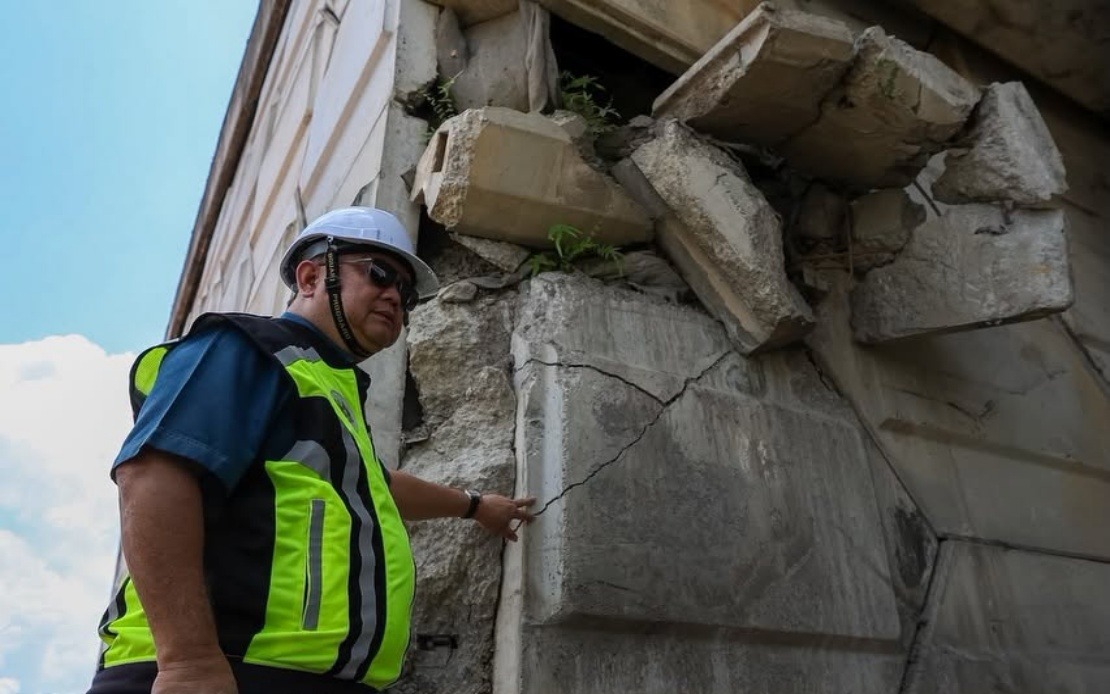
Works Minister Datuk Seri Alexander Nanta Linggi has committed to reopening the Selangau-Mukah Interchange Flyover in carefully managed phases, contingent upon comprehensive safety verification and structural rehabilitation. The commitment comes after the Pan Borneo Highway section suffered significant damage when Ramp 1 was struck by a palm oil tanker, necessitating immediate closure and detailed technical investigation to determine the extent of compromise to the infrastructure's structural integrity.
During an on-site inspection in Sibu, Nanta revealed that engineers have completed initial assessments confirming damage to the retaining wall structure at the impact point. The findings have shaped the ministry's reconstruction strategy, which prioritises controlled, methodical repairs designed to restore full stability to the affected zones before permitting vehicle passage. This phased approach allows uncompromised sections to reopen progressively while sections still presenting risk remain sealed off throughout the rehabilitation period.
The closure has generated considerable public concern and disruption, particularly affecting commuters and regular users along the vital Bintulu-Mukah-Sibu corridor. Nanta acknowledged the substantial inconvenience this has created for residents and commercial traffic dependent on this route, yet maintained that expediting reopening without guaranteeing structural soundness would represent an unacceptable compromise on public welfare. His statements reflect pressure from local stakeholders while asserting that premature reopening would contradict the government's responsibility to road users.
Nanta outlined three foundational priorities guiding the ministry's response: unwavering commitment to safety standards for all highway users, rigorous management of repair timelines to prevent avoidable delays, and transparent public communication regarding closure zones, available detours, and progress updates. These commitments suggest recognition that infrastructure incidents require not merely technical solutions but also effective stakeholder management and information dissemination to maintain public confidence in highway authorities.
The minister emphasised that community feedback warrants serious institutional attention, whether originating from conventional media channels or social media platforms. This acknowledgment reflects evolving awareness among Malaysian government agencies that public concerns about infrastructure safety cannot be dismissed and that digital communication has become integral to citizen engagement during infrastructure crises. Nanta's statement implicitly recognises that communities directly affected by closures possess legitimate standing to demand clarity and regular updates.
The Pan Borneo Highway represents a substantial infrastructural investment spanning Sarawak, designed to enhance connectivity and economic development across the state. Damage to critical interchange points like Selangau-Mukah consequently affects not merely local commuter patterns but broader regional economic flows, particularly for the palm oil and timber industries that depend on efficient freight movement. The extended closure creates disruptions rippling through supply chains and affecting business operations across Sarawak's interior regions.
The incident underscores vulnerabilities in critical highway infrastructure to collision damage from heavy commercial vehicles. The involvement of a palm oil tanker suggests that without enhanced safety measures or traffic management protocols, similar incidents could recur. Nanta's commitment to oversight of reconstruction may implicitly include evaluation of whether additional protective measures or traffic calming interventions should be incorporated during repairs to prevent recurrence.
The phased reopening strategy balances multiple competing pressures: ensuring structural integrity, accommodating public demand for rapid restoration, and maintaining ministerial credibility through transparent progress reporting. Each phase will require independent safety certification before activation, establishing a mechanism that protects the ministry against liability whilst providing measurable assurance to road users. This approach has become standard practice for major highway incidents across Southeast Asia.
Nanta's personal oversight of the reconstruction effort signals high-level attention to resolution and suggests the ministry views this incident as significant enough to warrant ministerial involvement. Such engagement typically accelerates decision-making and resource allocation whilst generating media coverage that reassures affected communities that authorities are treating their concerns with appropriate seriousness. However, it also establishes expectations for rapid progress that must be reconciled with the genuine time requirements of structural engineering and safety certification.
The incident raises questions about maintenance protocols and inspection regimes across Malaysia's expanding highway network. Whether similar vulnerability assessments have been conducted on comparable interchange structures nationwide remains unclear, though the Selangau-Mukah situation may prompt broader evaluation of infrastructure resilience against collision impacts. Regional authorities managing major highways throughout Southeast Asia likely will examine this incident for applicable lessons regarding protective design and incident response.
For Malaysian commuters and business operators in Sarawak, the phased reopening timeline remains undefined, creating ongoing uncertainty for route planning and logistics operations. Nanta's assurance that safety dictates timelines rather than administrative convenience provides principled guidance but limited concrete scheduling information. Detailed timelines and specific reopening benchmarks would enhance public confidence and enable commercial stakeholders to develop alternative arrangements with greater certainty.
The reconstruction effort will ultimately test whether Malaysian infrastructure authorities can effectively balance safety imperatives with public expectations for rapid restoration following transport disruptions. Success requires not merely completing repairs but maintaining transparent, regular communication that keeps affected communities informed throughout the recovery process, establishing confidence that decisions are guided by genuine safety considerations rather than administrative convenience or political pressure.

