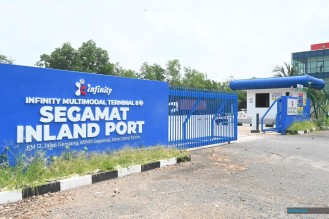
The Segamat Inland Port (SIP) in Johor has emerged as a critical piece of Malaysia's logistics infrastructure overhaul, targeting the handling of more than 6,000 TEUs of containerised cargo by the end of 2026. Since recommencing operations on June 25 following an extended shutdown that lasted over ten years, the facility managed by Infinity Logistics & Transport has already processed approximately 1,000 TEUs during its initial month of activity through July. This trajectory signals growing confidence in the facility's capacity to serve the broader regional economy, particularly across northern Johor, southern Pahang, southern Negeri Sembilan and Melaka.
The reactivation of SIP represents a cornerstone element of the government's broader Road to Rail initiative, executed in partnership with Keretapi Tanah Melayu Bhd. According to Samuel Ho, the port manager, the decision to restore operations stemmed from multiple strategic considerations beyond mere commercial viability. Rail-based freight transport fundamentally offers superior safety characteristics compared to road haulage, which remains susceptible to vehicular accidents and congestion-related delays that plague Malaysia's highways. The environmental and operational efficiencies are equally compelling: a single freight train service displaces the need for approximately 80 container trucks, substantially reducing diesel consumption while improving logistics predictability.
The reactivation timeline proved particularly fortuitous given recent infrastructure enhancements. For nearly a decade, SIP operated under significant operational constraints imposed by single-track railway configurations that forced cargo scheduling to subordinate itself to passenger train priorities. This arrangement rendered rail freight services economically impractical and operationally inflexible. The completion of double-tracking infrastructure extending to Johor fundamentally transformed the operational equation. SIP now accommodates four cargo reception and dispatch cycles weekly, representing a fourfold improvement over the single trip per week achievable under the previous single-track arrangement. This expanded capacity directly enables enhanced connectivity with major regional port complexes including Port Klang, Port of Tanjung Pelepas, and Johor Port in Pasir Gudang.
The facility occupies 20.23 hectares in its inaugural operational phase, positioned adjacent to Segamat Railway Station. Current development plans encompass three distinct expansion phases, with the initial phase already generating employment for over 200 local residents. Ho indicated that job creation would accelerate substantially as the facility completes its remaining development phases, with positions spanning security, logistics coordination, and related support functions. This employment dimension carries particular significance for districts such as Batu Pahat and Kluang, which historically experience more limited economic diversification compared to major urban centres.
The strategic importance of SIP extends beyond immediate cargo-handling metrics. Transport Minister Anthony Loke Siew Fook, during the facility's official launch ceremony, positioned SIP as a catalyst for sustained economic development throughout northern Johor while simultaneously strengthening Malaysia's integrated logistics architecture. The facility's operations promise to eliminate approximately 18,000 lorry movements—encompassing both standard trucks and container vehicles—from Malaysian roads monthly. This reduction translates directly into tangible improvements in highway safety, diminished traffic congestion, and more efficient utilisation of the national rail network.
The efficiency gains extend to supply chain optimisation across the broader region. By channelling containerised cargo through rail infrastructure rather than road transport, SIP improves cargo predictability and reduces delivery variance, factors increasingly important to multinational manufacturers and regional distribution networks. Industrial facilities throughout northern Johor benefit from enhanced logistics certainty, a consideration that Ho emphasised may attract additional manufacturing and warehouse development investment to surrounding industrial zones. The facility essentially functions as economic infrastructure that enhances the competitive positioning of interior locations relative to coastal urban centres.
SIP's operational framework reflects evolution in Malaysia's understanding of inland port functionality. Rather than functioning exclusively as transshipment nodes, modern inland ports serve as catalysts for regional economic clustering, attracting supporting industries and creating multiplier employment effects throughout surrounding communities. The collaboration between SIP management and Universiti Tun Hussein Onn Malaysia (UTHM) formalises knowledge transfer regarding rail-based inland port operations, providing academic institutions with practical fieldwork exposure while generating research that advances Malaysia's logistical capabilities.
The broader context underscores Malaysia's necessity to develop alternative transport modalities as road infrastructure saturates. Despite continuous highway expansion, Malaysia's trucking sector operates under increasing congestion pressure, particularly along critical corridors connecting major ports to interior industrial zones. Rail-based alternatives offer scalability and cost advantages as cargo volumes expand, provided that supporting infrastructure investments—such as the Johor double-tracking project—receive adequate prioritisation. SIP effectively demonstrates this principle in practice.
Looking toward the 6,000 TEU annual target, the facility's success depends partially on shipper and logistics operator awareness of available services. Industry participants must reassess traditional road-dependent supply chains in light of SIP's expanded capacity and improved scheduling reliability. For Malaysian manufacturers exporting through regional ports or importing containerised inputs, rail-based options now provide competitive alternatives worthy of serious evaluation. The monthly reduction of 18,000 lorry movements represents a measurable environmental and safety gain if fully realised.
The reactivation of SIP also carries implications for Malaysia's positioning within Southeast Asian logistics networks. As competing nations such as Thailand and Vietnam enhance their inland container capabilities, Malaysian operators must leverage comparable infrastructure advantages. SIP's operation under modern management practices and improved railway infrastructure positions Johor as an emerging alternative for regional shippers seeking rail-efficient logistics solutions. This competitive dimension reinforces the strategic importance of achieving operational targets and demonstrating reliability to potential users.
Operational success will ultimately depend on sustained demand from industrial users, port operators, and logistics providers. The 6,000 TEU target by year-end represents an achievable intermediate objective that would demonstrate the facility's viability to stakeholders initially sceptical of inland port advantages. Beyond numerical targets, SIP's true significance lies in its potential to reshape how Malaysia approaches supply chain infrastructure, moving toward integrated multimodal systems that leverage rail economics for heavy containerised freight while maintaining trucking's flexibility for final-mile distribution. For regional observers, SIP exemplifies how dormant infrastructure can experience transformation when strategic planning, infrastructure investment, and operational management converge effectively.

