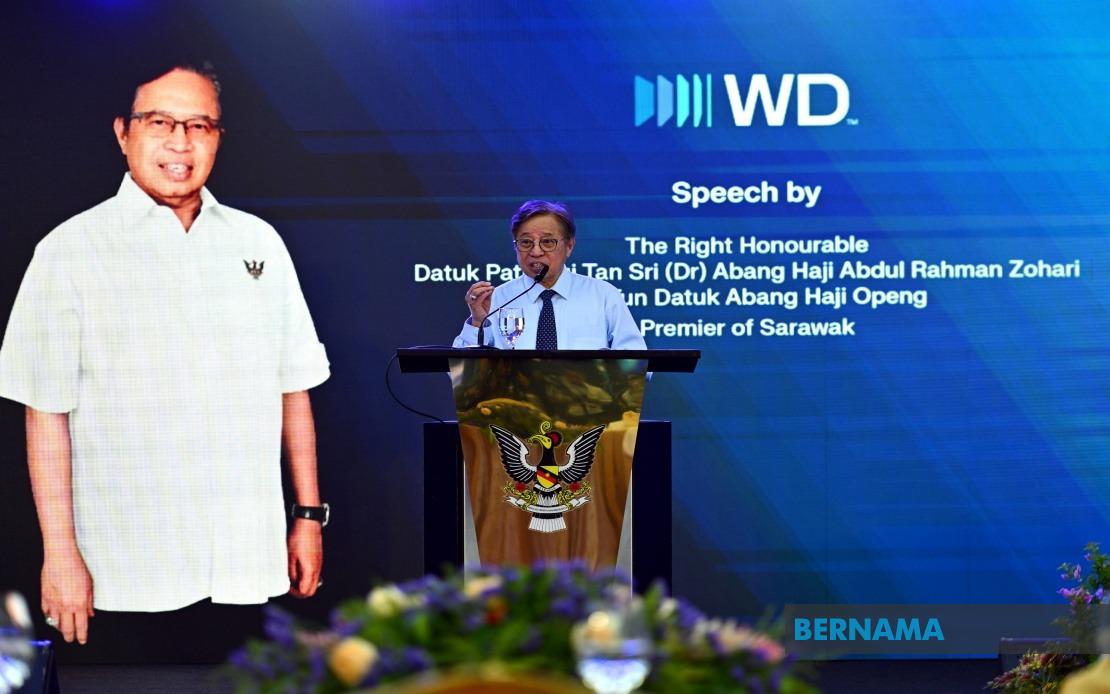
Sarawak's leadership has signalled pragmatic flexibility regarding a potential increase in the state's special constitutional grant, framing any advancement as dependent on whether the federal budget can sustain it. Premier Tan Sri Abang Johari Tun Openg delivered this measured response while acknowledging both the state's aspirations and the broader constraints facing Malaysia's fiscal position, striking a notably cooperative tone amid ongoing federalism discussions.
During remarks at a technology sector event in Kuching, Abang Johari explained that Sarawak recognises the Prime Minister's budgetary constraints and stands ready to accept whatever the federal government can reasonably provide. His statement reflects a departure from confrontational posturing that sometimes characterises centre-state relations in Malaysia, instead emphasising mutual understanding of fiscal realities. This calibrated approach underscores how regional administrations increasingly balance demands for fairer resource allocation against macroeconomic prudence at the federal level.
The special grant mechanism enshrined in Article 112D of the Federal Constitution remains a cornerstone of Sarawak's fiscal arrangement within Malaysia, rooted in the Malaysia Agreement 1963 (MA63). These provisions were designed to recognise Sarawak's unique constitutional position and resource wealth when the state joined the federation. Over decades, however, debates about whether the grant has kept pace with inflation, population growth, and developmental needs have periodically surfaced, creating periodic friction between Kuching and federal authorities.
Abang Johari disclosed that formal negotiations on any grant enhancement have not yet progressed beyond preliminary discussions. He noted that the matter was raised only in general conversation during a recent meeting with Prime Minister Datuk Seri Anwar Ibrahim in Bintulu, without detailed proposals or figures being tabled. This absence of substantive negotiation suggests the initiative remains exploratory rather than urgent or confrontational, consistent with the premier's diplomatic framing.
Prime Minister Anwar's own confirmation, delivered in the Dewan Rakyat on June 30, that discussions on Sarawak's special grant continue, carries significance beyond routine acknowledgment. By linking these conversations explicitly to the spirit of MA63, Anwar emphasised the government's commitment to honouring the foundational agreement governing Sarawak's federation status. Such language resonates powerfully in Sarawak, where constitutional arrangements and historical agreements carry symbolic weight in discussions of state autonomy and federal relations.
Beyond immediate fiscal negotiations, Abang Johari used the occasion to articulate a forward-looking vision of Sarawak's economic trajectory centred on technological advancement and renewable energy infrastructure. His remarks reflected the state's strategic pivot toward high-value sectors beyond traditional resource extraction, particularly data storage technology and artificial intelligence-driven industries. This repositioning carries implications for federal-state resource discussions, as states presenting credible economic diversification strategies often find themselves in stronger negotiating positions.
The premier highlighted Sarawak's three-decade partnership with Western Digital, the American technology corporation, as exemplifying how the state attracts international capital through competitive advantages in renewable energy and abundant freshwater resources. These natural advantages have positioned Sarawak as an increasingly attractive destination for data centre operations, which require substantial power supplies and cooling capacity. The state's expanding technology sector thus represents a genuine claim to developmental momentum that may inform future discussions about resource allocation and grant levels.
Glass substrate technology, which Western Digital is advancing in Sarawak, represents a substantial leap in data storage capacity compared to conventional recording methods. This innovation matters particularly as artificial intelligence infrastructure demands exponentially larger computational and storage capabilities. Sarawak's involvement in manufacturing these next-generation components positions the state within genuinely cutting-edge sectors, lending credibility to arguments about future revenue generation and investment attraction.
Abang Johari's assertion that data will become more valuable than oil in coming decades reflects a globally acknowledged shift in how economies generate wealth and competitive advantage. For a state long dependent on petroleum revenues, this framing signals recognition that long-term prosperity depends on diversification into knowledge-intensive industries. Malaysian policymakers at both federal and state levels are grappling with this reality, though progress toward genuine high-tech clustering remains uneven across the country.
The strategic importance of Sarawak's renewable energy endowment has grown considerably as technology companies increasingly commit to carbon-neutral operations. Major multinational corporations now prioritise locating energy-intensive facilities where abundant clean power is available and sustainably generated. Sarawak's hydroelectric resources and potential for renewable expansion thus function as genuine competitive advantages in attracting data centre and semiconductor-related investments, providing economic substance to the state's negotiating position.
For Malaysian federalism more broadly, the Sarawak grant discussion illustrates how constitutional arrangements continue shaping resource distribution decades after the agreements were signed. That both state and federal leadership approach these matters through negotiation rather than confrontation suggests institutional mechanisms, however imperfect, do function to manage centre-periphery tensions. However, the absence of detailed progress indicates either limited priority on either side or genuine fiscal constraints limiting what Kuala Lumpur can offer.
The coming months will reveal whether these preliminary discussions mature into substantive negotiations with specific proposals and figures. The federal government's overall budget position, shaped by spending commitments, revenue performance, and debt service obligations, ultimately constrains what can be offered. Simultaneously, Sarawak's demonstrated capacity to attract high-value technology investment strengthens the state's argument that enhanced fiscal capacity would generate returns benefiting the broader federation.

