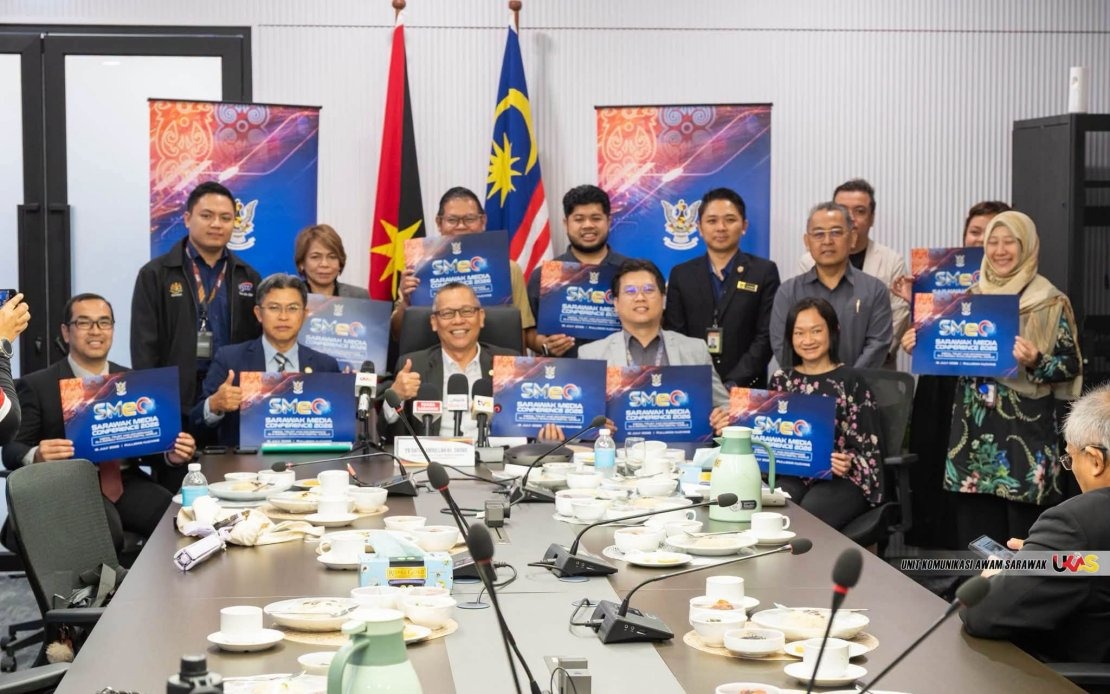
The Sarawak Government is preparing to host a significant gathering of media and communications professionals this week, with organisers expecting around 800 delegates to attend the inaugural Sarawak Media Conference (SMeC) 2026. The event, coordinated through the Sarawak Public Communications Unit (UKAS), will serve as a platform for stakeholders across the media landscape to engage with critical questions about maintaining public trust, implementing sound governance practices and navigating the complexities of an increasingly digital world. The conference carries particular relevance for Malaysia and Southeast Asia, where media fragmentation and the proliferation of digital platforms have intensified scrutiny on journalistic standards and institutional credibility.
Sarawak Premier Tan Sri Abang Johari Tun Openg will formally open the proceedings, underlining the state government's commitment to media discourse as a policy priority. The gathering has been framed around the theme "Media, Trust and Governance in a Rapidly Evolving Digital World," a formulation that acknowledges the interconnected nature of contemporary challenges facing news organisations and information ecosystems. According to Datuk Abdullah Saidol, Deputy Minister in the Sarawak Premier's Department with responsibility for corporate affairs, information and UKAS, the conference will concentrate on two complementary objectives: strengthening the relationship between media institutions and the public they serve, while simultaneously examining how governance frameworks can adapt to technological change.
The agenda explicitly addresses the transformative impact of digital technology on journalism and communications practice. Artificial intelligence has emerged as a focal point for discussion, reflecting broader regional concerns about algorithmic content distribution, automated reporting systems and the potential for AI-generated misinformation. Rather than treating technology as an external threat, conference organisers have positioned it as a subject requiring sophisticated engagement from practitioners who understand both its capabilities and limitations. This framing suggests recognition that media organisations across Southeast Asia cannot simply resist digital transformation but must develop informed strategies for harnessing innovation while maintaining editorial integrity.
The participant composition reveals an intentional effort to create dialogue across institutional boundaries. The expected attendance spans media practitioners working in newsrooms, academic researchers studying communications phenomena, government policymakers responsible for regulatory frameworks, industry leaders representing media and technology sectors, and students entering the profession. This diversity of perspectives theoretically enables more productive discussion than gatherings limited to journalists alone, as different stakeholder groups bring distinct concerns and expertise. For Malaysian observers, the multi-sectoral approach offers a model relevant to ongoing conversations about media regulation, press freedom and the relationship between government institutions and news organisations.
Among the confirmed speakers are prominent figures whose involvement signals the conference's reach beyond Sarawak's borders. Lunnie Gan, founder of SOL Digital, brings expertise in digital media entrepreneurship and innovation within the Malaysian context. Premesh Chandran, serving as deputy chairman of the Malaysian Media Council (MMC), represents institutional frameworks designed to uphold journalistic standards and handle complaints. The inclusion of these individuals suggests the conference will move beyond abstract principles to examine practical applications of ethical journalism in digital environments, including how media councils and industry bodies can maintain relevance as publishing platforms and audience behaviours shift.
The emphasis on ethical journalism within the conference framework responds to documented erosion of public confidence in media institutions across the region. Trust deficits have been attributed to multiple factors including perceived bias, sensationalism in digital outlets, inadequate correction protocols and the blurring of boundaries between news and commentary. By positioning ethical practice as central rather than peripheral to discussions about digital transformation, conference organisers acknowledge that technological solutions alone cannot address credibility challenges. The conversation recognises that audience trust depends fundamentally on demonstrable commitment to verification, transparency about sources and methods, and accountability when errors occur.
The conference schedule incorporates ceremonial recognition of journalistic achievement through the Sarawak Premier's Special Appreciation Awards. Five categories spanning different media disciplines—print and digital journalism, photography, video production, radio broadcasting and social media influence—acknowledge the diversification of professional roles within contemporary media ecosystems. The inclusion of social media influencers alongside traditional journalists reflects the reality that information flow and audience engagement increasingly occur through non-institutional channels. Whether influencers can be held to equivalent ethical standards as credentialed journalists represents one of the unresolved tensions in contemporary media governance, and the award categories suggest Sarawak is signalling openness to that broader conversation.
A parallel celebration of the Sarawak-level National Journalists' Day (HAWANA) 2026 will coincide with the conference, providing additional symbolic weight to the event. Deputy Prime Minister Datuk Seri Fadillah Yusof's confirmed attendance at the accompanying dinner signals federal government interest in the proceedings and potentially creates opportunity for national-level policymakers to observe and engage with media sector perspectives. This official presence may influence the tenor of discussions, particularly regarding sensitive topics such as media regulation, press freedom and government-media relations, though it also underscores the importance federal authorities attach to dialogue with media stakeholders.
The timing of SMeC 2026 coincides with intensifying regional pressures on news media, including economic challenges threatening traditional publishing models, regulatory pressures in several Southeast Asian nations, and ongoing competition from social platforms for audience attention and advertising revenue. Sarawak's initiative to convene such a forum reflects broader recognition that media institutions cannot navigate these challenges in isolation. The conference structure allows for comparison of approaches across different jurisdictions and sectors, potentially generating insights applicable to Malaysian media organisations facing similar pressures.
The focus on digital transformation acknowledges that the next phase of media evolution will be substantially shaped by decisions made now regarding AI deployment, data governance, algorithm transparency and the relationship between institutional journalism and automated information systems. For Malaysian news organisations and policymakers observing the conference outcomes, the discussions may illuminate emerging best practices for maintaining editorial standards while embracing technological innovation. The gathering also provides opportunity for Malaysian media professionals to contribute their own experiences and perspectives to regional discourse on these critical issues.
The conference's attention to governance extends beyond internal media management to encompass the regulatory environment within which media operates. This reflects understanding that trust in media institutions cannot be rebuilt without corresponding attention to the rules, oversight mechanisms and institutional frameworks that govern journalistic practice. The inclusion of policymakers alongside practitioners creates space for discussion of how regulatory approaches can support rather than constrain ethical journalism, and how government can foster environments conducive to media credibility.

