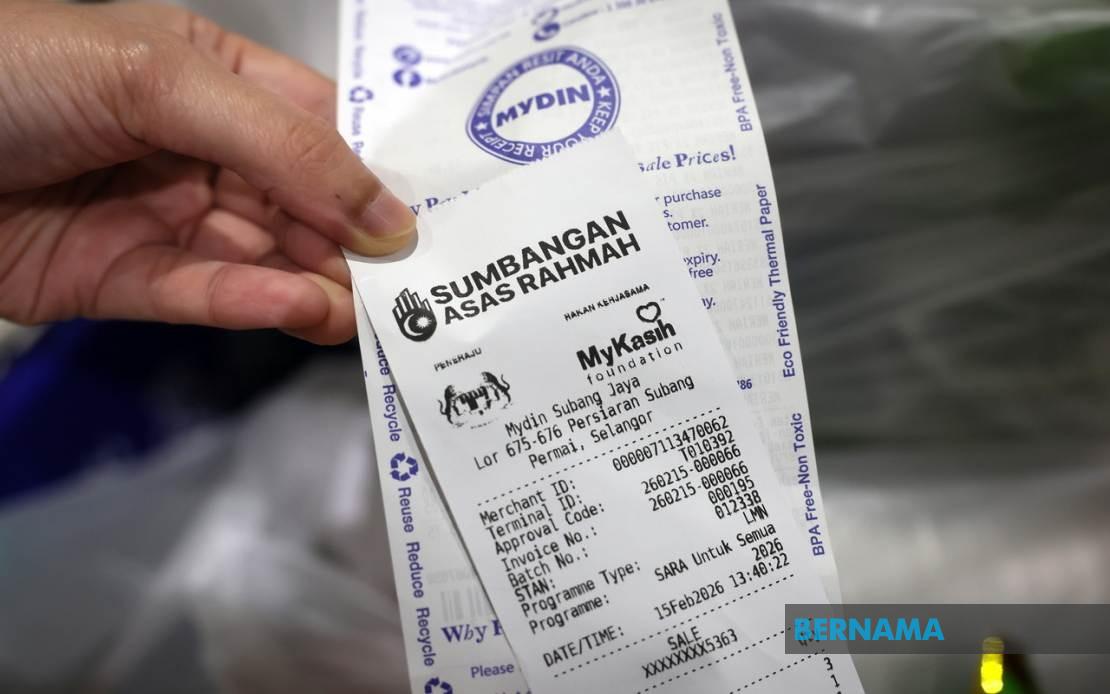
Malaysia's Sumbangan Asas Rahmah (SARA) programme is delivering substantial impact on household spending and local economic activity, with the Ministry of Finance revealing that the initiative has achieved a 99 percent utilisation rate among its nearly nine million beneficiaries. The latest figures show transaction volumes have reached RM3.45 billion since the scheme's inception this year, demonstrating strong engagement from recipients who access the cashless benefits through MyKad credits at registered outlets.
The SARA Untuk Semua component of the broader initiative has proven equally impressive, with approximately 22 million people—representing 87 percent of eligible recipients—participating in the scheme and generating over RM1.77 billion in local market transactions. These metrics, disclosed through a parliamentary written reply from the Ministry of Finance to Datuk Aminolhuda Hassan of Petaling Jaya (PH-Sri Gading), underscore the government's success in channelling aid to intended beneficiaries while simultaneously stimulating grassroots economic activity. The near-complete uptake rate among eligible Sumbangan Tunai Rahmah (STR) monthly recipients indicates that the programme has successfully overcome initial awareness and accessibility barriers that often plague welfare initiatives in developing economies.
At its core, SARA functions as a cashless distribution mechanism that operates via MyKad-based credits, allowing recipients to purchase from 15 designated essential commodity categories at a network of participating merchant outlets branded as SARA Rakan Niaga. The product basket spans basic foodstuffs, personal hygiene items, household cleaning supplies, and affordable medications—categories selected to address immediate cost-of-living pressures faced by vulnerable households. This structured approach differs markedly from conventional cash transfers, as it provides the government with granular transaction data enabling real-time monitoring of programme effectiveness and ensuring that disbursed funds serve their intended purpose of alleviating poverty and economic hardship rather than being diverted to discretionary spending.
The Ministry of Finance emphasised that recipient spending patterns function as a critical performance indicator for assessing how successfully both STR and SARA are reducing financial strain on lower and middle-income households. When beneficiaries consume the majority of their allocated credits at registered outlets, it signals that the aid instruments are meaningfully addressing household budget constraints and essential needs. Beyond direct poverty alleviation, the ministry highlighted that this spending generates positive multiplier effects throughout the local economy, as money circulates through small retailers, wholesalers, and suppliers who service the registered merchant network, thereby supporting employment and business viability in communities where poverty incidence remains elevated.
The government's commitment to expanding these programmes is evident in budgetary allocation trends. The combined STR and SARA budget has more than doubled, increasing from RM10 billion in 2024 to RM15 billion projected for 2026, reflecting a strategic pivot toward more comprehensive and targeted social protection mechanisms. This escalation signals recognition that rising living costs, particularly food price inflation and utility expenses, necessitate enhanced government intervention to sustain household purchasing power and prevent further income inequality deterioration. For Malaysian policymakers, the data validates the effectiveness of cashless, commodity-targeted aid systems over traditional cash transfers, offering a replicable model for other Southeast Asian nations grappling with similar poverty and inflation challenges.
The implementation architecture of SARA carries particular relevance for Malaysia's broader economic policy trajectory. By restricting redemption to essential items through a pre-authorised merchant network, the government simultaneously achieves multiple policy objectives: it ensures aid reaches vulnerable populations, prevents potential misuse of welfare funds, maintains oversight capacity through digital transaction records, and supports formal sector retailers who comply with programme requirements. This approach represents a middle path between paternalistic commodity rationing and unrestricted cash assistance, preserving recipient dignity and autonomy while maintaining necessary programme integrity and fiscal discipline.
The 87 percent participation rate among eligible SARA Untuk Semua beneficiaries—representing 22 million individuals across the nation—demonstrates substantial penetration into Malaysia's target demographic of lower-income workers and informal sector participants. Such comprehensive coverage is rare among developing economy social programmes, suggesting effective government coordination across federal and state welfare agencies and successful merchant network establishment even in geographically dispersed or rural areas. The RM1.77 billion in documented spending under this component alone illustrates the quantum of economic stimulus flowing into small towns and community-level retail environments where multiplier effects prove most pronounced.
Moving forward, the Ministry of Finance pledged sustained monitoring of both programmes to verify that support continues reaching those most vulnerable to economic shocks. This commitment carries significance given Malaysia's exposure to commodity price volatility, potential currency fluctuations, and structural economic transitions that disproportionately affect lower-income households. By maintaining real-time analytics on SARA transaction patterns and STR utilisation rates, policymakers acquire data enabling dynamic programme adjustment—expanding beneficiary numbers, modifying commodity baskets, or increasing per-capita allocations in response to evolving economic conditions and poverty indicators.
For the broader Southeast Asian context, Malaysia's SARA experience offers instructive lessons on designing poverty-targeted programmes in middle-income economies where informal employment predominates and financial exclusion remains substantial. The scheme's digital infrastructure, built upon existing national identity systems and merchant networks, required relatively modest implementation investment compared to building entirely new distribution systems. Similarly, the commodity-targeting approach sidesteps the inflation risks that plague purely monetary transfers while maintaining political acceptability superior to means-tested programmes that often face beneficiary stigma. As inflation pressures persist across the region and fiscal space narrows, other ASEAN governments monitoring Malaysia's SARA results may discover operational templates worthy of adaptation to their domestic contexts.
The parliamentary disclosure of SARA's performance metrics also reflects evolving standards of government accountability and evidence-based policymaking in Malaysia. By systematically publishing programme utilisation rates, transaction volumes, and comparative spending patterns across recipient cohorts, the Ministry of Finance enables informed public debate about welfare efficacy and permits opposition legislators and civil society organisations to scrutinise government claims with reference to verifiable data rather than anecdote. This transparency mechanism, while sometimes politically inconvenient for incumbent administrations, strengthens overall institutional credibility and public confidence in social policy implementation.

