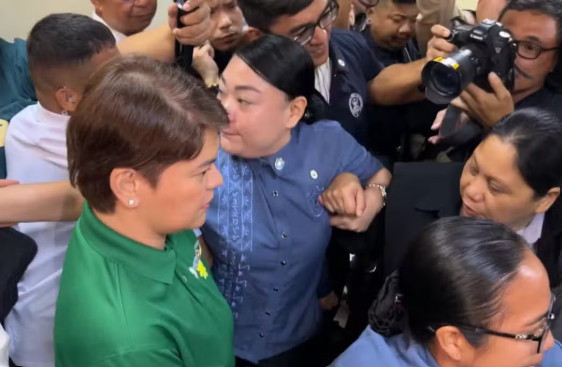
Philippine Vice President Sara Duterte arrived at the Senate on Tuesday to meet with her legal team, using the occasion to reiterate her defiant stance toward the impeachment proceedings against her. Drawing language from William Ernest Henley's classical poem "Invictus," she declared to waiting reporters that while she expects to be "bloodied but unbowed" throughout what she characterised as a "bloodbath and bludgeoning." The imagery she employed underscores a narrative of resilience and refusal to capitulate, positioning herself as a figure standing firm despite sustained institutional and political pressure.
The Vice President first articulated her desire for a "bloodbath" impeachment process in May 2025, a statement that drew considerable scrutiny from political opponents and media commentators. Her willingness to embrace such inflammatory language stood in stark contrast to her subsequent actions, notably her near-total absence from House impeachment proceedings during both 2025 and 2026. This apparent contradiction between her rhetorical embrace of the trial and her physical non-participation has become a focal point for critics questioning the authenticity of her stated commitment to defending herself against the charges.
Duterte faces four distinct articles of impeachment that collectively pose existential threats to her political career. Conviction on any article could result not merely in her removal from the vice presidency but also permanent disqualification from holding elected office in the Philippines. The first article concerns the alleged misappropriation of P612.5 million in public funds, specifically P500 million from confidential allocations within the Office of the Vice President and P112.5 million from the Department of Education. These sums are substantial by Philippine standards, and the allegations strike at fundamental questions of fiscal accountability and the proper stewardship of taxpayer resources.
The second article of impeachment addresses what prosecutors characterize as unexplained wealth accumulation spanning the 2022-2024 period. Beyond the sheer accumulation of assets, Duterte stands accused of failing to truthfully disclose her holdings in Statements of Assets, Liabilities and Net Worth filings—documents that serve as a critical transparency mechanism in Philippine governance. Additionally, she faces allegations of maintaining business interests despite requirements for public officials to divest from commercial enterprises that might present conflicts of interest. This article strikes at questions of governmental ethics and whether those holding high office operate according to the same legal standards as ordinary citizens.
The third article introduces allegations of bribery and irregular procurement practices involving Department of Education officials, suggesting a pattern of corrupt dealings within one of the nation's most critical institutions. The fourth and perhaps most serious article accuses Duterte of making assassination threats against President Ferdinand Marcos Jr., First Lady Liza Araneta-Marcos, and former House Speaker Martin Romualdez. Such allegations, if substantiated, would constitute threats against the constitutional order itself and represent conduct fundamentally incompatible with high office.
For Malaysian observers and Southeast Asian policymakers, this impeachment carries broader implications beyond Philippine politics. The trial will test whether institutional mechanisms designed to hold executive branch officials accountable can function effectively even when the accused commands significant political support among portions of the electorate. The procedural framework itself—requiring a two-thirds supermajority of senator-judges for conviction—creates an exceptionally high bar for removal, reflecting constitutional design that protects executive authority while theoretically preserving removal options for egregious misconduct.
The trial's anticipated 92-day duration extending into early 2027 suggests a protracted institutional crisis that will consume significant political bandwidth at a moment when the Philippines faces economic challenges, regional security concerns, and governance demands. The extended timeline means that uncertainty regarding the Vice President's status will persist for months, potentially complicating policy coordination between her office and other branches of government. In a regional context where political stability undergirds investor confidence and institutional effectiveness, such prolonged uncertainty merits close monitoring.
Duterte's invocation of "Invictus" carries symbolic weight that extends beyond mere rhetorical flourish. The poem's emphasis on unconquerable will in the face of fate resonates with audiences predisposed to view her as a victim of political persecution. However, the same rhetoric may alienate those who view impeachment as a legitimate constitutional remedy for alleged governmental misconduct. Her legal strategy, whatever form it ultimately takes, must navigate this treacherous political terrain where perceptions of victimhood can paradoxically strengthen political support while simultaneously undermining the case for exoneration on substantive grounds.
The composition of the Senate as judge and jury introduces further complexity. Senator-judges must weigh evidence presented while functioning as elected politicians themselves answerable to their constituents. This admixture of judicial and political functions creates inherent tensions between impartial adjudication and partisan calculation. The requirement for a supermajority vote means that even senators hostile to Duterte must be convinced beyond reasonable doubt to cross the threshold for removal, a standard that substantially favours the defence in any such proceeding.
For regional context, this impeachment unfolds against a backdrop of broader democratic contestation across Southeast Asia. The Philippines has repeatedly demonstrated institutional capacity for dramatic political confrontations—from the 1986 People Power Revolution to subsequent impeachment attempts—yet ultimately these mechanisms have generally functioned to channel rather than permanently resolve political conflict. Whether the Duterte trial follows this pattern or represents a genuine inflection point in Philippine governance remains an open question that will become clearer only as proceedings advance through 2026 and into 2027.

