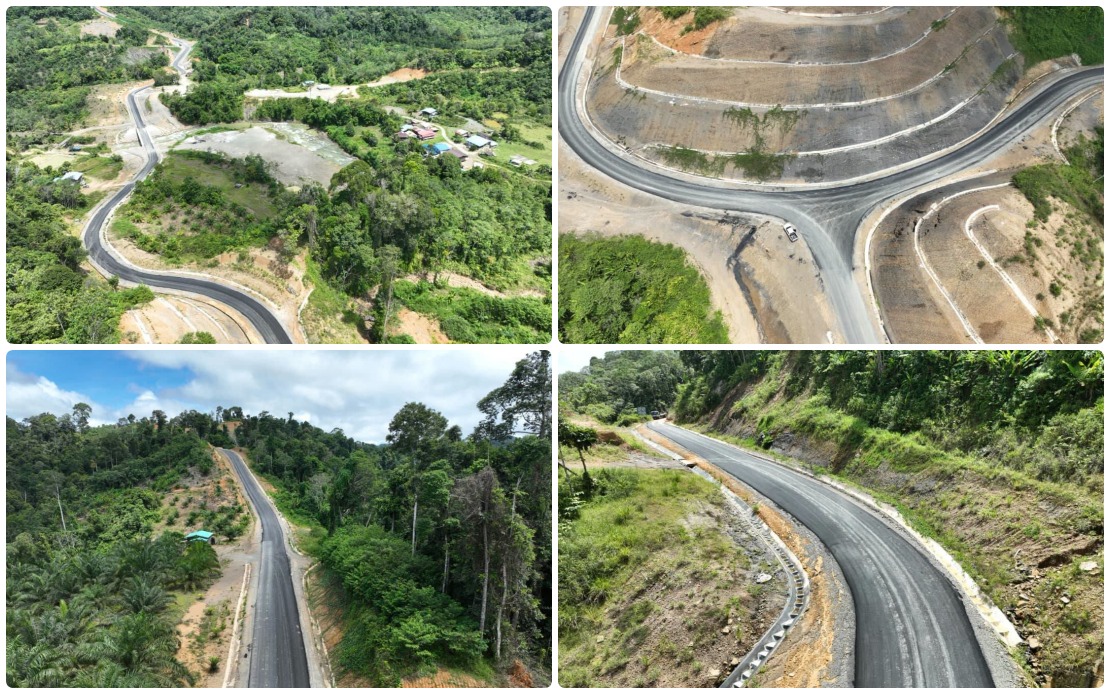
The completion of the Sapulut-Salong-Pagalungan-Pensiangan road to Pensiangan town marks a watershed moment for one of Sabah's most remote constituencies, transforming what was once an arduous journey into a manageable commute. Minister of Natural Resources and Environmental Sustainability Datuk Seri Arthur Joseph Kurup, who represents Pensiangan in Parliament, revealed that the upgraded route now connects the region in just three hours from Keningau—a reduction of more than half the previous six-plus hour journey. The significance of this improvement extends far beyond mere convenience; it addresses fundamental infrastructure deficits that have historically isolated interior communities and constrained their economic potential.
Arthur's recent inspection of the completed stretch underscored how tangible the transformation has become on the ground. He observed a striking shift in the visible landscape of Pensiangan town itself, noting the proliferation of vehicles where boats once dominated the transport scene. This basic indicator—the presence of private vehicles rather than watercraft as the primary mode of transport—reflects deeper changes in accessibility and economic activity. The enhanced road quality eliminates the danger that previously plagued travellers during inclement weather, when monsoon rains could maroon motorists for extended periods. Such hazards disproportionately affected essential services; teachers, healthcare professionals, and administrative personnel faced real risks in reaching their postings, a constraint that discouraged recruitment and retention of skilled personnel in remote areas.
The road project itself represents a manifesto commitment that Arthur made to constituents, embedding it within a broader strategic vision for Pensiangan's development. Rather than viewing this as a standalone infrastructure achievement, the minister frames it as one component of an integrated master plan he has been nurturing over several years. This approach acknowledges that road connectivity alone cannot trigger sustained economic transformation without complementary investments in production capacity, market access, and institutional frameworks. The completed route now provides a foundation upon which subsequent phases can build, with Phase Four already envisioned to extend the network to the Kalimantan border, potentially unlocking cross-border trade and tourism flows that have remained latent due to geographic isolation.
Beyond the primary road achievement, the supporting ecosystem of development projects reveals a coordinated strategy to address multiple constraints simultaneously. The Sapulut coffee processing facility under construction represents an attempt to add value to local agricultural output rather than merely exporting raw commodities, a principle that could enhance returns to smallholder farmers. Similarly, the upgrading of jetty and boat facilities at Pangkalan Salong acknowledges that water transport remains integral to the region's economy, even as road infrastructure expands. These complementary investments suggest recognition that interior Sabah communities possess distinct advantages—agricultural land, natural resources, cultural assets—that require differentiated development approaches rather than uniform urban-centric models.
The digital infrastructure upgrades targeting telephone and internet connectivity address a modernisation gap that has become increasingly critical. In contemporary economies, rural communities cannot attract knowledge-based enterprises or support small businesses without reliable digital access. Young professionals and entrepreneurs have repeatedly cited poor connectivity as a primary reason for remaining in or relocating to urban centres. By systematically upgrading digital infrastructure throughout the district, the government signals commitment to enabling remote work, e-commerce, and digital services that can generate income without requiring physical relocation. This is particularly significant for Sabah, where demographic trends show persistent youth migration to Kuala Lumpur and Singapore.
The agricultural infrastructure initiatives—the collection centre, Pagalungan Tamu market, and Salong Agrobazaar—represent an attempt to professionalise local commerce and create formal aggregation points for smallholder production. Traditional tamu markets have long served as vital economic institutions in Sabah's interior, but they often lack basic facilities and operate informally. Upgrading these facilities and creating dedicated collection infrastructure can improve post-harvest handling, reduce spoilage, and enable better market linkages. For farming communities that have historically sold produce at disadvantageous terms through intermediaries, such infrastructure offers potential to capture greater value within local supply chains.
The planned immigration and customs complex at the Kalimantan border reflects strategic thinking about regional integration. Sabah shares extensive borders with Indonesia, yet administrative barriers and inadequate border infrastructure have historically limited legitimate cross-border commerce and people movement. A dedicated facility could streamline procedures, reduce informal trade, and create employment in border administration. For communities adjacent to the border, such facilities often become employment hubs and service centres, generating secondary economic activity beyond the initial government investment.
Arthur's announcement that Sabah's first Sixth Form Centre for Nabawan district has been completed at Sekolah Menengah Kebangsaan Nabawan signals investment in educational advancement for interior communities. The availability of sixth-form education locally reduces the need for families to send children away for secondary schooling, a financial and social burden that particularly affects lower-income households. More significantly, maintaining young people within their home districts during formative years may influence future migration patterns and career choices, potentially creating pools of trained personnel for local economic enterprises.
The broader context for these developments involves Malaysian government priorities around regional equity and inclusive growth. Peninsular Malaysia's dominance in economic metrics and infrastructure investment has long created disparities relative to East Malaysia. Sabah, despite its natural resource wealth and agricultural potential, has historically received proportionally lower infrastructure investment, contributing to persistent economic gaps. Arthur's multi-project approach addresses this through coordinated action rather than ad hoc initiatives, suggesting a governance model focused on systematic rather than episodic intervention.
The social impacts of improved road access are already manifesting in demographic and economic behaviour. Arthur noted that younger residents are increasingly returning to their villages to develop agricultural land and participate in local economic activities. This reversal of the typical rural-urban migration pattern, even at modest scale, indicates that access improvements combined with income-generating opportunities can influence settlement and investment decisions. Young people with education and skills have typically sought opportunities in urban centres; their willingness to invest in interior communities signals perceived economic viability that road access alone cannot create, but can substantially enable.
For Malaysian policymakers and development practitioners, the Sapulut-Pensiangan experience offers lessons about integrated infrastructure development in remote regions. The recognition that roads must be complemented by production facilities, market infrastructure, digital connectivity, and border facilitation reflects sophisticated understanding of rural development constraints. Many infrastructure projects fail to generate expected returns because complementary investments remain absent; the Pensiangan strategy attempts to avoid this by bundling related initiatives. Success will ultimately depend on sustained implementation of all planned components and the emergence of local entrepreneurship and investment to utilise newly available infrastructure and services.
The three-hour journey from Keningau to Pensiangan town, while still substantial, represents a threshold improvement that could catalyse significant change in a region previously measured in half-day journeys. Whether this infrastructure investment translates into sustained economic dynamism depends on factors beyond government control—commodity prices, climate patterns, human capital migration, and private entrepreneurship. Yet the foundation has been laid; residents and investors can now access Pensiangan without the previous hazards and delays that discouraged investment and service provision. In the logic of development economics, this removal of friction from connectivity often precedes tangible economic transformation, making the road completion not merely a present achievement but a platform for future possibilities in Sabah's interior.

