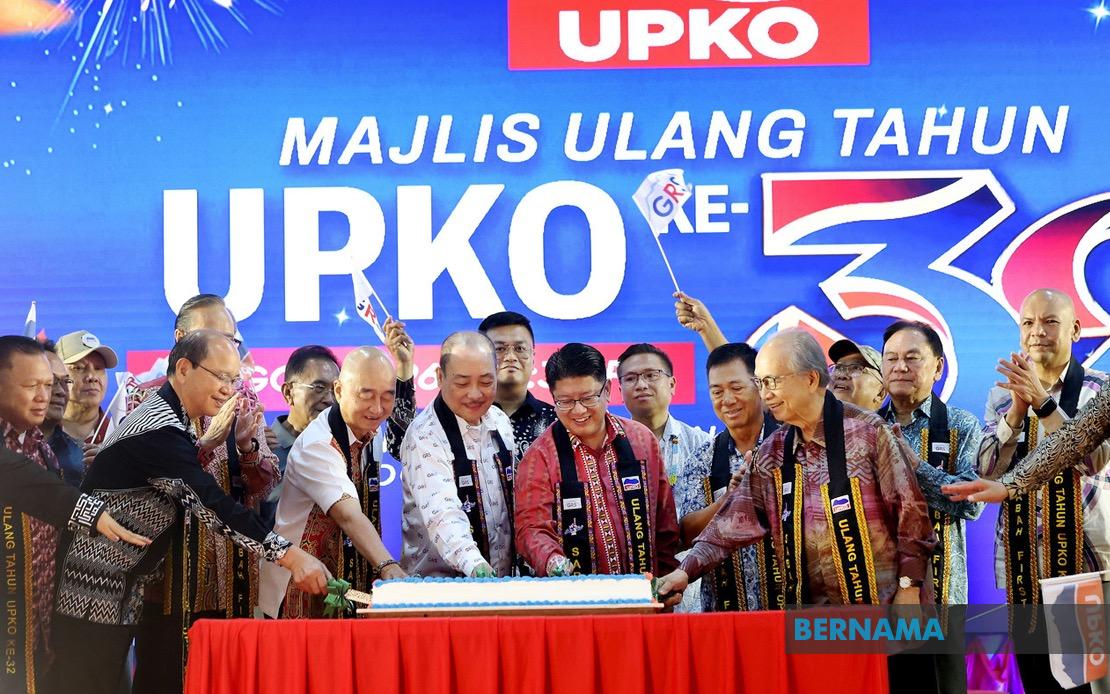
Chief Minister Datuk Seri Hajiji Noor has pledged that every ringgit received by Sabah from Kuala Lumpur will flow directly back to ordinary Sabahans in the form of tangible development, targeted financial assistance and social welfare programmes. Speaking at the 32nd anniversary celebration of the United Progressive Kinabalu Organisation (UPKO) and opening of the 17th UPKO Triennial Delegates Conference in Kota Kinabalu, Hajiji outlined how the state government intends to deploy federal transfers to address longstanding infrastructure gaps and improve living standards across the state.
The Chief Minister specifically welcomed Prime Minister Datuk Seri Anwar Ibrahim's decision to boost Sabah's interim special grant allocation to RM1.5 billion annually, treating the increased federal support as a mandate to accelerate critical infrastructure work. Rather than allowing the funds to languish in state coffers, Hajiji signalled that Sabah's administration would immediately channel resources into expanding the road network, constructing durable concrete bridges, and upgrading water and electricity systems in areas where service delivery remains inadequate. This commitment reflects recognition that rural and semi-urban areas in Sabah continue to lag behind peninsula counterparts in terms of basic infrastructure, a persistent challenge that has frustrated residents and limited economic opportunities across the state.
Among the specific initiatives earmarked for federal funding is an expansion of the Rumah Mesra Sabah Maju Jaya (SMJ) housing programme, which has provided affordable residential units to qualifying low-income families. The state government also intends to intensify the Sentuhan Kasih Rakyat (SYUKUR) programme, a targeted welfare initiative designed to provide direct financial support and essential assistance to vulnerable populations. By coupling infrastructure investment with these people-centric programmes, the administration seeks to address both immediate household financial pressures and longer-term productive capacity within the state economy.
Context for this commitment emerged from the fact that Sabah had already received RM600 million of the RM1.5 billion interim special grant payment that the Federal Government disbursed on June 12. The remaining funds represent a significant injection of capital into state coffers at a time when Sabah, like other Malaysian states, faces pressure to balance social spending with development needs. The timing of the federal increase also carries political significance, as it signals the Anwar Ibrahim administration's recognition that Sabah—as an East Malaysian state with distinct demographic and geographic challenges—requires elevated fiscal support to narrow regional development disparities.
Beyond immediate spending priorities, Hajiji highlighted that Sabah's state government has sustained annual revenue collections at RM7 billion since 2022 and expects that figure to climb to RM8 billion in the current year. This improving domestic revenue base suggests that the state administration has strengthened its tax collection capacity and fiscal management, making it less dependent on federal transfers while simultaneously enhancing its ability to co-finance development initiatives. The revenue growth trajectory underscores that Sabah's fiscal health is improving, though the state remains reliant on federal support given the geographic dispersal of its population and the infrastructure-intensive nature of development needs.
The Chief Minister's remarks also positioned Sabah as an economically resilient jurisdiction capable of weathering both domestic policy uncertainties and global economic volatility. By maintaining revenue collections and channelling federal transfers into productive investment, the state administration aims to strengthen Sabah's appeal to private investors and demonstrate that the state offers stability and growth potential. This messaging is particularly relevant for Malaysian and Southeast Asian investors evaluating regional business opportunities, as infrastructure quality and predictable policy frameworks significantly influence investment decisions in emerging markets.
Sabah's geographic position and resource endowments—including substantial oil and gas reserves, timber, and fishing industries—have historically made it economically significant to Malaysia. However, the state has long grappled with inadequate infrastructure outside major urban centres, which has constrained private sector development and limited the ability of rural residents to participate fully in broader economic growth. By committing federal transfers to infrastructure and welfare, Hajiji signals an intention to address these structural constraints and create conditions for more inclusive and sustainable economic development across the state.
The UPKO gathering itself carries political undertones, as the party represents indigenous Sabah interests within the broader Malaysian political system. Hajiji's emphasis on channelling federal resources to benefit Sabahans reflects a party message that political partnership with the federal administration translates into tangible gains for the state's population. In the context of Malaysian federalism, where states compete for development resources and political attention, such public commitments serve both as electoral messaging and as accountability mechanisms that voters can monitor and assess.
Looking ahead, the sustainability of these development initiatives will depend on several factors: the maintenance of federal grant levels, the state government's ability to execute projects efficiently, and continued economic stability within Sabah. Infrastructure projects in remote areas typically face logistical and cost challenges that can delay implementation or inflate expenses. Additionally, the expansion of social welfare programmes requires careful design to ensure fiscal sustainability without creating structural deficits that compromise future state finances. The commitment to raise annual revenue collections to RM8 billion will be crucial in underwriting these expanded spending commitments.
For Malaysian observers, Sabah's experience illustrates broader questions about federal-state resource allocation in a ethnically and geographically diverse federation. The state's pursuit of higher federal transfers reflects the reality that decentralised development—where states bear primary responsibility for local infrastructure—requires corresponding fiscal capacity. Sabah's relatively lower per-capita revenue collection compared to wealthier states underscores why federal equalisation transfers remain essential to prevent widening regional inequality and ensure that all Malaysian residents have access to comparable basic services.
The Chief Minister's statement also implicitly acknowledges that federal transfers constitute a significant share of Sabah's development budget, making the relationship between state and federal governments consequential for local political fortunes. As Hajiji noted, the increase in interim special grant payments represents a political victory that the state administration can showcase to voters, demonstrating that partnership with the federal government yields material benefits. Whether these commitments can be sustained and effectively implemented will test both the state administration's governance capacity and the federal government's willingness to maintain elevated support for East Malaysian development.

