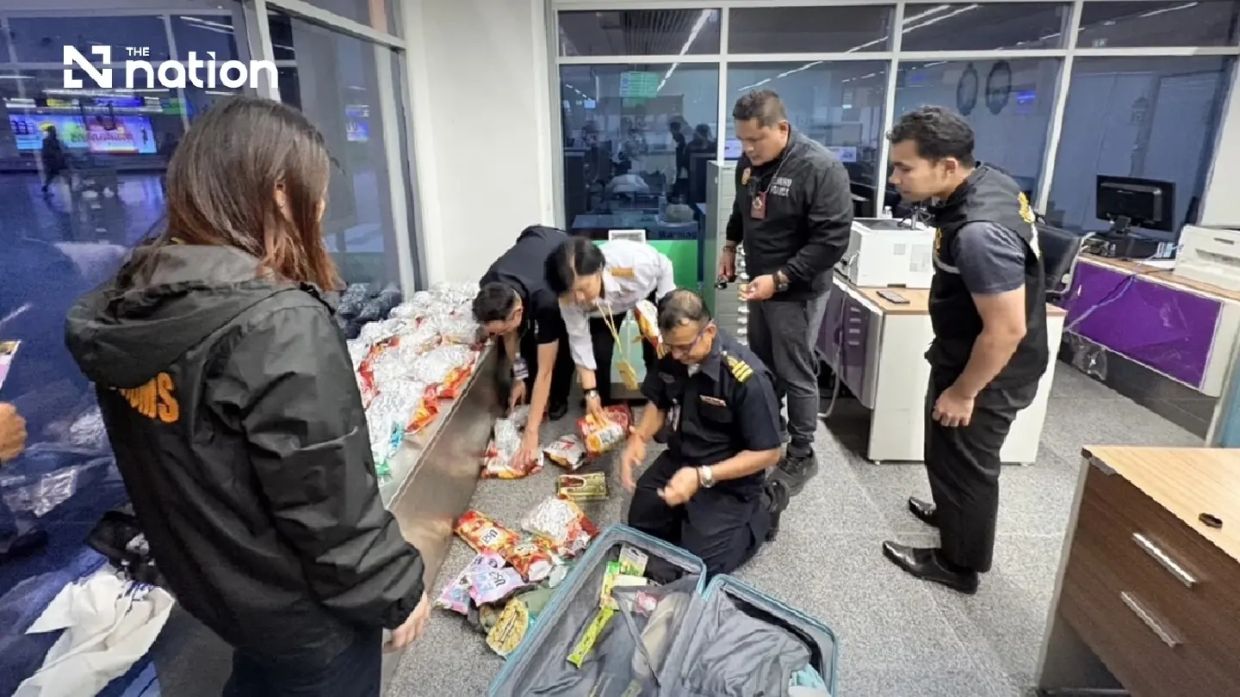
A 30-year-old Russian national was taken into custody at Phuket International Airport on Wednesday, July 8, after authorities uncovered a substantial cannabis cache hidden within his luggage as he prepared to board an international flight. The discovery represents a significant drug seizure at one of Thailand's busiest transport hubs and underscores ongoing challenges with narcotic trafficking through the kingdom's aviation infrastructure.
The arrest unfolded within the international departure terminal when customs inspectors opened two blue BP WORLD suitcases belonging to Sergei Chalabari for routine examination. What began as a standard pre-departure screening evolved into a major enforcement operation as officers methodically uncovered vacuum-sealed packages concealing the contraband. The suitcases themselves, weighing just over eight kilogrammes combined, yielded their illicit contents during the systematic search.
Authorities located 35 individually sealed packages of cannabis flowers totalling 11.4 kilogrammes, alongside 12 additional packages of cannabis resin weighing 6.2 kilogrammes collectively. The precision of the concealment—vacuum-sealed and distributed across multiple packages—suggests deliberate smuggling methodology rather than casual possession. Officials seized both the narcotics and the luggage as evidence in what represents one of the larger drug interdictions at the airport in recent months.
During preliminary interrogation, Chalabari acknowledged ownership of the suitcases and their contents without immediate resistance, according to law enforcement accounts. Authorities subsequently levelled charges related to attempted smuggling of controlled substances without compliance with customs regulations—a serious offence under Thai law that carries substantial penalties. The straightforward admission may influence sentencing considerations, though Thai courts maintain strict protocols regarding drug trafficking cases regardless of cooperativeness during arrest procedures.
The operation involved coordinated efforts across multiple enforcement agencies, demonstrating institutional cooperation in Thailand's drug interdiction framework. Customs officer Rawin Kanokakorn led the inspection team, while Nucha Jeeradit, chief of the Phuket Airport Customs House, oversaw the broader operation. Police involvement came through Sakhu Police Station, with Pol Col Salan Sankhisasanakun and Pol Lt Col Rattanawut Nukaew directing the investigative response and subsequent processing of the suspect.
The incident highlights persistent vulnerabilities within international transit points across Southeast Asia. Phuket International Airport, serving over 30 million passengers annually, processes vast quantities of luggage daily—creating opportunities for sophisticated smugglers to attempt moving contraband through crowded terminals. The timing of the interdiction, during the departure phase rather than arrival, suggests the suspect may have acquired the cannabis within Thailand itself, potentially implicating domestic trafficking networks.
For Malaysian readers, the case carries particular relevance given Malaysia's geographical proximity and extensive air connections with Thailand. Regional organised crime syndicates frequently exploit these networks, moving narcotics across borders through commercial aviation. Enhanced vigilance at Kuala Lumpur International Airport and other Malaysian hubs remains essential, particularly given the demonstrated willingness of international trafficking operations to utilise major regional airports as transit points.
Thailand's tourism economy, heavily dependent on international visitor confidence, creates pressure to maintain robust drug enforcement at transportation nodes. High-profile arrests serve dual purposes: they demonstrate commitment to narcotics control while simultaneously signalling serious consequences for trafficking attempts. Yet the persistence of such seizures—now numbering in the dozens annually at Phuket Airport alone—indicates that deterrence messaging has yet to fully penetrate criminal supply chains.
Chalabari faced transfer to Sakhu Police Station for comprehensive legal proceedings following the airport detention. Thailand's drug legislation provides for substantial custodial sentences in trafficking cases, with sentencing calculations based on quantity and substance type. Resin-based cannabis carries different legal classifications than plant material in some jurisdictions, though Thai law typically treats all cannabis forms uniformly within the framework of controlled substance schedules.
The case also reflects broader regional dynamics surrounding cannabis prohibition. While some Southeast Asian nations have begun reconsidering cannabis policies for medical applications, Thailand maintains strict prohibitions applicable to all forms of the plant. This rigidity contrasts with evolving approaches elsewhere globally, potentially creating perception gaps among international travellers unfamiliar with regional legal frameworks—a factor that may contribute to continued smuggling attempts by individuals genuinely underestimating penalties.
Law enforcement coordination between customs and police agencies proved effective in this instance, though the volume of international passenger traffic suggests many similar contraband movements may successfully evade detection. The 17.6-kilogramme seizure represents visible enforcement success, yet likely represents a fraction of actual trafficking volume passing through Thai airports. Strengthening detection capabilities—through advanced scanning technologies and enhanced intelligence sharing—remains an ongoing priority for Thai authorities managing the security-tourism balance that defines contemporary Phuket operations.

