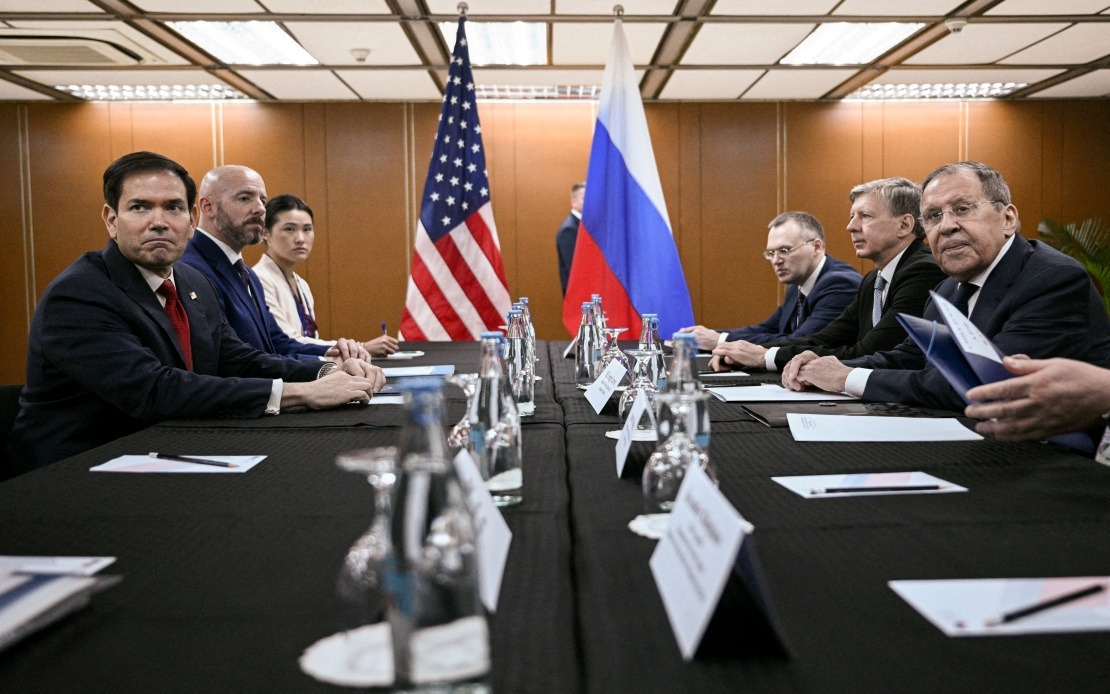
In a rare moment of diplomatic alignment between Washington and Moscow, Russian Foreign Minister Sergey Lavrov and United States Secretary of State Marco Rubio have committed to sustaining communications between their respective foreign ministries. The agreement, reached during their encounter in Manila on Thursday, establishes a framework for continued engagement through multilateral organisations despite the considerable tension characterising Russia-US relations in recent years. The accord underscores the recognition by both nations that maintaining formal channels of communication, even amid profound disagreements, serves mutual strategic interests and reduces the risk of miscalculation.
The Manila meeting represents a significant moment in contemporary US-Russia diplomacy. Although the two countries remain at loggerheads over Ukraine, sanctions regimes, and NATO expansion, the decision to preserve institutional pathways for dialogue suggests both sides acknowledge the dangers inherent in allowing communication infrastructure to deteriorate completely. For policymakers across Southeast Asia, who navigate delicate balancing acts between major powers, this development carries particular relevance. Regional nations have long expressed concern about being caught in escalating great power competition; evidence that Washington and Moscow can establish practical modus vivendi offers at least modest reassurance that containment mechanisms exist.
Beyond the headline commitment to continued contact, the Russian Foreign Ministry's statement reveals substantive areas of potential cooperation. The two powers have specifically agreed to address the operational difficulties faced by their respective diplomatic missions, a bureaucratic but symbolically important issue. When embassy functioning becomes complicated by administrative obstacles or restrictions, it signals deteriorating relations and can rapidly escalate tensions. By prioritising the normalisation of working conditions for diplomats in each other's capitals, Lavrov and Rubio have identified a practical starting point for improving the relationship's baseline.
Particularly noteworthy is the mutual endorsement of resumed collaboration between Roscosmos and NASA, the space agencies of Russia and the United States respectively. Space cooperation has historically served as a stabilising element in US-Russian ties, offering an arena where scientific collaboration transcends political disputes. The International Space Station programme has continued even as tensions spiked elsewhere, providing a model for compartmentalised engagement. The explicit welcoming of full-scale contacts between these state enterprises suggests recognition that human spaceflight and scientific research represent domains where mutual benefit justifies cooperation regardless of political climate.
The agreement also encompasses support for revitalised interparliamentary exchanges and cultural programmes between the two nations. These people-to-people connections, though sometimes dismissed as peripheral, constitute essential relationship scaffolding. When parliamentary delegations stop visiting and cultural institutions cease exchanges, public understanding of the other nation becomes hostage to media narratives and political rhetoric, making compromise increasingly difficult. By endorsing these softer forms of engagement, both foreign ministers have acknowledged that relationships cannot be purely transactional or zero-sum; sustained interaction across multiple societal layers creates constituencies with interests in maintaining dialogue.
For Malaysia and other Southeast Asian nations, the implications warrant careful consideration. These countries have maintained pragmatic relationships with both Russia and the United States, avoiding the forced alliance choices that characterised the Cold War. The Manila agreement illustrates that even when major powers clash fundamentally on issues like regional influence and military positioning, they need not sever all contact. This provides a potential template: regional states can maintain ties with competing powers without necessarily taking sides in their disputes, provided they manage relationships transparently and avoid actions perceived as threatening to either.
The agreement must be understood within the broader context of Russian and American competition in Asia-Pacific. Both powers maintain significant interests in Southeast Asia—Russia through energy sales, arms transfers, and naval presence, while the United States emphasises alliance relationships, trade partnerships, and security arrangements. A conversation infrastructure between Moscow and Washington reduces the likelihood that regional disputes become flash points in their wider confrontation. When the two powers have mechanisms for communication, misunderstandings about intentions or capabilities in hotspots like the South China Sea or around Taiwan become more manageable.
The timing of this agreement carries weight given recent geopolitical developments. The continuation of dialogue channels suggests neither Russia nor the United States has concluded that the other is an irredeemable adversary with whom no accommodation is possible. This positioning differs markedly from rhetoric suggesting inevitable conflict or irreconcilable differences. Realistic acknowledgment that coexistence requires functional communication networks, even between competitors, represents a more stable foundation than declarations of existential opposition.
However, observers should avoid overstating the significance of this agreement. Lavrov and Rubio consenting to maintain contact addresses symptoms rather than underlying causes of US-Russia friction. The fundamental disputes regarding Ukraine, NATO enlargement, sanctions, and competing regional ambitions remain unresolved. This accord provides a framework for managing tensions, not resolving them. Nevertheless, frameworks matter; they prevent disagreements from cascading into crisis and create space for negotiation.
For Southeast Asian diplomacy, the Manila discussion offers instructive lessons about conducting relations with great powers. The agreement demonstrates that maintaining communication channels need not imply approval of the other party's actions, nor does it require alignment on substantive issues. Nations can reserve judgment on major disputes while ensuring that practical mechanisms for dialogue remain functional. This calibrated approach—neither capitulation nor confrontation—characterises successful regional statecraft during periods of major power competition.
Looking forward, the question becomes whether this agreement translates into substantive progress on specific issues. Ministerial-level agreements carry weight only when implemented by lower-ranking officials and when both sides demonstrate genuine commitment beyond ceremonial gestures. The litmus test will be whether diplomatic missions actually experience improved working conditions, whether Roscosmos-NASA collaboration expands meaningfully, and whether parliamentary and cultural exchanges resume at meaningful scales. Incremental improvements in these areas would represent genuine warming; mere rhetorical affirmations would constitute theatre.
The broader implication for Asia-Pacific stability hinges on whether this Manila accord reflects a stabilising pattern or represents a temporary aberration. Should Russian and American officials increasingly use multilateral forums as dialogue spaces and commit to compartmentalised cooperation in non-political domains, regional anxieties about conflict escalation might ease. Conversely, if this agreement proves ephemeral and relations continue deteriorating, it would underscore that even minimal institutional frameworks cannot withstand fundamental strategic antagonism. For now, the willingness of Moscow and Washington to agree on maintaining contact offers a modest but genuine foundation for more stable great power competition in Southeast Asia.

