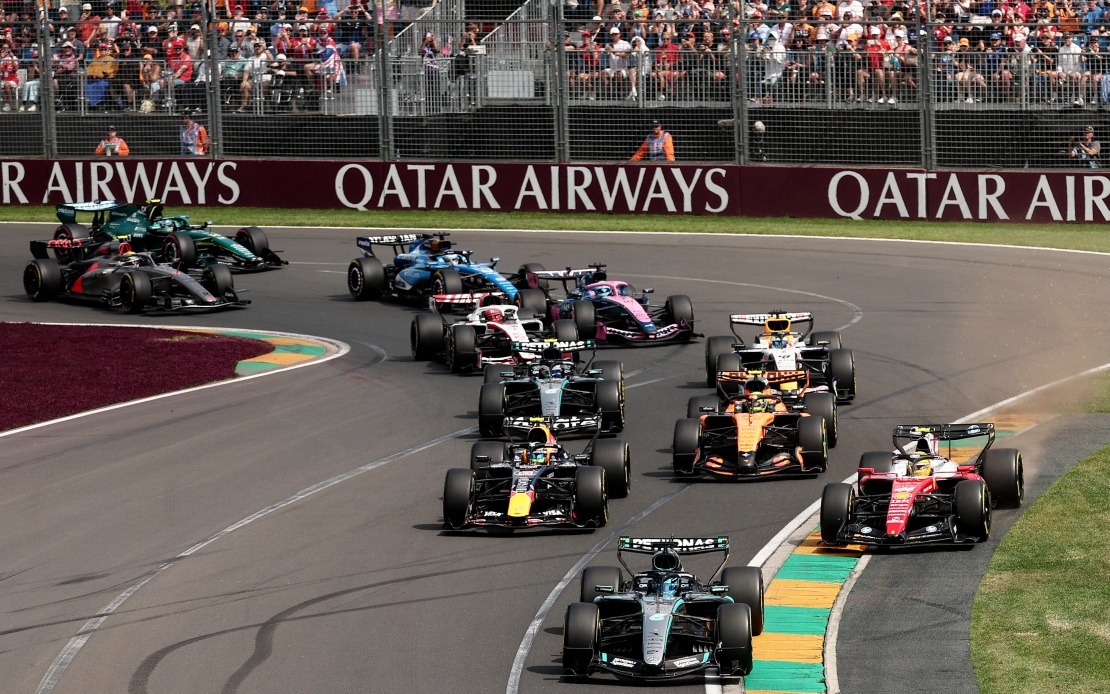
George Russell's frustration boiled over at Spa-Francorchamps on Sunday after mechanical gremlins and a collision with Lewis Hamilton combined to wreck his Belgian Grand Prix. The Mercedes driver, already struggling in his bid to reclaim the championship lead, delivered a withering criticism of his team via radio communications that captured the mounting pressure within the team's garage as the season enters its critical phase.
The British driver now trails his teenage teammate Kimi Antonelli by a substantial 50 points in the world championship standings. Antonelli, the 19-year-old Italian sensation, has seized control of the title race with six victories from the first ten rounds, establishing a commanding position that threatens to make the remaining races merely a formality. This stark reversal of fortunes represents one of the season's most dramatic storylines, with a generational shift appearing to unfold at arguably sport's most prestigious marque.
Russell's afternoon fell apart when an energy management problem exposed him to pursuing competitors immediately after the opening lap, setting in motion a chain of events that culminated in his retirement. The unbroadcasted radio transmission revealed a driver at his wit's end, questioning the fundamental reliability of his machinery: "What the f*** happened with the SOC down the straight? I had no f****** battery down the straight. Guys, unacceptable. Un-f******-acceptable, this whole weekend." The raw emotion conveyed the depth of his frustration after enduring what he perceives as a season-long litany of technical failures.
The Spa weekend had been fraught with complications before the race even began. Russell qualified half a second adrift of Antonelli, a deficit that Mercedes initially attributed to the driver's approach through the corners. This diagnosis proved incorrect, however, when the team's engineers discovered the problem lay elsewhere entirely. The confusion highlighted the complex interdependencies within modern Formula 1, where distinguishing between driver error and mechanical shortcoming requires meticulous analysis of telemetry and system diagnostics.
Toto Wolff, Mercedes' team principal, responded to Russell's outburst with measured sympathy while defending the team's commitment to resolution. Wolff acknowledged that drivers operating at this elite level experience unavoidable emotional turbulence when equipment fails, yet he also gently reminded Russell of the privilege inherent in driving for Mercedes. The dynamic between driver and team principal revealed the delicate balance required when managing high-performing athletes confronted with chronic reliability problems. Wolff emphasised that all drivers experience difficult periods and that the team remained fully committed to supporting Russell through his current struggles.
The specific technical failure centred on the power unit's energy harvest and deployment systems. Modern Formula 1 regulations demand extraordinary precision in how electrical energy is managed throughout a lap, with microsecond-level decisions affecting performance across every sector. Wolff revealed that engineers had identified a deficit in available energy for deployment into turn 18, a discovery that paradoxically carried some positive implications. The problem's visibility at the energy-intensive Belgian circuit meant it could be identified and debugged before the Hungarian Grand Prix, where power management becomes less of a limiting factor. Nonetheless, this partial consolation offered little comfort to Russell, who calculated that the malfunction accounted for approximately half or slightly more of his qualifying deficit to Antonelli.
Russell's lament extended beyond the immediate technical failure to encompass what he perceives as a recurring pattern throughout 2024. His statement that he is now "numb to disappointment" following accumulating mechanical setbacks suggests psychological wear alongside the physical and competitive toll. This emotional state carries concerning implications for a championship campaign requiring maximum mental sharpness and resilience. The final round before the summer break at Budapest presented a crucial opportunity to arrest the momentum swinging towards Antonelli, yet Russell's confidence appeared fractured by persistent equipment problems rather than driver performance.
The collision with Hamilton that ultimately ended Russell's race represents a secondary drama within the broader narrative of Mercedes' internal championship battle. The mechanics of this incident remain contested, but its occurrence followed Russell's initially compromised position following the engine glitch. This sequence illustrates how technical problems cascade through a race, forcing drivers into compromised tactical situations that increase the likelihood of further mishaps. Had Russell maintained his expected grid position, the Hamilton incident might never have occurred.
Wolff's detailed explanation of power unit complexity revealed the sophisticated engineering challenges now endemic to Formula 1 under current regulations. The interaction between driver inputs, energy harvesting systems, deployment strategies, and circuit characteristics creates an intricate puzzle that teams must solve repeatedly across the season's varying venues. Mercedes' acknowledgement of reliability problems whilst simultaneously defending the competitiveness of their fundamental package suggested internal confidence that solutions remain achievable, though perhaps not within the compressed timeframe remaining before summer.
The championship mathematics now favour Antonelli heavily, particularly if Russell continues experiencing mechanical attrition whilst competing against a teammate of manifest talent. Five rounds remain before the break, providing a theoretical window for Russell to recover ground through flawless execution and improved reliability. However, the psychological dimension of his current predicament—the admitted numbness and apparent erosion of confidence—may prove as consequential as any technical upgrade Mercedes can deliver. The team's challenge extends beyond the garage to the mental resilience required of their lead driver as he confronts the possibility of seeing a championship slip away through a combination of equipment failures and competitive underperformance.

