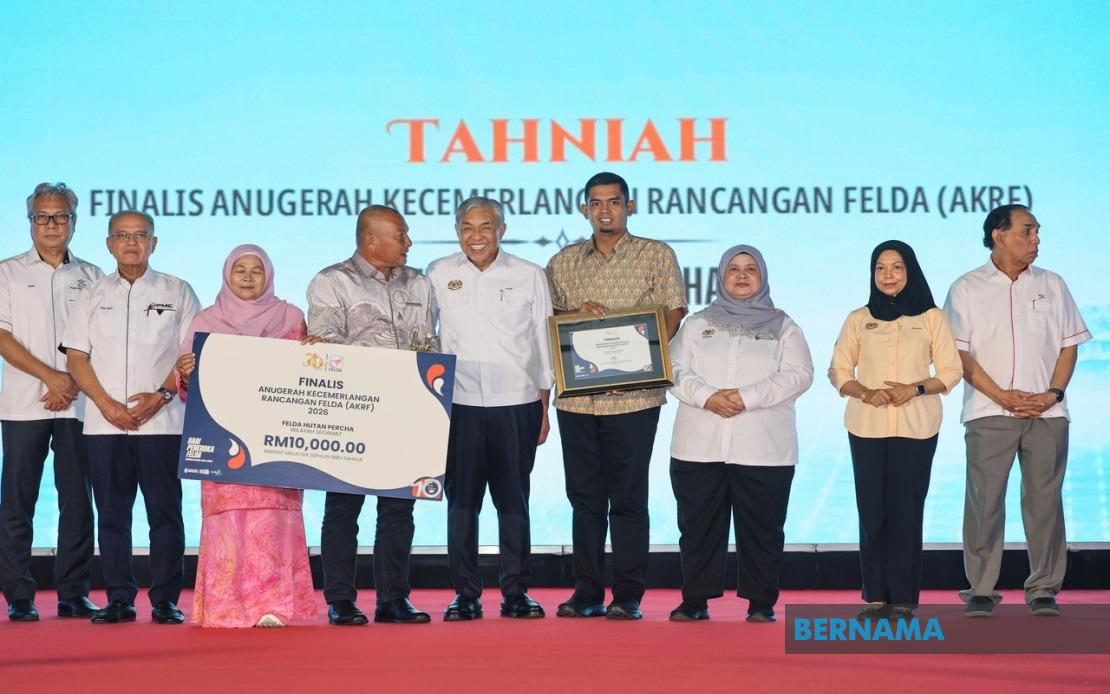
Deputy Prime Minister Datuk Seri Dr Ahmad Zahid Hamidi has articulated a transformative vision for rural development in Malaysia, one that transcends traditional domestic boundaries and positions rural communities as active participants in regional and international commerce. Speaking at the World Rural Development Day 2026 celebration held at Bandar Tun Razak Stadium in Maran, Ahmad Zahid, who also serves as Rural and Regional Development Minister, emphasised that the era of viewing rural progress through a purely local lens has fundamentally shifted. The imperative now, he stressed, is for rural entrepreneurs to harness emerging opportunities across Southeast Asia and beyond, particularly within the expanding global halal economy that presents significant untapped potential for Malaysian producers.
The philosophy underlying Ahmad Zahid's remarks reflects a deliberate recalibration of national rural policy. Rather than compartmentalising rural development as a domestic concern separate from international trade corridors, his position integrates rural advancement into the broader economic architecture of regional integration and global commerce. This conceptual reframing has profound implications for how Malaysia approaches agricultural and entrepreneurial support in traditionally marginalised communities. By explicitly linking rural networks to cross-border opportunities, the government signals recognition that competitive advantage and economic resilience for rural Malaysia depends increasingly on access to markets that extend well beyond provincial or national administrative divisions. The emphasis on ASEAN integration aligns with Malaysia's broader commitment to regional economic cooperation, while the focus on halal sectors specifically leverages a distinctive competitive advantage that Malaysian rural producers possess.
To operationalise this vision, the Rural and Regional Development Ministry has deployed a suite of initiatives designed to equip entrepreneurs with the tools and connectivity necessary for market expansion. The RisSMart programme and IkonDesa platform represent concrete mechanisms through which rural producers can enhance their marketing reach and commercial visibility. According to Ahmad Zahid's statement, these programmes have catalysed remarkable growth metrics over the preceding three years. More than seven thousand rural entrepreneurs have entered the formal economy, an expansion that has simultaneously generated approximately fifteen thousand employment opportunities across rural regions. The cumulative sales generated by these enterprises have exceeded RM1.77 billion, a tangible measure of economic activity stimulation that demonstrates the efficacy of targeted intervention strategies.
This economic expansion occurs within the context of a broader strategic framework: the National Rural Economy Agenda, which Ahmad Zahid identified as Malaysia's comprehensive blueprint for the next phase of rural transformation. This agenda represents a deliberate shift from infrastructure-centric approaches towards a more multidimensional model that prioritises competitiveness and market readiness. The implicit recognition here is that roads, electricity, and water systems—while essential—constitute necessary but insufficient conditions for sustainable rural prosperity. Contemporary rural development demands simultaneous attention to entrepreneurial capacity, market information systems, quality standards, and export logistics. By positioning competitiveness as central rather than peripheral to the rural development agenda, the ministry signals that twenty-first-century rural communities cannot remain passive recipients of infrastructure investment but must instead develop the institutional and human capacities requisite for active market participation.
Parallel investments in human capital development underscore this integrated approach. Ahmad Zahid highlighted that nearly five hundred Orang Asli students have gained university admission, representing a historic achievement in educational access for indigenous communities. This figure carries significance beyond mere enrolment numbers; it reflects systematic efforts to build intellectual and professional capacity within historically marginalised populations, creating a foundation for long-term economic participation and social mobility. Educational advancement of this scale, achieved within measurable timeframes, demonstrates that targeted human capital investment can yield substantial outcomes when coupled with institutional commitment and adequate resource allocation.
The infrastructure development achievements registered during the 12th Malaysia Plan period provide crucial context for understanding the enabling environment within which rural enterprise can flourish. Nearly five thousand kilometres of rural roads have been upgraded, directly addressing a persistent constraint on commerce and connectivity in dispersed communities. Simultaneously, electricity extension has reached more than seven thousand households, while clean water provision has expanded to over ten thousand rural residences. Nearly ten thousand homes have been constructed or rehabilitated, benefiting approximately forty thousand residents. These figures collectively demonstrate substantial investment in foundational rural infrastructure that facilitates both improved living standards and economic activity. However, their significance extends beyond immediate welfare improvements; improved physical infrastructure reduces transaction costs for rural entrepreneurs, enhances supply chain reliability, and improves the investment climate for rural enterprise development.
The timing of this policy articulation coincides with the inaugural global observance of World Rural Development Day, a relatively recent international initiative. The United Nations General Assembly formally proclaimed World Rural Development Day on September 6, 2024, designating July 6 as the annual date of commemoration to honour the establishment of the Centre on Integrated Rural Development for Asia and the Pacific. Malaysia's participation in this inaugural global celebration in 2026 represents both symbolic commitment and practical engagement with an emerging international framework for rural advancement. By hosting commemorative events and articulating explicit rural development philosophies on such occasions, Malaysia positions itself as an active participant in global discourse surrounding rural transformation, rather than a passive recipient of international development paradigms.
For Malaysian policymakers and rural stakeholders, Ahmad Zahid's vision carries several practical implications. The emphasis on market expansion beyond national borders suggests that future rural development support should increasingly incorporate trade facilitation, standards harmonisation, and cross-border logistics capacity. This represents a material shift from conventional approaches that often focus narrowly on domestic market access. The integration of human capital development with entrepreneurial support suggests that sustainable rural prosperity requires concurrent investment in education, skills training, and institutional capacity building. The explicit mention of halal economy opportunities positions Malaysian rural producers to capture growing regional and global demand for certified halal products, a market segment where Malaysia possesses established credibility and institutional frameworks.
For Southeast Asian readers and policymakers observing Malaysian rural development approaches, Ahmad Zahid's statements offer both a model and a challenge. The model demonstrates how sustained policy commitment, targeted programme implementation, and infrastructure investment can generate measurable outcomes in rural entrepreneurship and employment creation. The challenge involves recognising that merely expanding into regional markets demands not only improved physical connectivity but also quality standardisation, export certification capacity, and market information systems that remain underdeveloped in many Southeast Asian countries. The Malaysian experience suggests that rural economic transformation requires integrated approaches combining infrastructure, human capital development, and targeted entrepreneurial support rather than isolated interventions in any single dimension.
The underlying philosophy articulated by Ahmad Zahid reflects broader recognition that rural communities and rural economies cannot remain spatially or economically isolated in contemporary Southeast Asia. Regional supply chains increasingly integrate rural production across national borders. Consumer markets for premium and certified products increasingly transcend geographic boundaries. Investment capital increasingly seeks opportunities across regional markets rather than within single national contexts. Rural development policy that ignores these realities risks condemning rural communities to economic peripheralisation despite infrastructure improvements. Conversely, policy that explicitly positions rural entrepreneurs as regional and global market participants, supported by appropriate institutional frameworks and capacity-building investments, can generate employment opportunities and income growth that improve rural welfare while contributing to broader national economic objectives.
Moving forward, the success of this expanded rural development vision will depend substantially on implementation effectiveness and sustained political commitment. Government agencies must translate aspirational statements about regional market access into concrete support mechanisms for export promotion, standards compliance, and trade facilitation. Private sector engagement will prove essential for value chain development and market linkages that extend beyond government facilitation. International cooperation frameworks, including ASEAN mechanisms and bilateral trade agreements, will require explicit attention to rural enterprise development to ensure that liberalised trade generates genuine opportunities for small producers rather than merely intensifying competitive pressures. The coming years will reveal whether Ahmad Zahid's vision of rural development extending beyond borders can be systematically operationalised or whether it remains primarily aspirational.

