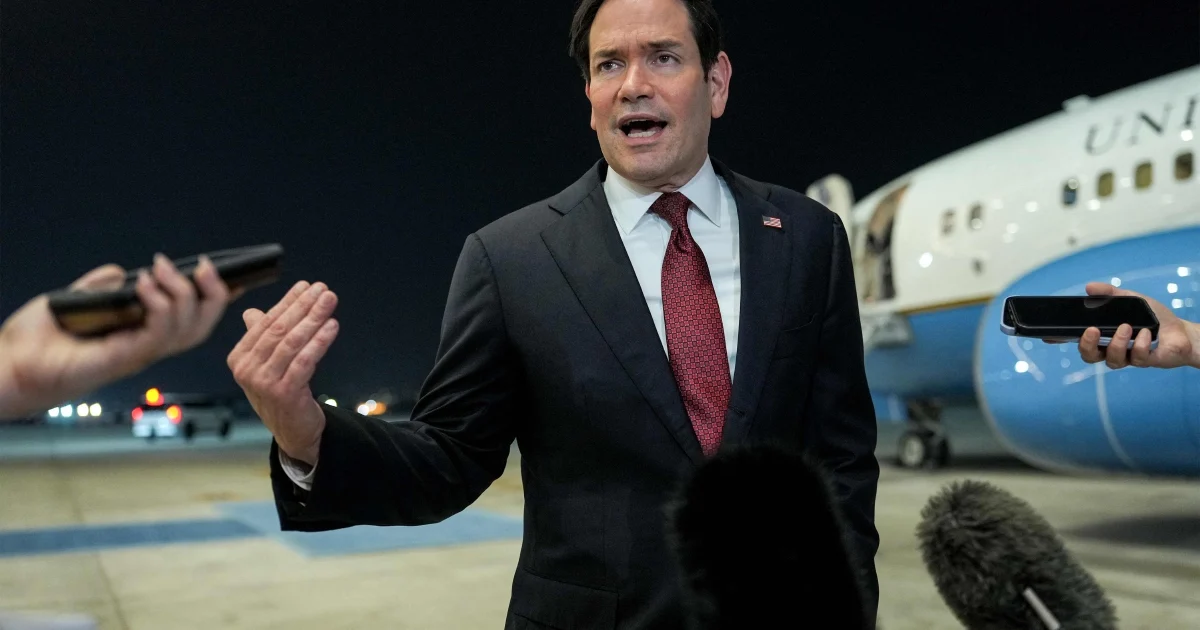
The United States has firmly rejected any Iranian attempt to impose tolls or levies on shipping through the Strait of Hormuz, according to a statement from Secretary of State Marco Rubio on Tuesday, marking a significant stumbling block in broader diplomatic efforts aimed at de-escalating Middle East tensions. The American position reflects deep concerns about maintaining the international legal principle of free passage through one of the world's most strategically important maritime corridors, through which roughly one-third of global seaborne traded oil transits annually.
Rubio's declaration underscores the complexity of ongoing negotiations designed to bring an end to the protracted regional conflict. While the outline of a comprehensive settlement remains elusive, disagreements over three fundamental issues—Iran's claimed authority to levy charges on Hormuz traffic, the scope and frequency of nuclear inspections, and restrictions on missile development—have emerged as major negotiating challenges within the first weeks of talks. These early disputes suggest that crafting a durable agreement capable of addressing all stakeholders' security concerns will prove substantially more difficult than initially anticipated.
The Strait of Hormuz dispute carries particular significance for Malaysia and other Southeast Asian nations heavily dependent on Middle Eastern energy supplies and reliant on stable maritime commerce. Any disruption to shipping through the waterway or the introduction of arbitrary toll systems would raise transportation costs for oil imports throughout the Asia-Pacific region, potentially triggering inflationary pressures on fuel prices and shipping rates that could ripple through regional supply chains. Malaysian ports and shipping companies, already navigating volatile global trade conditions, would face additional operational uncertainties if the legal status of Hormuz passage becomes contested.
Iran's apparent insistence on toll collection appears rooted in both economic motivations and assertions of regional sovereignty. The country has historically framed such demands as compensation for security costs associated with protecting shipping lanes or as assertions of national control over waters it considers part of its territorial domain. However, this position contradicts established international maritime law, including the United Nations Convention on the Law of the Sea, which guarantees freedom of navigation through international straits. Washington's unequivocal rejection of toll proposals therefore reflects not merely American commercial interests but a broader commitment to preserving the international legal framework governing global maritime commerce.
The nuclear inspection dispute presents another layer of complexity in the negotiations. Iran has apparently sought to limit the frequency and scope of International Atomic Energy Agency inspections, while Western powers insist on robust verification mechanisms to ensure compliance with any agreement limiting uranium enrichment activities. This deadlock reflects fundamental trust deficits between negotiating parties, with each side viewing the other's positions as efforts to preserve covert capabilities or impose unacceptable constraints on sovereign decision-making. Resolution will require substantial bridging of these positions, possibly through creative compromises involving phased inspection schedules or technological solutions enabling remote monitoring.
Missile development restrictions have equally proven contentious. Iran views its ballistic missile program as essential to national deterrence against potential military action by the United States or regional adversaries, while Western negotiators argue that missiles capable of carrying nuclear warheads pose unacceptable proliferation risks. The gap between these positions suggests that any agreement will likely require intricate trade-offs involving other concessions, whether economic sanctions relief, security guarantees, or phased technology transfers. The challenge lies in crafting provisions that satisfy both Iranian security concerns and Western non-proliferation objectives.
For the broader Asia-Pacific region, these negotiating difficulties carry implications extending beyond energy security. Instability in the Middle East influences global geopolitical alignments and can affect the operating environment for international commerce throughout Southeast Asia. Malaysia, as a leading shipping nation and energy consumer, has particular interest in achieving a durable regional settlement that prevents escalating military confrontation and preserves the stable international environment necessary for commerce and investment. Prolonged negotiations or failure to reach agreement could perpetuate strategic uncertainty that constrains regional economic growth.
The involvement of international bodies like the IAEA in these talks reflects recognition that nuclear and missile issues transcend bilateral American-Iranian concerns. Multiple nations possess security stakes in how Iran's nuclear program develops and what constraints govern its weapons capabilities. This multilateral dimension complicates negotiations but also creates opportunities for creative diplomacy involving third-party mediators or guarantors capable of addressing multiple stakeholders' security requirements. Southeast Asian nations, while not direct participants, have interests in negotiating outcomes that reduce destabilization risks and preserve international legal frameworks governing maritime commerce and non-proliferation.
Rubio's public rejection of toll proposals signals that the United States intends to maintain firm positions on core issues rather than making early concessions hoping to build momentum. This negotiating stance reflects both the genuine importance these issues hold for American interests and possibly a desire to establish credibility with regional allies who fear the United States might prioritize reaching any agreement over protecting legitimate security concerns. However, such hard-line positioning also risks entrenching positions and reducing flexibility for creative compromise solutions that might satisfy multiple parties' underlying interests.
Moving forward, successful negotiations will likely require outside mediation or confidence-building measures enabling parties to explore creative solutions without immediately appearing to retreat from stated positions. Regional powers and respected international mediators could facilitate discussions exploring whether Iran's security concerns and revenue objectives might be addressed through mechanisms other than Hormuz tolls, or whether phased nuclear inspections could balance verification demands with Iranian sovereignty considerations. Without such diplomatic creativity, current disputes threaten to consume negotiations and push resolution timelines further into an uncertain future, perpetuating regional instability and the economic uncertainty affecting maritime-dependent economies throughout Asia.